
Monel 400 (N04400) is the traditional choice for seawater condenser tubes. Its 67% nickel / 30% copper chemistry provides strong resistance to both flowing seawater and the biofouling deposits that cause under-deposit corrosion. Titanium is an alternative, but costs 2–3x more. Incoloy 825 works in polluted seawater with high sulfide content. Pure nickel (200/201) is not suitable for seawater.

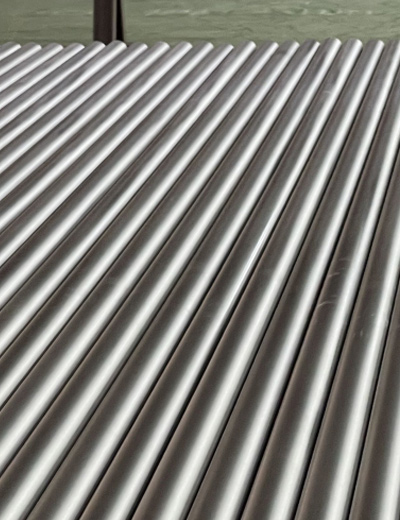
ASTM B163 Nickel Alloy Condenser & Heat Exchanger Tube Standard
A single tube leak in a shell-and-tube heat exchanger can bring an entire process unit to a halt. In high-pressure condensers and critical thermal recovery systems, tube integrity is not optional; it is operational insurance. That is why condenser and heat-exchanger tubes are manufactured to stricter dimensional, metallurgical, and mechanical controls than general-service tubing. Outside diameter tolerances are tighter, bend radii are defined by the specification, and expansion capability is verified through mandatory flare testing to ensure the tube can be rolled into a tubesheet without cracking.
ASTM B163 is the specification written specifically for this duty. It covers seamless nickel and nickel alloy condenser and heat exchanger tubes across a wide compositional range, from commercially pure Nickel 200 and 201 to Monel 400, the Inconel 600/601 family, and the Incoloy 800/800H/800HT/825 grades.
This page explains the full scope of B163: covered alloys, chemical differences, mechanical property options including higher-yield variants, dimensional tolerances unique to condenser service, minimum bend radii for U-tube fabrication, heat-treatment requirements, inspection protocols, and the practical specification decisions that arise during procurement.
ASTM B163 PDF Free Download ASTM B163 PDF Free Download
What is ASTM B163?
ASTM B163 is the Standard Specification for Seamless Nickel and Nickel Alloy Condenser and Heat-Exchanger Tubes. The specification is published by ASTM International, a globally recognised organisation that develops technical standards for materials, products, systems, and services. It falls under ASTM Committee B02 on Nonferrous Metals and Alloys and is maintained by Subcommittee B02.07 on Refined Nickel and Cobalt and Their Alloys. The specification also references ASTM B829, which outlines general requirements for nickel and nickel alloy seamless pipe and tube, including testing, inspection, certification, marking, and packaging requirements.
What makes B163 different from other nickel alloy tube specs like B161, B167, or B444? B163 is application-specific. It is written for tubes that will be rolled, expanded, or bent into tubesheets and U-bends inside heat exchangers and condensers. That application focus drives 3 requirements you will not find in general-service tube specifications:
- 1. Minimum bend radius tables that vary by alloy, tube OD, wall thickness, and temper condition.
- 2. Expansion and flare testing to verify that every tube end can be rolled into a tubesheet without splitting.
- 3. Higher yield strength tubes (for Inconel 600 and Incoloy 800 families) with controlled yield ranges for specific high-pressure condenser designs.
B163 tubes are dimensioned by OD and wall thickness (average or minimum). We supply these tubes in sizes from OD 6–457 mm, wall 1–65 mm, and lengths up to 22 metres.
Chemical Composition of ASTM B163 Alloys
The chemical composition of ASTM B163 alloys defines the balance of nickel and other alloying elements used in seamless tubes for condensers and heat exchangers. These controlled compositions ensure good corrosion resistance, thermal stability, and reliable mechanical performance in demanding industrial environments. The table below consolidates the key elements across the most specified B163 alloys.
| GRADE | UNS Designation |
Standard (Tube) |
Chemical Requirement (Max) | ||||||||||||
| C | Mn | P | S | Si | Ni | Cr | Mo | Cu | Fe | Ti | Al | Co | |||
| Nickel 200 | N02200 | B163 | 0.15 | 0.35 | 0.010 | 0.35 | min 99.0 | 0.25 | 0.4 | - | |||||
| Nickel 201 | N02201 | B163 | 0.02 | 0.35 | 0.010 | 0.35 | min 99.0 | 0.25 | 0.4 | ||||||
| Monel 400 | N04400 | B163 | 0.30 | 2.00 | 0.024 | 0.50 | min 63.0 | 28.0-34.0 | 2.5 | ||||||
| Inconel 600 | N06600 | B163 | 0.15 | 1.00 | 0.015 | 0.50 | min 72 | 14.0-17.0 | 0.50 | 6.0-10.0 | |||||
| Inconel 601 | N06601 | B163 | 0.10 | 1.50 | 0.015 | 0.50 | 58.0-63.0 | 21.0-25.0 | 1.00 | BAL | 1.0-1.7 | ||||
| Incoloy 800 | N08800 | B163 | 0.10 | 1.50 | 0.045 | 0.015 | 1.00 | 30.0-35.0 | 19.0-23.0 | 0.75 | min 39.5 | 0.15-0.6 | 0.15-0.6 | ||
| Incoloy 825 | N08825 | B163 | 0.05 | 1.00 | 0.030 | 0.50 | 38.0-46.0 | 19.5-23.5 | 2.5-3.5 | 1.5-3.0 | min 22.0 | 0.6-1.2 | 0.2 | ||
The chemistry split between these alloys reveals a clear design logic. Pure nickel (200/201) handles alkalis. Monel 400 adds copper for seawater. Inconel 600 adds chromium for high-temperature oxidation. Incoloy 800 adds iron and chromium for cost-effective high-temperature resistance. Incoloy 825 adds molybdenum and copper for acid environments.
Mechanical Properties of ASTM B163 Tubes
Mechanical requirements under B163 depend on alloy, temper, and tube size. B163 allows both annealed and stress-relieved conditions for most alloys. For Inconel 600 and Incoloy 800 family alloys, a “higher yield strength” option exists per Table 6 of the specification—useful for high-pressure condenser designs where wall thickness savings matter.
| Grade | Condition & Size | Standard | Tensile Strength Min, MPa |
Yield Strength Min, MPa |
Elongation Min, % |
| N02200 | Annealed: OD≤127mm | B163 | 380 | 105 | 35 |
| N02200 | Annealed: OD>127 | B163 | 380 | 80 | 40 |
| N02200 | Stress-Relieved: All size | B163 | 450 | 275 | 15 |
| N02201 | Annealed: OD≤127mm | B163 | 345 | 80 | 35 |
| N02201 | Annealed: OD>127mm | B163 | 345 | 70 | 40 |
| N02201 | Stress-Relieved: All size | B163 | 415 | 205 | 15 |
| N04400 | Annealed: OD≤127mm | B163 | 480 | 195 | 35 |
| N04400 | Annealed: OD>127mm | B163 | 480 | 170 | 35 |
| N04400 | Stress-Relieved: All size | B163 | 585 | 380 | 15 |
| N06600 | Hot-worked or hot-worked annealed; OD≤127mm | B163 | 550 | 205 | 35 |
| N06600 | Hot-worked or hot-worked annealed; OD>127mm | B163 | 515 | 170 | 35 |
| N06600 | Cold-worked annealed; OD≤127mm | B163 | 550 | 240 | 30 |
| N06600 | Cold-worked annealed; OD>127mm | B163 | 550 | 205 | 35 |
| N06601 | Cold-worked annealed or hot-worked annealed | B163 | 550 | 205 | 30 |
| N08800 | Cold-worked annealed | B163 | 520 | 205 | 30 |
| N08800 | Hot-finished annealed or hot-finished | B163 | 450 | 170 | 30 |
| N08810 | Hot-finished annealed or cold-worked annealed | B163 | 450 | 170 | 30 |
| N08811 | Hot-finished annealed or cold-worked annealed | B163 | 450 | 170 | 30 |
| N08825 | Hot-finished annealed | B163 | 517 | 172 | 30 |
| N08825 | Cold-worked annealed | B163 | 586 | 241 | 30 |
The “Higher Yield Strength” option for N06600 and N08800 deserves attention. These tubes are cold-worked to a controlled yield range of 276–448 MPa (40–65 ksi) with a defined OD range of 1/4 to 7/8 in. (6.35–22.23 mm) and a wall up to 0.100 in. (2.54 mm). They are specified for high-pressure feedwater heaters and nuclear steam generators, where reducing wall thickness by even 0.5 mm saves significant weight and improves heat transfer.
ASTM B163 Tolerances
B163 condenser tube tolerances are tighter than most general-service tube specs. The specification splits tolerance requirements by alloy group—Nickel/Monel tubes in one category, Inconel/Incoloy in another—because the higher-alloy grades are harder to cold-draw to the same precision as softer pure-nickel or Monel tubes.
| STANDARD | OD(D) | TOLERANCE(MM) | THICKNESS(S) | TOLERANCE | LENGTH | TOLERANCE |
| MM | COMMON HIGH | MM | MM | MM | ||
| B163 (N02200,N02201, N04400) |
12.7<D≤15.9 | +0.13/0 | ave. ±12.5% | min:+25.0%/0 | Cut-to-length | +3.2/0 |
| 15.9≤D≤38.1 | ±0.13 | ave. ±10.0% | min:+20.0%/0 | |||
| 38.1<D≤76.2 | ±0.25 | ave. ±12.5% | min:+22.0%/0 | |||
| 12.7≤D≤15.9 | ±0.13 | ave. ±12.5% | min:+25.0%/0 | Cut-to-length>9.1m | +6.4/0 | |
| 15.9≤D≤38.1 | ±0.19 | ave. ±10.0% | min:+20.0%/0 | |||
| B163(for rest) | 15.9≤D≤38.1 | ±0.13 | ave. ±10.0% | min:+22.0%/0 | ||
| 38.1<D≤76.2 | ±0.25 | |||||
| 10≤D≤16 | ±0.13 | |||||
| 16<D≤38 | ±0.19 |
If you want to know more product details, please contact us!
ASTM B163 Alloy Families and Grades
B163 has 4 distinct alloy families, each suited for a different corrosion environment and temperature range. The table below covers every major alloy, its UNS number, primary alloy system, and the heat exchanger service it handles best.
| Alloy | UNS | Alloy System | Ni Content | Primary Heat-Exchanger Service |
| Nickel 200 | N02200 | Pure Nickel | 99% min | Caustic evaporators, dry halogen coolers |
| Nickel 201 | N02201 | Low-C Nickel | 99% min | Hot caustic service above 600°F (315°C) |
| Monel 400 | N04400 | Ni-Cu | 63% min | Seawater condensers, brackish water, HF acid |
| Inconel 600 | N06600 | Ni-Cr-Fe | 72% min | Nuclear steam generators, high-temp oxidation |
| Inconel 601 | N06601 | Ni-Cr-Fe-Al | 58–63% | High-temp oxidising environments, nitric acid |
| Incoloy 800 | N08800 | Ni-Fe-Cr | 30–35% | Process heaters, steam generators up to 1100°F |
| Incoloy 800H | N08810 | Ni-Fe-Cr | 30–35% | Creep service above 1100°F (593°C) |
| Incoloy 800HT | N08811 | Ni-Fe-Cr | 30–35% | Controlled grain—creep/rupture above 1100°F |
| Incoloy 825 | N08825 | Ni-Fe-Cr-Mo-Cu | 38–46% | Sulfuric acid, phosphoric acid, sour gas coolers |
Nickel 200 (UNS N02200)
Alloy 200 is a commercially pure nickel (99% minimum Ni) with moderate carbon content (up to 0.15%). It offers excellent resistance to caustic alkalis across a wide range of concentrations. Its thermal conductivity and ductility make it particularly suitable for tube rolling operations.
More About Nickel 200Nickel 201 (UNS N02201)
Alloy 201 is the low-carbon version of Nickel 200 (0.02% max C). The reduced carbon content prevents graphitisation at temperatures above 600°F (315°C), making it the required grade for hot caustic service. In high-temperature alkali evaporators and process heaters, Alloy 201 provides improved long-term structural stability compared to Alloy 200.
More About Nickel 201Monel 400 (UNS N04400)
Alloy 400 is a nickel-copper alloy containing approximately 63-67% nickel and 28–34% copper. This composition provides excellent resistance to seawater, brackish water, and hydrofluoric acid across all concentrations. Seawater-cooled power plant condensers use this grade where titanium is not economically justified.
More About Monel 400Inconel 600 (UNS N06600)
UNS N06600 is a nickel-chromium-iron alloy (approximately 72% Ni, 14–17% Cr) designed for high-temperature oxidation resistance. Its strength and corrosion resistance remain stable at elevated temperatures where pure nickel or Monel would not perform adequately.
More About Inconel 600Inconel 601 (UNS N06601)
Nickel Alloy 601 consists of aluminium (1.0–1.7%), which enhances oxide-scale stability at temperatures up to 2200°F (1200°C). This makes it suitable for high-temperature oxidising environments and high-temperature oxidising and carburising environments. In radiant heat exchangers and thermal oxidiser components, Alloy 601 offers superior resistance to scaling compared to Alloy 600.
More About Inconel 601Incoloy 800 (UNS N08800)
UNS N08800 is a nickel-iron-chromium alloy (30–35% Ni, 19–23% Cr) designed for strength and oxidation resistance up to 1100°F (593°C). It is widely used in steam generators, process heaters, and petrochemical heat-exchange systems where cost efficiency relative to high-nickel alloys is important.
More About Incoloy 800Incoloy 800H (UNS N08810)
UNS N08810 is a controlled-carbon (0.05–0.10%) version of 800 with a specified coarse grain size (ASTM No. 5 or coarser). The controlled chemical composition and grain structure improve creep-rupture strength above 1100°F (593°C). It is specified for ethylene cracker tubes, reformer pigtails, and high-temperature process gas coolers where long-term stability under stress is critical.
More About Incoloy 800HIncoloy 800HT (UNS N08811)
UNS N08811 further optimises high-temperature performance through tighter control of titanium and aluminium content (combined 0.85–1.20%). This precipitation strengthening enhances creep rupture resistance above 1200°F (650°C). For extended elevated-temperature service in petrochemical furnaces, 800HT is generally preferred over 800H.
More About Incoloy 800HTIncoloy 825 (UNS N08825)
UNS N08825 consists of molybdenum (2.5–3.5%), copper (1.5–3.0%), and titanium in the Ni-Fe-Cr alloy. This chemical composition provides resistance to sulfuric acid, phosphoric acid, and sour gas (H₂S) environments where both pure nickel and Inconel 600 are insufficient.
More About Incoloy 825Minimum Bend Radius for U-Tube Fabrication
This is the section that sets B163 apart. Table 5 of the specification defines the tightest bend radius permitted for U-tube fabrication, based on tube OD, average wall, alloy family, and temper condition. Going below these limits risks cracking on the extrados (outer bend) or buckling on the intrados (inner bend).
Annealed tubes allow tighter bends than stress-relieved tubes. For example, an annealed tube up to 1/2 in. (12.7 mm) OD with a wall of 0.046–0.057 in. (1.17–1.45 mm) has a minimum bend radius of 1-3/16 in. (30.2 mm) in the annealed condition, versus 1-1/4 in. (31.8 mm) in the stress-relieved condition.
| Tube OD, in. (mm) | Avg. Wall Range, in. (mm) | Min Bend Radius – Annealed, in. (mm) | Min Bend Radius – Stress-Relieved, in. (mm) |
| Up to 1/2 (12.7) | 0.046–0.057 (1.17–1.45) | 1-3/16 (30.2) | 1-1/4 (31.8) |
| Up to 1/2 (12.7) | Over 0.057–0.120 (1.45–3.05) | 1 (25.4) | 1-1/8 (28.6) |
| Over 1/2 to 5/8 (12.7–15.9) | 0.037–0.057 (0.94–1.45) | 1-3/16 (30.2) | 1-1/4 (31.8) |
| Over 1/2 to 5/8 (12.7–15.9) | Over 0.057–0.120 (1.45–3.05) | 1 (25.4) | 1-3/16 (30.2) |
| Over 5/8 to 3/4 (15.9–19.0) | 0.049–0.057 (1.24–1.45) | 1-1/4 (31.8) | 1-1/2 (38.1) |
| Over 5/8 to 3/4 (15.9–19.0) | Over 0.057–0.109 (1.45–2.77) | 1-3/16 (30.2) | 1-1/4 (31.8) |
| Over 3/4 to 1 (19.0–25.4) | 0.049–0.058 (1.24–1.47) | 2 (50.8) | 4 (101.6) |
| Over 3/4 to 1 (19.0–25.4) | 0.058–0.109 (1.47–2.77) | 1-3/4 (44.5) | 2-1/4 (57.2) |
Note: These radii apply to all alloys except N08810, N08801, and N08811. For minimum-wall tubes, calculate the corresponding average wall from the tolerance table, then use Table 5. The bend radius is measured to the tube centreline.
Heat Treatment for ASTM B163 Tubes
Heat treatment requirements vary by alloy. Pure nickel and Monel 400 tubes are annealed at lower temperatures (1300–1600°F / 700–870°C for nickel, 1300–1700°F / 700–925°C for Monel) in protective atmospheres. Inconel 600 and the Incoloy 800 family require higher anneal temperatures.
For Incoloy 800H (N08810) and 800HT (N08811), the anneal must produce an ASTM grain size of No. 5 or coarser. This controlled grain growth is not a defect—it is the mechanism that gives these tubes their creep-rupture strength above 1100°F (593°C). Finer grains would sacrifice long-term strength at elevated temperatures.
Stress-relieved tubes retain residual cold-work strength. The stress-relief temperature (typically 525–900°F / 275–480°C for nickel) removes residual stresses without fully recrystallising the grain structure. B163 requires that for stress-relieved tubes with annealed ends, the tension test specimen be taken from the stress-relieved portion—not the annealed end.
Testing and Inspection Requirements
B163 testing goes beyond what general-service tube specs demand. In addition to the standard tension and hydrostatic tests, B163 adds flare testing on every random length—a requirement that directly validates whether the tube can survive being rolled into a tubesheet.
Tension Test
One specimen per lot, tested in the longitudinal direction. Full-section tubular specimens are preferred. When the tube is too large for the testing machine, longitudinal strip specimens are used. Yield strength is measured at 0.2% offset.
Flare Test
One end of each random-length tube is flared over a tapered mandrel. The expanded end must increase in OD without showing cracks, splits, or other visible defects. This test simulates the stress that occurs when tube ends are rolled into tubesheet holes. No other nickel alloy pipe or tube specification (B161, B165, B167, B444) requires this test as a standard—it is unique to B163.
Hydrostatic or NDE Test
Every tube must pass either a hydrostatic test or eddy-current testing per ASTM E571. For hydrostatic testing, the test pressure follows P = 2St/D (where S is the allowable fibre stress per B829). Tubes showing leaks are rejected. When NDE is used, the calibration reference uses a drilled hole no larger than 0.031 in. (0.79 mm).
Hardness Test (Stress-Relieved Tubes with Annealed Ends)
For stress-relieved tubes furnished with annealed ends, a Rockwell hardness test is performed on the inside surface of the tube near one end. This checks that the stress-relieved zone has maintained its target hardness and that the annealing of the ends did not extend into the body of the tube.
Frequently Asked Questions
-
Which Alloy Should I Pick for a Seawater Condenser?
-
My Project Requires U-Tubes. How Do I Specify Them Under B163?Specify the alloy, temper (annealed for the tightest bends), nominal OD and wall, leg length, and the required bend radius. Confirm the bend radius meets or exceeds the minimum in Table 5 of B163. For very tight bends, an annealed condition is mandatory; stress-relieved tubes crack at small radii. Also specify whether you need the legs cut to equal or unequal lengths.
-
What Is the Difference Between B163 and B161?B161 covers nickel pipe and tube for general service; B163 covers nickel and nickel alloy tubes specifically for condensers and heat exchangers. B163 includes more alloy families (Monel, Inconel, and Incoloy), adds bend radius requirements, and mandates flare testing. If the tube goes into a heat exchanger or condenser, B163 is the correct specification.
-
Can B163 Tubes Be Used in ASME Code Vessels?Yes, the ASME equivalent is SB-163. It appears in ASME BPVC Section II, Part B. The code listing includes all alloy families covered by B163. For code-stamped heat exchangers, the material test report must confirm compliance with both ASTM B163 and ASME supplementary requirements.
-
Why Does B163 Have Two Tolerance Groups for Different Alloys?Cold-drawing pure nickel and Monel 400 is easier than cold-drawing Inconel 600 or Incoloy 800; these higher-alloy grades work-harden faster and resist deformation more aggressively. The tighter OD tolerance for Nickel/Monel (±0.005 in. at 5/8–1-1/2 in. OD) versus Inconel/Incoloy (±0.0075 in. at the same OD range) reflects this manufacturing reality.
-
What Does “Higher Yield Strength” Mean in B163 Table 6?Table 6 applies to Inconel 600 (N06600) and Incoloy 800 (N08800) only. These tubes are cold-worked to a yield range of 276–448 MPa (40–65 ksi) instead of the standard annealed minimum of 205 MPa (30 ksi). The controlled upper limit prevents excessive hardness that would make tube-to-tubesheet rolling difficult. These tubes are used in high-pressure feedwater heaters and nuclear steam generators.
-
How Does Incoloy 800H Differ from 800HT in Heat-Exchanger Service?Both are creep-optimised variants of Incoloy 800, but 800HT (N08811) requires higher combined Al+Ti content (0.85–1.20%) than 800H. This extra Al+Ti precipitation strengthening gives 800HT better long-term creep rupture strength above 1200°F (650°C). For ethylene cracker radiant tubes and reformer pigtails, 800HT is the preferred grade. Below 1200°F, 800H is sufficient and less expensive.