
Seamless pipe has no weld seam and provides uniform strength in all directions. It is preferred for high-pressure, high-temperature, and sour service. Welded pipe is 15–30% less expensive and available in larger diameters. ASME B31.3 assigns equal design stress to seamless and welded A312 pipe (weld joint efficiency = 1.0 for full-radiographed welds), so the choice often comes down to cost vs. perceived reliability.

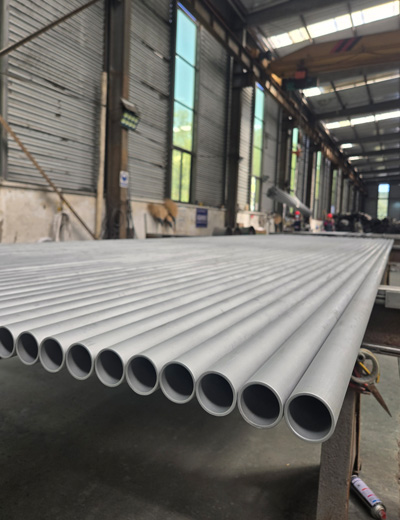
ASTM A312 Seamless & Welded Stainless Steel Pipe Standard
ASTM A312 is the standard specification for seamless, welded, and heavily cold-worked austenitic stainless steel pipes used in high-temperature and general corrosive service. It is the most widely used pipe specification in the stainless steel industry, covering everything from 1/8 in. NPS instrument lines to 30 in. NPS processes headers in refineries, chemical plants, power stations, and pharmaceutical facilities.
The specification covers standard 300-series grades (TP304, TP304L, TP316, TP316L, TP321, TP347), their high-carbon H-grade variants for elevated-temperature creep service, nitrogen-strengthened LN grades, and super-austenitic alloys with up to 6% molybdenum. Manufacturing is permitted by seamless extrusion, automatic welding without filler metal addition, or heavy cold working.
ASTM A312 seamless pipe is specified in petrochemical processing, oil and gas pipelines, power generation, food and pharmaceutical manufacturing, fertiliser plants, pulp and paper mills, and desalination systems. This page covers grades, chemical composition, mechanical properties, dimensional tolerances, heat treatment, testing protocols, and pipe dimensions, providing engineers and procurement teams with the data to specify the right austenitic stainless steel pipe.
ASTM A312 PDF Free Download ASTM A312 PDF Free Download
What is ASTM A312?
ASTM A312 is the standard specification for seamless, welded, and heavily cold-worked austenitic stainless steel pipes. It falls under ASTM Committee A-1 on Steel, Stainless Steel, and Related Alloys, Subcommittee A01.10 on Stainless and Alloy Steel Tubular Products. This ASTM standard has been approved for multiple applications by agencies of the U.S. Department of Defence.
The specification covers stainless steel seamless pipe and welded pipe intended for high-temperature and general corrosive service. Pipe dimensions follow NPS designations per ANSI B36.19. Welded pipe NPS 14 and smaller has a single longitudinal weld seam; sizes larger than NPS 14 may have two longitudinal seams when approved by the purchaser.
General requirements conform to ASTM A450/A450M for steel tubes and A530/A530M for specialized carbon and alloy steel pipes. The ASME equivalent is SA-312, listed in the ASME Boiler and Pressure Vessel Code, Section II. Grades TP304, TP304L, and TP347 are accepted by ASME Section VIII Division 1 for service temperatures as low as -425°F (-254°C) without impact testing.
ASTM A312 Stainless Steel Pipe Chemical Composition
The chemical composition of ASTM A312 stainless steel pipes defines the percentage of alloying elements. Elements such as chromium, nickel, molybdenum, and carbon vary across grades like TP304, TP304L, TP316, TP316L, TP321, and TP347, which helps each grade perform in specific industrial environments. The table below shows the chemical composition limits for these ASTM A312 stainless steel pipe grades.
| GRADE | UNS Designation |
C | Mn | P | S | Si | Cr | Ni | Mo | Ti | Cu | Al | Other |
| 304 | S30400 | 0.080 | 2.00 | 0.045 | 0.030 | 1.00 | 18.0-20.0 | 8.0-11.0 | - | - | - | - | - |
| 304L | S30403 | 0.035 | 2.00 | 0.045 | 0.030 | 1.00 | 18.0-20.0 | 8.0-13.0 | - | - | - | - | - |
| 304H | S30409 | 0.04-0.1 | 2.00 | 0.045 | 0.030 | 1.00 | 18.0-20.0 | 8.0-11.0 | - | - | - | - | - |
| 253MA | S30815 | 0.05-0.1 | 0.80 | 0.040 | 0.030 | 1.4-2.0 | 20.0-22.0 | 10.0-12.0 | N:0.14-0.20 Ce:0.03-0.08 |
||||
| 309S | S30908 | 0.080 | 2.00 | 0.045 | 0.030 | 1.00 | 22.0-24.0 | 12.0-15.0 | 0.75 | - | - | - | - |
| 310S | S31008 | 0.080 | 2.00 | 0.045 | 0.030 | 1.00 | 24.0-26.0 | 19.0-22.0 | 0.75 | - | - | - | - |
| 310H | S31009 | 0.04-0.1 | 2.00 | 0.045 | 0.030 | 1.00 | 24.0-26.0 | 19.0-22.0 | - | - | - | - | - |
| 254SMO | S31254 | 0.020 | 1.00 | 0.030 | 0.010 | 0.80 | 19.5-20.5 | 17.5-18.5 | 6.0-6.5 | 0.5-1.0 | N:0.18-0.25 | ||
| 316 | S31600 | 0.080 | 2.00 | 0.045 | 0.030 | 1.00 | 16.0-18.0 | 10.0-14.0 | 2.0-3.0 | - | - | - | - |
| 316L | S31603 | 0.035 | 2.00 | 0.045 | 0.030 | 1.00 | 16.0-18.0 | 10.0-14.0 | 2.0-3.0 | - | - | - | - |
| 316Ti | S31635 | 0.080 | 2.00 | 0.045 | 0.030 | 0.75 | 16.0-18.0 | 10.0-14.0 | 2.0-3.0 | 5(C+N)-0.7 | - | - | N:≤0.1 |
| 317 | S31700 | 0.080 | 2.00 | 0.045 | 0.030 | 1.00 | 18.0-20.0 | 11.0-15.0 | 3.0-4.0 | - | - | - | - |
| 317L | S31703 | 0.035 | 2.00 | 0.045 | 0.030 | 1.00 | 18.0-20.0 | 11.0-15.0 | 3.0-4.0 | - | - | - | - |
| 321 | S32100 | 0.080 | 2.00 | 0.045 | 0.030 | 1.00 | 17.0-19.0 | 9.0-12.0 | - | 5(C+N)-0.7 | - | - | N:≤0.1 |
| 321H | S32109 | 0.04-0.1 | 2.00 | 0.045 | 0.030 | 1.00 | 17.0-19.0 | 9.0-12.0 | - | 4(C+N)-0.7 | - | - | N:≤0.1 |
| 654SMO | S32654 | 0.020 | 2.0-4.0 | 0.030 | 0.005 | 0.50 | 24.0-25.0 | 21.0-23.0 | 7.0-8.0 | 0.3-0.6 | N:0.45-0.55 | ||
| 347 | S34700 | 0.080 | 2.00 | 0.045 | 0.030 | 1.00 | 17.0-19.0 | 9.0-13.0 | - | - | - | - | Nb:10C-1.0 |
| 347H | S34709 | 0.04-0.1 | 2.00 | 0.045 | 0.030 | 1.00 | 17.0-19.0 | 9.0-13.0 | - | - | - | - | Nb:8C-1.0 |
| 904L | N08904 | 0.020 | 2.00 | 0.040 | 0.030 | 1.00 | 19.0-23.0 | 23.0-28.0 | 4.0-5.0 | - | 1.0-2.0 | - | N:≤0.1 |
| 926 | N08926 | 0.020 | 2.00 | 0.030 | 0.010 | 0.50 | 19.0-21.0 | 24.0-26.0 | 6.0-7.0 | - | 0.5-1.5 | - | N:0.15-0.25 |
Mechanical Properties of ASTM A312 Seamless Stainless Steel Pipe
ASTM A312 covers seamless, straight-seam welded, and heavily cold-worked welded austenitic stainless steel pipe intended for high-temperature and general corrosive service. The specification defines minimum mechanical property requirements, including tensile strength, yield strength, and elongation across a wide range of UNS-designated grades to ensure structural integrity under demanding operating conditions. The following table summarises the minimum mechanical properties for each grade covered under ASTM A312.
| Grade | Condition & Size | Standard | Heat Treating Temp. : min | Tensile Strength Min. MPa |
Yield Strength Min. MPa |
Elongation min. % |
| 304 | A312 | 1040°C | 515 | 205 | 35 | |
| 304L | A312 | 1040°C | 485 | 170 | 35 | |
| 304H | Cold Finished | A312 | 1040°C | 515 | 205 | 35 |
| 304H | Hot Finished | A312 | 1040°C | 515 | 205 | 35 |
| 253MA | A312 | 1040°C | 600 | 310 | 35 | |
| 309S | A312 | 1040°C | 515 | 205 | 35 | |
| 310S | A312 | 1040°C | 515 | 205 | 35 | |
| 310H | A312 | 1040°C | 515 | 205 | 35 | |
| 254SMO | t≤5mm | A312 | 1150°C | 675 | 310 | 35 |
| 254SMO | t>5mm | A312 | 1150°C | 655 | 310 | 35 |
| 316 | A312 | 1040°C | 515 | 205 | 35 | |
| 316L | A312 | 1040°C | 485 | 170 | 35 | |
| 316Ti | A312 | 1040°C | 515 | 205 | 35 | |
| 317 | A312 | 1040°C | 515 | 205 | 35 | |
| 317L | A312 | 1040°C | 515 | 205 | 35 | |
| 321 | t≤9.5mm | A312 | 1040°C | 515 | 205 | 35 |
| 321 | t>9.5mm | A312 | 1040°C | 485 | 170 | 35 |
| 321H | Cold Finished; t≤9.5mm | A312 | 1100°C | 515 | 205 | 35 |
| 321H | Cold Finished; t>9.5mm | A312 | 1100°C | 480 | 170 | 35 |
| 321H | Hot Finished; t≤9.5mm | A312 | 1050°C | 515 | 205 | 35 |
| 321H | Hot Finished; t>9.5mm | A312 | 1050°C | 480 | 170 | 35 |
| 654SMO | A312 | 1150°C | 750 | 430 | 35 | |
| 347 | A312 | 1040°C | 515 | 205 | 35 | |
| 347H | Cold Finished | A312 | 1100°C | 515 | 205 | 35 |
| 347H | Hot Finished | A312 | 1050°C | 515 | 205 | 35 |
| N08904 | A312 | 1100°C | 490 | 215 | 35 |
Note: Elongation is measured in 2 in. (50 mm) or 4D gauge length. Longitudinal elongation of 35% applies to all standard grades except S31050, S32615, and N08367, which require 25–30%. TP321 and TP321H have reduced requirements when manufactured by the seamless process with a nominal wall thickness greater than 3/8 in. (9.5 mm): tensile drops to 70 ksi (485 MPa) and yield to 25 ksi (170 MPa).
ASTM A312 Tolerances
ASTM A312 tolerances specify the permissible variations in outside diameter, wall thickness, and length for seamless and welded stainless steel pipe, as outlined in the table below:
| STANDARD | OD(D) | TOLERANCE(MM) | THICKNESS(S) | TOLERANCE | LENGTH | TOLERANCE |
| MM | COMMON HIGH | MM | MM | MM | ||
| A312 | 10.3≤D≤48.3 | +0.4/-0.8 | 10.3≤D≤73.0 | +20%/-12.5% | For all sizes | +6.0/0 |
| 48.3<D≤114.3 | +0.8/-0.8 | 88.9≤D≤457.2,ID<5% | +22.5%/-12.5% | |||
| 114.3<D≤219.1 | +1.6/-0.8 | 88.9≤D≤457.2,ID>5% | +15%/-12.5% | |||
| 219.1<D≤457.2 | +2.4/-0.8 | D≥508.0,tD≤5%,SMLS | +22.5%/-12.5% | |||
| 457.2<D≤660.4 | +3.2/-0.8 | D≥508.0,tD>5%,SMLS | +15%/-12.5% | |||
| 660.4<D≤863.6 | +4.8/-0.8 | D≥508.0, WLD | +17.5%/-12.5% | |||
| 863.6<D≤1219.2 | +4.8/-0.8 |
If you want to know more product details, please contact us!
ASTM A312 Seamless Stainless Steel Pipe Grades
ASTM A312 covers seamless, welded, and heavily cold-worked austenitic stainless steel pipes intended for high-temperature and corrosive service. The specification includes common grades such as 304, 304L, 316, 316L, and 321, each with defined chemical composition limits for elements like chromium, nickel, carbon, and molybdenum. These grades are widely used where strength, corrosion resistance, and reliability are essential. The table below summarises the major grades.
| Grade | Key Alloying Element | Main Performance Feature |
| 304 | 18Cr–10Ni | General corrosion resistance |
| 304L | Low carbon (0.035% max) | Weldability, no sensitisation |
| 304H | Higher carbon (0.04–0.10%) | High-temperature creep strength |
| 309S | 23Cr–13Ni | Oxidation resistance to 2000°F |
| 310S | 25Cr–20Ni | Highest oxidation resistance |
| 316 | 2–3% Molybdenum | Chloride and pitting resistance |
| 316L | Low C + Molybdenum | Welded corrosive service |
| 316H | Higher C + Molybdenum | High-temp creep with Mo |
| 316LN | Low C + Mo + Nitrogen | Strength + corrosion resistance |
| 317 | 3–4% Molybdenum | Severe pitting environments |
| 317L | Low C + higher Mo | Welded chemical service |
| 321 | Titanium stabilised | Intergranular corrosion resistance |
| 321H | Ti + higher carbon | High-temp stability |
| 347 | Niobium stabilised | Creep + intergranular resistance |
| 347H | Nb + higher carbon | Stress rupture at high temp |
Grade 304
Stainless steel 304 pipe is the most widely specified grade in the A312 family. With 18–20% chromium and 8–11% nickel, it provides reliable corrosion resistance in atmospheric, freshwater, and mild chemical environments. SS 304 is the default choice for applications where cost and general performance are the primary drivers.
More About 304 MaterialGrade 304L
SS 304L limits carbon to 0.035% maximum (vs. 0.08% for SS 304), which prevents chromium carbide precipitation (sensitisation) during welding. This makes SS 304L seamless pipe the standard choice for welded piping systems in chemical processing, dairy, and pharmaceutical plants where post-weld solution annealing is impractical.
More About 304L MaterialGrade 304H
ASTM 321 SS 304H raises carbon to 0.04–0.10% for improved creep and stress-rupture strength above 1000°F (538°C). The higher carbon content forms Cr₂₃C₆ carbides that pin grain boundaries and resist grain-boundary sliding under sustained load at elevated temperatures. SS 304H is specified for applications where long-term high-temperature strength is the design driver.
Grade 309S
Grade 309S stainless steel pipe is the low-carbon version of the 309 alloy. It typically contains 22–24% chromium and 12–15% nickel, which gives it strong resistance to oxidation and scaling at temperatures up to about 2000°F (1093°C). The lower carbon content (0.08% max) helps reduce carbide precipitation during welding, making 309S suitable for welded furnace parts, flue gas ducting, and high-temperature structural components.
Grade 309H
Grade 309H stainless steel pipe is the high-carbon variant of the 309 series, with a carbon range of about 0.04–0.10%. The higher carbon level improves creep strength and high-temperature mechanical performance, making it suitable for prolonged service in elevated temperature environments. Because of this, 309H pipes are commonly used in furnace components, fire-box parts, heat treatment equipment, and other high-temperature industrial applications.
Grade 316
SS 316 pipe adds 2.0–3.0% molybdenum to the 18Cr-12Ni base, providing significantly better pitting and crevice corrosion resistance in chloride-bearing environments. Stainless steel 316 pipe is the standard material for chemical processing, marine hardware, coastal industrial piping, and any application where brackish water, seawater exposure, or chlorinated chemicals are present.
More About 316 MaterialGrade 316L
SS 316L seamless pipe combines the pitting resistance of molybdenum with the weldability of low carbon (0.035% max C). It is the most specified grade in pharmaceutical, food, semiconductor, and chemical process piping worldwide. The dual benefit of molybdenum for chloride resistance and low carbon for sensitisation prevention makes SS 316L the preferred material for welded process pipe in corrosive service.
More About 316L MaterialGrade 316LN
ASTM A312 316LN stainless steel pipe adds 0.10–0.16% nitrogen to the SS 316L composition. Nitrogen increases yield strength from 25 ksi (170 MPa) to 30 ksi (205 MPa) without affecting corrosion resistance. This makes SS 316LN suitable for pressure piping systems and cryogenic applications where higher design stress is needed without sacrificing weldability.
Grade 316H
SS 316H raises carbon to 0.04–0.10% for elevated-temperature creep strength while retaining 2–3% molybdenum. It provides reliable performance where both high-temperature creep resistance and moderate chloride/pitting resistance are required, like refinery service above 1000°F (538°C) in mildly corrosive process streams.
Grade 317
317 stainless steel pipe raises molybdenum to 3.0–4.0% (vs 2–3% in SS 316), with higher chromium (18–20%) and nickel (11–14%). The additional Mo significantly improves the pitting resistance number (PREN = Cr + 3.3Mo + 16N), making SS 317 suitable for FGD scrubber environments, pulp and paper bleach plants, and other severely corrosive chemical services.
More About 317 MaterialGrade 317L
SS 317L seamless pipe is the low-carbon version (0.035% max C) of SS 317, designed for welded applications in severely corrosive environments. It combines the high-Mo pitting resistance of SS 317 with sensitisation prevention for as-welded service in chemical and petrochemical process piping.
More About 317L MaterialGrade 321
321 seamless pipe is stabilised with titanium (Ti ≥ 5× carbon content) to prevent intergranular corrosion in the 800–1500°F (427–816°C) range. Titanium preferentially forms TiC instead of Cr23C6, keeping chromium in solid solution and preserving corrosion resistance after high-temperature exposure. SS 321 is the standard refinery and petrochemical grade for piping that operates above 800°F.
More About 321 MaterialGrade 321H
SS 321H seamless pipe raises carbon to 0.04–0.10% for improved creep strength at elevated temperatures. It maintains titanium stabilisation while adding the grain-boundary strengthening of higher carbon. SS 321H is specified for applications where both sensitisation resistance and creep life are required.
More About 321H MaterialGrade 347
347 stainless steel pipe uses niobium (Nb ≥ 10× carbon content) instead of titanium for stabilisation. Niobium carbides (NbC) are more thermally stable than titanium carbides (TiC), giving stainless steel 347 better weldability and higher creep strength than SS 321 above 1000°F (538°C). SS 347 is preferred for refinery piping, power plant superheaters, and nuclear service.
More About 347 MaterialGrade 347H
SS 347H pipe combines niobium stabilisation with higher carbon (0.04–0.10%) for maximum creep and stress-rupture strength. It is the primary grade for refinery heater tubes, FCCU catalyst standpipes, and power generation superheater headers where long-term service above 1100°F (593°C) with high internal pressure is the design condition.
More About 347H MaterialHeat Treatment Requirements for ASTM A312
All ASTM A312 pipe is supplied in the heat-treated condition. The standard requirement is solution annealing at a minimum of 1900°F (1040°C), followed by water quenching or rapid cooling to restore corrosion resistance and achieve the required austenitic structure. Certain grades mandate higher solution temperatures to ensure complete carbide dissolution and proper microstructural stability. For seamless pipe, the specification also permits hot forming at or above the minimum solution annealing temperature, followed by immediate quenching. This in-line hot finishing process can serve as an alternative to separate furnace annealing, streamlining production while maintaining compliance.
Testing and Inspection Requirements
ASTM A312 requires tensile testing, flattening tests (for welded pipe), hydrostatic or NDE testing, and grain size verification for specific grades. These form a comprehensive quality verification framework.
Tension Test
One transverse or longitudinal tension test per lot for lots up to 100 pipes; two tests for lots over 100. Tensile, yield, and elongation must meet the values specified by the ASTM A312 standard. A lot is all pipe of the same size, wall thickness, and heat, subjected to the same finishing treatment.
Flattening Test
For welded pipe heat-treated in a batch furnace: flattening tests on 5% of the lot (minimum 2 lengths). The weld is positioned at 90° to the direction of the applied force. A transverse-guided face bend test of the weld may substitute for the flattening test.
Hydrostatic Test
Each length of pipe is hydrostatically tested per A530/A530M unless specifically exempted. For pipe NPS 10 and larger with wall thickness equal to or exceeding 0.200 in. (5.08 mm), the manufacturer may offer a system hydrostatic test in place of individual testing. Pipe not hydrostatically tested must be marked “NH.”
Non-Destructive Examination (NDE)
As an alternative to hydrostatic testing, NDE per ASTM E 213 (ultrasonic), E 426 (electromagnetic/eddy current), or E 381 (macroetch) may be specified. The manufacturer selects the NDE method unless the purchaser specifies a particular practice.
Grain Size
ASTM E 112 grain size requirements: UNS S32615 must be No. 3 or finer; TP309H, TP309HCb, TP310H, and TP310HCb must be No. 6 or coarser; TP304H, TP316H, TP321H, and TP348H must be No. 7 or coarser.
Frequently Asked Questions
-
How to Choose Between Seamless and Welded ASTM A312 Pipe?
-
What Is the Difference Between ASTM A312 and ASTM A213?A312 covers pipe (NPS × schedule) for piping systems. A213 covers seamless tubing (OD × wall) for boilers, superheaters, and heat exchangers. A312 includes welded manufacturing; A213 is seamless only. A312 follows ASME B31.1 and B31.3 piping codes; A213 follows ASME Section I (boilers) and Section VIII (pressure vessels).
-
How to Select the Right ASTM A312 Grade?Start with the service conditions: for general service below 800°F, choose TP304/304L. For chloride environments, choose TP316L. For service above 800°F with sensitisation risk, choose TP321 or TP347. For creep service above 1000°F, specify the H-grade (304H, 316H, 321H, or 347H). For severe pitting (FGD, bleach plants), step up to TP317L or super-austenitic S31254.
-
What Heat Treatment Is Required for ASTM A312 Pipe?All A312 pipe is solution-annealed at a minimum of 1900°F (1040°C), followed by water quenching or rapid cooling. Super-austenitic grades (S31254, S32654, N08367) require 2100°F (1150°C) minimum to fully dissolve molybdenum. Stabilised grades may receive an additional stabilisation anneal below the solution temperature when specified by Supplementary Requirement S6.
-
What is the Maximum Allowable Working Pressure for A312 Pipe?A312 does not specify pressure ratings directly. These are calculated as per ASME B31.3 using the pipe’s dimensions, allowable stress at temperature, and weld joint efficiency. For example, 2 in. NPS Schedule 80S TP316L pipe at 100°F (38°C) has an allowable working pressure of approximately 3,850 psi (26.5 MPa) per B31.3 at a 20,000 psi allowable stress.
- What is ASTM A312?
- ASTM A312 Stainless Steel Tubes Chemical Composition
- Mechanical Properties of ASTM A312 Seamless Stainless Steel Pipe
- ASTM A312 Tolerances
- ASTM A312 Seamless Stainless Steel Pipe Grades
- Heat Treatment Requirements for ASTM A312
- Testing and Inspection Requirements
- Frequently Asked Questions
- Explore Other ASTM Standards