
Yes, Monel 400 offers exceptional resistance to HF across a wide range of concentrations and temperatures, making it one of the few metallic materials suitable for HF service. This makes ASTM B165 pipe the default choice in HF alkylation units at petroleum refineries, fluorine gas handling equipment, and HF acid storage piping. The nickel-copper matrix forms a protective fluoride film that prevents further attack, unlike stainless steels, which dissolve rapidly in HF.

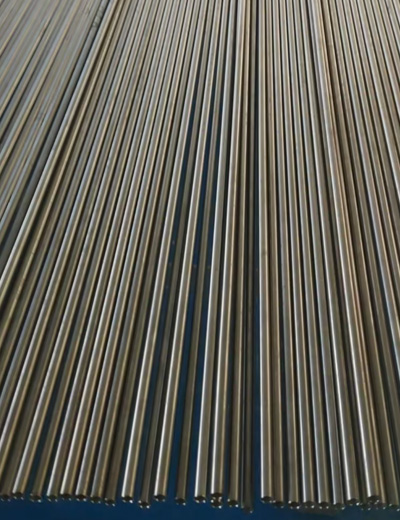
ASTM B165 Monel 400 (UNS N04400) Seamless Pipe & Tube Standard
ASTM B165 is the specification of the ASTM International standard published by the American Society for Testing and Materials (ASTM) that governs the manufacturing and quality requirements for nickel-copper alloy (UNS N04400) seamless pipe and tube. This material is commonly known as Monel 400. It defines the chemical composition, mechanical properties, dimensional tolerances, heat treatment conditions, hydrostatic testing protocols, and inspection requirements for cold-worked seamless products.
Monel 400 combines a high nickel base (63% minimum) with 28-34% copper to produce an alloy that resists corrosion from seawater, hydrofluoric acid, sulfuric acid, and alkaline environments. ASTM B165 Monel 400 pipe and tube are widely used in marine engineering, chemical processing, oil refining, power generation, and pharmaceutical equipment. This guide covers every section of ASTM B165, including grade details, chemical limits, mechanical requirements, tolerances, testing, and practical questions, so engineers and procurement teams can specify and source the right product with confidence.
ASTM B165 PDF Free Download ASTM B165 PDF Free Download
What is ASTM B165?
ASTM B165 is the Standard Specification for Nickel-Copper Alloy (UNS N04400) Seamless Pipe and Tube. It falls under the jurisdiction of ASTM Committee B02 on Nonferrous Metals and Alloys, Subcommittee B02.07 on Refined Nickel and Cobalt and Their Alloys.
In this standard, two temper conditions are defined: annealed (soft, with a dull matte finish) and stress-relieved (thermally treated below the annealing temperature, with a thin light- to medium-dark surface). Hot-worked material is also available, but its properties and tolerances must be agreed upon between the manufacturer and buyer.
Pipe dimensions follow standard NPS (Nominal Pipe Size) designations, while tube dimensions are specified by outside diameter and nominal or minimum wall thickness. The standard covers sizes from fractional OD tubing up through NPS 8 (8.625 in. / 219.1 mm OD) and beyond, with pipe schedules including Sch 5, 10, 40, and 80 listed in Appendix X2.
A key distinction: ASTM B165 covers both pipe and tube forms of Monel 400. For nickel-copper alloy specifically intended for condenser and heat exchanger tubes, ASTM B163 is the applicable specification. B163 shares the same chemical composition and mechanical requirements as B165 but includes additional rules for condenser-specific testing and dimensional control.
Chemical Composition of ASTM B165
The chemical composition of ASTM B165 alloys specifies the controlled percentages of nickel and other alloying elements used in seamless nickel and nickel-copper alloy pipes and tubes. These elements influence the material's corrosion resistance, strength, and performance in marine, chemical, and industrial environments. Understanding the chemical composition helps ensure the correct ASTM B165 grade is selected for reliable service in demanding applications.
| GRADE | UNS Designation |
Standard (Tube) |
Chemical Requirement (Max) | ||||||||||||
| C | Mn | P | S | Si | Ni | Cr | Mo | Cu | Fe | Ti | Al | Co | |||
| Monel 400 | N04400 | B165 | 0.30 | 2.00 | 0.024 | 0.50 | min 63.0 | - | - | 28.0-34.0 | 2.5 | - | - | - | |
Note: Nickel content is determined arithmetically by difference. Product (check) analysis variations apply when the purchaser requests re-testing of finished material. The test method for chemical analysis is ASTM E 76 (Test Methods for Chemical Analysis of Nickel-Copper Alloys).
Mechanical Properties of ASTM B165
ASTM B165 defines mechanical requirements for two temperature conditions: annealed and stress-relieved. Annealed Monel 400 provides moderate strength with high ductility (35% elongation). Stress-relieved material retains higher tensile and yield strength at the cost of lower ductility (15% vs 35% elongation in the annealed condition). The table below lists minimum values per the ASTM B165 standards.
| Grade | Condition & Size | Standard | Tensile Strength Min, MPa |
Yield Strength Min, MPa |
Elongation Min, % |
| N04400 | Annealed: OD≤127mm | B165 | 480 | 195 | 35 |
| N04400 | Annealed: OD>127mm | B165 | 480 | 170 | 35 |
| N04400 | Stress-Relieved: All size | B165 | 585 | 380 | 15 |
Note: Elongation is measured in 2-in. (50 mm) gauge length, or 4D for round specimens. Yield strength is determined by the 0.2% offset method. The allowable fibre stress values are used in the hydrostatic test pressure formula (P = 2St/D). For small-diameter and light-wall tube (converter sizes), see Appendix X1 in the specification, which lists properties for annealed, half-hard, and full-hard conditions.
If you want to know more product details, please contact us!
ASTM B165 Monel 400
ASTM B165 covers a single alloy: UNS N04400, commonly called Monel 400. Monel 400 is a solid-solution nickel-copper alloy with no precipitation hardening. Its strength comes entirely from solid-solution strengthening and cold work. The alloy was first developed in 1905 and remains one of the most widely used nickel alloys today because it combines corrosion resistance, good mechanical properties, and workability.
The nickel-copper ratio (roughly 2:1) gives Monel 400 a unique corrosion profile. Monel 400 offers exceptional resistance to hydrofluoric acid across a wide range of concentrations and temperatures, which is why it is widely used in HF alkylation units in petroleum refineries. It also performs well in sulfuric acid, phosphoric acid, seawater, brackish water, and caustic soda. This makes it a preferred choice for chemical processing, marine hardware, valves, pumps, and offshore platform piping.
Monel 400 maintains useful strength up to 1000°F (538°C) in non-oxidising atmospheres. Below its Curie temperature of about 70°F (21°C), the alloy becomes weakly ferromagnetic. Above that temperature, it is non-magnetic.
| Property | Value | Standard | Notes |
| UNS Number | N04400 | ASTM B165 | Nickel-copper solid-solution alloy |
| Common Name | Monel 400 | — | First developed in 1905 by INCO |
| Ni Content | 63.0% min | Table 2 | Balance element (determined by difference) |
| Cu Content | 28.0–34.0% | Table 2 | Primary alloying element for corrosion resistance |
| Density | 0.319 lb/in³ (8.83 g/cm³) | — | Higher than stainless steel (0.29 lb/in³) |
| Melting Range | 2370–2460°F (1300–1350°C) | — | Narrow solidification range aids castability |
| Curie Temp | ~70°F (21°C) | — | Weakly ferromagnetic below this temperature |
| ASME Equiv | SB-165 | ASME Sec II-B | Used for code-stamped pressure equipment |
Note: For pressure vessels, boilers, and piping systems built to ASME Boiler and Pressure Vessel Code (BPVC), the equivalent specification is ASME SB-165. Chemically and mechanically identical to ASTM B165, SB-165 is required when the fabricator needs code compliance for ASME-stamped equipment. Procurement teams should confirm which designation applies based on the applicable design code.
Heat Treatment and Conditions
ASTM B165 Monel 400 pipe and tube are supplied in one of two conditions: annealed or stress-relieved. The condition directly affects both mechanical properties and surface finish. Choosing the right temper depends on the application’s requirements for strength, ductility, and formability.
Annealed Condition
Annealing involves heating the cold-worked material to a temperature high enough to recrystallise the grain structure, then cooling it at a controlled rate. The result is a soft, ductile product with a dull matte finish. Annealed Monel 400 offers 35% minimum elongation and is suited for bending, flaring, swaging, and other forming operations. Typical annealing temperatures for Monel 400 range from 1300-1700°F (705-927°C), depending on the degree of softness required.
Stress-Relieved Condition
Stress-relieving heats the cold-worked pipe or tube below the full annealing temperature. This is enough to reduce residual stresses from cold working without fully recrystallising the grain structure. The product retains higher strength (85,000 psi / 585 MPa tensile minimum) and a thin, light- to medium-dark surface. Elongation drops to 15% minimum. This condition suits applications that need higher strength with moderate ductility, such as shafting, springs, and structural marine components.
ASTM B165 Tolerances
Dimensional accuracy is critical for proper fit-up in piping systems and heat exchangers. ASTM B165 defines tolerances for outside diameter, wall thickness, and cut length. These tolerances apply to seamless cold-worked pipe and tube. For hot-worked material, tolerances must be agreed between manufacturer and purchaser.
| STANDARD | OD(D) | TOLERANCE(MM) | THICKNESS(S) | TOLERANCE | LENGTH | TOLERANCE |
| MM | COMMON HIGH | MM | MM | MM | ||
| B165 (Cold-Drawn Tube) |
D<12.7 | +0.13/0 | ave. ±12.5% | min: +25.0%/0 | Cut-to-length ≤9.1m |
+3.2/0 |
| 12.7≤D≤15.9 | ±0.13 | |||||
| 15.9<D≤38.1 | ±0.13 | ave. ±10.0% | min: +20.0%/0 | |||
| 38.1<D≤76.2 | ±0.25 | ave. ±12.5% | min: +22.0%/0 | |||
| D<12.7 | ±0.13 | ave. ±12.5% | min: +25.0%/0 | Cut-to-length >9.1m |
+6.4/0 | |
| 12.7≤D≤15.9 | ±0.15 | |||||
| 15.9<D≤38.1 | ±0.19 | ave. ±10.0% | min: +20.0%/0 | |||
| 38.1<D≤50.8 | ±0.25 | ave. ±12.5% | min: +22.0%/0 | |||
| 50.8<D≤76.2 | ±0.38 | |||||
| B165 (Hot-Finished Tube) |
19≤D≤38 | +0.4/-0.8 | for nominal wall: ±12.5% | for min wall: +28.5%/0 | OD<50.8: +3.2/-0 OD≥50.8: +4.8/-0 Details refer to B829 |
- |
| 38.1<D≤102 | ±0.8 | |||||
| 102<D≤235 | +1.6/-0.8 | |||||
| B165 (Hot-Worked Pipe) |
25≤D≤48 | ±0.38 | for nominal wall: +16%/-12.5% |
for min wall: +28.5%/0 | - | - |
Hydrostatic Testing Requirements
Every pipe or tube with an OD of 1/8 in. (3 mm) or larger and a wall thickness of 0.015 in. (0.38 mm) or over must pass a hydrostatic test. The manufacturer tests each piece at an internal pressure of 1,000 psi (6.9 MPa), provided the fibre stress calculated by the formula below does not exceed the allowable limits.
The hydrostatic test pressure is calculated using P = 2St/D, where P = test pressure in psi (or MPa), S = allowable fibre stress, t = minimum wall thickness in inches (or mm), and D = outside diameter in inches (or mm).
| Condition & Size | Allowable Fiber Stress, psi | Allowable Fiber Stress, MPa |
| Annealed, ≤5 in. (127 mm) OD | 17,500 | 120 |
| Annealed, >5 in. (127 mm) OD | 16,700 | 115 |
| Stress-Relieved, All Sizes | 21,200 | 145 |
If any pipe or tube shows leaks during the hydrostatic test, it is rejected. When agreed upon by buyer and manufacturer, the test pressure may be raised to 1.5 times the values shown above. If the purchaser does not require hydrostatic testing, a nondestructive electric test may be substituted.
Testing and Inspection Requirements
ASTM B165 requires chemical analysis, tension testing, and hydrostatic testing on every lot. Additional sampling, inspection, and marking requirements round out the quality assurance framework. Here is a breakdown of each required test.
Chemical Analysis
One chemical analysis test per lot. A lot for chemical analysis is defined as one heat. Testing follows ASTM E 76 (Chemical Analysis of Nickel-Copper Alloys). Representative samples are taken during pouring or subsequent processing.
Tension Test
One tension test per lot. A lot for mechanical testing consists of all material from the same heat, same nominal size (excluding length), and same condition (temper). Testing follows ASTM E 8 (Test Methods of Tension Testing of Metallic Materials). Material is tested in the direction of fabrication using a full tubular, longitudinal strip, or the largest possible round specimen.
Hydrostatic Test
Every individual pipe or tube piece is hydrostatically tested. Pipes and tubes with OD of 1/8 in. (3 mm) and larger, with a wall thickness of 0.015 in. (0.38 mm) and over, are pressurised to 1,000 psi (6.9 MPa) minimum. The test verifies that no leaks exist under internal pressure.
Workmanship and Finish
All material must be uniform in quality and temper, commercially straight, and free of injurious imperfections. The product must be free of bends and kinks. Ends are plain cut and deburred.
Product Marking
Each pipe or tube must be marked with: the alloy name or UNS number (N04400), heat number, condition (temper), this specification number (B165), the size, and the gross/tare/net weight. Marking is applied on the material surface or on attached labels and tags.
Frequently Asked Questions
-
Can Monel 400 Handle Hydrofluoric Acid?
-
What Is the Maximum Service Temperature for Monel 400?Monel 400 can be used up to 1000°F (538°C) in non-oxidising or mildly oxidising conditions. Above this temperature, oxidation becomes significant. In strongly oxidising environments, the practical limit drops to around 900°F (480°C). Temperature limits are also influenced by the specific corrosive environment. Monel 400 is susceptible to stress corrosion cracking (SCC) in certain media, such as moist aerated HF vapours and mercury compounds, so application-specific corrosion data should always be consulted. For sustained high-temperature service in oxidising atmospheres, nickel-chromium alloys are better choices.
-
How Does Monel 400 Compare to 316L Stainless Steel in Seawater?Monel 400 outperforms 316L in seawater service across every major corrosion metric. In flowing seawater, Monel 400 resists erosion-corrosion at velocities up to 100 ft/s (30 m/s), while 316L begins to pit at much lower velocities. Monel 400 also resists biofouling better due to its copper content. However, Monel 400 can suffer pitting and crevice corrosion in stagnant or low-velocity seawater, so continuous flow conditions are preferred.
-
What is the Difference Between ASTM B165 and ASTM B163?ASTM B165 covers Monel 400 seamless pipe and tube for general service; ASTM B163 covers nickel-copper alloy condenser tubes and ferrule stock specifically designed for heat exchanger and condenser applications. Both standards share the same UNS N04400 chemistry and mechanical requirements. The differences lie in dimensional designation, testing frequency, and finish requirements. B163 includes tighter controls on OD tolerances and mandates additional testing for tubes intended for condenser duty.
-
Is Monel 400 Magnetic?Monel 400 is weakly ferromagnetic below its Curie temperature of approximately 70°F (21°C). Above 70°F, the alloy becomes non-magnetic. At room temperature (around 72°F / 22°C), it is essentially non-magnetic for practical purposes. This is important for applications near sensitive magnetic instruments or MRI equipment, where a non-magnetic structural material is required.
-
What Welding Precautions Apply to Monel 400?Monel 400 requires low heat input, no preheating (unless the material is below 60°F), and a non-oxidising shielding atmosphere. The recommended filler metals are ENiCu-7 (covered electrode) or ERNiCu-7 (bare wire) per AWS A5.11 and A5.14. Joint surfaces must be clean and free of grease, oil, and mill scale. Interpass temperature should stay below 300°F (150°C) to prevent hot cracking. Post-weld heat treatment is normally not required for Monel 400.
-
How Does Monel 400 Differ From Monel K-500?Monel K-500 (UNS N05500) adds aluminium and titanium to the Monel 400 base, which allows precipitation hardening (age hardening). After ageing, K-500 reaches tensile strengths above 160,000 psi (1100 MPa). This is more than double the minimum tensile strength of annealed Monel 400. K-500 is specified for pump shafts, doctor blades, and fasteners where higher strength is needed. However, K-500 costs more and requires controlled heat treatment. For general pipe and tube applications, Monel 400 under ASTM B165 remains the standard choice.