
ASTM B622 covers seamless nickel and nickel-cobalt alloy pipe and tube; ASTM B619 covers welded nickel and nickel-cobalt alloy pipe. Both standards share the same alloy families and chemical composition requirements. The differences lie in the manufacturing process (seamless vs welded), additional testing for welded pipe (weld integrity tests), and slightly different tolerance structures. Seamless B622 pipe is preferred for high-pressure, high-integrity service.

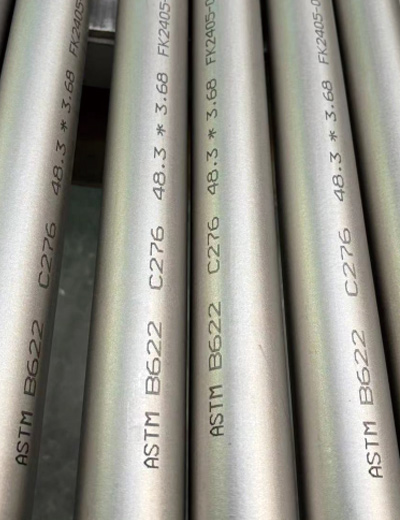
ASTM B622 Nickel Alloy Seamless Pipe & Tube Standard
ASTM B622 is a standard specification published by the American Society for Testing and Materials (ASTM) that covers the manufacturing and quality requirements for seamless nickel and nickel-cobalt alloy pipe and tube. It applies to over 30 UNS-designated alloys, including the Hastelloy B, C, and G families, Haynes 230, Alloy 20, and several other high-performance nickel-base grades used in the world’s most corrosive industrial environments.
The specification defines chemical composition, mechanical properties, hydrostatic testing, dimensional tolerances, heat treatment requirements, and inspection protocols for all covered alloys. Every pipe and tube under ASTM B622 must be delivered in the solution-annealed and descaled condition.
ASTM B622 nickel alloy pipe and tube is widely specified in chemical processing, pharmaceutical production, flue gas desulfurisation (FGD), pulp and paper, oil and gas, power generation, and pollution control equipment. This guide covers every section of ASTM B622 (alloy families, chemical composition, mechanical properties, tolerances, testing, and practical questions) so engineers and procurement teams can identify the right alloy and product form for their application.
ASTM B622 PDF Free Download ASTM B622 PDF Free Download
What is ASTM B622?
ASTM B622 is the Standard Specification that covers pipe and tube made from Seamless Nickel and Nickel-Cobalt Alloy. It falls under the jurisdiction of ASTM Committee B02 on Nonferrous Metals and Alloys, Subcommittee B02.07 on Refined Nickel and Cobalt and Their Alloys.
Pipe dimensions follow standard NPS (Nominal Pipe Size) designations per ANSI B36.19, while tube dimensions are specified by outside diameter, minimum or average wall thickness, and length.
What sets B622 apart from other nickel alloy pipe specifications is its broad scope. While ASTM B165 covers only Monel 400 and ASTM B167 covers only Inconel 600/601, ASTM B622 consolidates over 30 nickel and nickel-cobalt alloys into a single specification. This makes it the preferred standard for Hastelloy, Haynes, and many other high-nickel alloy pipe products.
The ASME equivalent is SB-622, listed in ASME Boiler and Pressure Vessel Code, Section II, Part B (Nonferrous Materials). Pipe produced to ASTM B622 that also meets ASME requirements can carry the SB-622 designation for code-stamped pressure equipment.
Chemical Composition of ASTM B622
The chemical composition of ASTM B622 alloys defines the controlled percentages of nickel, chromium, molybdenum, iron, and other elements used in seamless nickel and nickel-alloy pipes and tubes. These elements are carefully balanced to provide excellent corrosion resistance, strength, and stability in aggressive chemical and high-temperature environments.
The table below shows that chemical composition helps ensure the correct ASTM B622 alloy is selected for reliable industrial service. For the full list of all 30+ alloys, refer to the following table of the ASTM B622 specification.
| GRADE | UNS Designation |
Standard |
Chemical Requirement | |||||||||||||
| C | Mn | P | S | Si | Ni | Cr | Mo | Cu | Fe | Ti | Al | Co | Other | |||
| Alloy C276 | N10276 | B622 | 0.01 | 1.00 | 0.040 | 0.030 | 0.08 | BAL | 14.5–16.5 | 15.0–17.0 | - | 4.0–7.0 | - | - | 2.5 | W: 3.0–4.5; V: 0.35 |
| Alloy C22 | N06022 | B622 | 0.015 | 0.50 | 0.020 | 0.020 | 0.08 | BAL | 20.0–22.5 | 12.5–14.5 | - | 2.0–6.0 | - | - | 2.5 | W: 2.5–3.5; V: 0.35 |
| Alloy B2 | N10665 | B622 | 0.02 | 1.00 | 0.040 | 0.030 | 0.10 | BAL | 1.0 | 26.0–30.0 | - | 2.0 | - | - | 1.0 | - |
| Alloy B3 | N10675 | B622 | 0.01 | 1.50 | 0.040 | 0.010 | 0.10 | BAL | 1.0–3.0 | 27.0–32.0 | 0.50 | 1.0–3.0 | 0.20 | 0.50 | 3.0 | W: 3.0 |
| Alloy C2000 | N06200 | B622 | 0.01 | 0.50 | 0.025 | 0.010 | 0.08 | BAL | 22.0–24.0 | 15.0–17.0 | 1.3–1.9 | 3.0 | - | - | 2.0 | W: 0.50 |
| Alloy C4 | N06455 | B622 | 0.01 | 1.00 | 0.040 | 0.030 | 0.08 | BAL | 14.0–18.0 | 14.0–17.0 | - | 3.0 | 0.70 | - | 2.0 | - |
Note: All values are maximum percentages unless a range is shown. Nickel is the balance element for all grades listed above. Product analysis variations are governed by ASTM B880. For alloys containing tungsten (C-276, C-22), W contributes to crevice corrosion resistance. For alloys without Cr (B-2, B-3), the alloy is only resistant to reducing acids.
Mechanical Properties of ASTM B622
The mechanical properties of ASTM B622 alloys define their strength, ductility, and ability to perform under demanding service conditions. Key properties such as tensile strength, yield strength, and elongation ensure that these nickel and nickel-alloy pipes provide reliable performance in corrosive and high-temperature environments. Understanding these mechanical values helps engineers select the appropriate alloy for safe and durable industrial applications.
| Grade | Standard | Tensile Strength Min, MPa |
Yield Strength Min, MPa |
Elongation Min, % |
| N10276 | B622 | 690 | 283 | 40 |
| N06022 | B622 | 690 | 310 | 45 |
| N10665 | B622 | 760 | 350 | 40 |
| N10675 | B622 | 760 | 350 | 40 |
| N06200 | B622 | 690 | 283 | 45 |
| N06455 | B622 | 690 | 276 | 40 |
Note: All values are minimum requirements in the solution-annealed condition. Yield strength is measured by 0.2% offset method. Elongation is measured in 2 in. (50 mm) gauge length or 4D for round specimens. All fibre stress values from the published tensile minimums using the formula S = Tensile Min ÷ 4. The small discrepancies can create compliance issues if quoted in procurement documents.
ASTM B622 Tolerances
Dimensional tolerances for all ASTM B622 alloys cover outside diameter and wall thickness for seamless pipe and tube. The tolerances vary depending on the type of finishes chosen for the product. However, there are no alloy-specific dimensional differences. Length tolerances and straightness requirements are also specified.
| STANDARD | OD(D) | TOLERANCE(MM) | THICKNESS(S) | TOLERANCE | LENGTH | TOLERANCE |
| MM | COMMON HIGH | MM | MM | MM | ||
| B622 (Cold-worked Pipe and Tube) |
D≤10 | ±0.10 | S(ave):±15% | S(Min): +30%/0 | OD<50.8:+3.2/-0 OD≥50.8: +4.8/-0 Details refer to B829 |
- |
| 10<D≤16 | ±0.13 | |||||
| 38<D≤76 | ±0.25 | S(ave):±10% | S(Min): +22%/0 | |||
| 76<D≤114 | ±0.38 | |||||
| 114<D≤152 | ±0.51 | S(ave):±12.5% | S(Min): +28%/0 | |||
| 152≤D≤168 | ±0.64 | |||||
| 168<D≤219 | ±0.79 | |||||
| 219<D≤356 | +1.57/-0.79 | |||||
| 356<D≤610 | +3.18/-0.79 | |||||
| B622 (Hot-finished Tube) |
19≤D≤38 | +0.4/-0.8 | for nominal wall:±12.5% | for min wall:±28.5%/0 | OD<50.8: +3.2/-0 OD≥50.8: +4.8/-0 Details refer to B829 |
- |
| 38.1<D≤102 | +1.6/-0.8 | |||||
| 102<D≤235 | ±0.38 | |||||
| B622 (Hot-worked Pipe) |
25≤D≤48 | ±0.38 | for nominal wall: +16%/-12.5% |
for min wall:±28.5%/0 | - | - |
|---|---|---|---|---|---|---|
| 48≤D≤114 | ±0.51 | |||||
| 114≤D≤165 | ±0.64 | |||||
| 165≤D≤235 | ±0.79 |
If you want to know more product details, please contact us!
ASTM B622 Alloy Grades
ASTM B622 organises its alloys into families based on their primary alloying elements. Each family targets a different corrosion profile: nickel-molybdenum alloys resist reducing acids, nickel-chromium-molybdenum alloys handle both oxidising and reducing conditions, and nickel-iron-chromium alloys serve high-temperature applications. The table below lists the major alloy families, their UNS designations, common trade names, and primary applications.
| Alloy Family | UNS | Trade Name | Key Elements | Primary Application |
| Ni-Mo | N10001 | Hastelloy B | Ni-26Mo | HCl, H₂SO₄ (reducing acids) |
| Ni-Mo | N10665 | Hastelloy B-2 | Ni-28Mo | HCl, H₂SO₄ (improved B) |
| Ni-Mo | N10675 | Hastelloy B-3 | Ni-28.5Mo | Reducing acids (latest gen) |
| Ni-Mo | N10629 | Hastelloy B-4 | Ni-28Mo | Reducing acids, improved stability |
| Ni-Mo-Cr-Fe | N10242 | — | Ni-25Mo-8Cr | Mixed acid environments |
| Low C Ni-Mo-Cr | N10276 | Hastelloy C-276 | Ni-16Cr-16Mo-W | Broad chemical resistance |
| Ni-Cr-Mo-Fe | N06002 | Hastelloy X | Ni-22Cr-9Mo | High-temp oxidation resistance |
| Low C Ni-Mo-Cr | N06022 | Hastelloy C-22 | Ni-22Cr-13Mo-W | Oxidising + reducing acids |
| Low C Ni-Mo-Cr | N06455 | Hastelloy C-4 | Ni-16Cr-16Mo | Pitting, HCl, H₂SO₄ |
| Low C Ni-Mo-Cr | N06058 | Hastelloy C-2000 alt. | Ni-23Cr-16Mo | Broad acid resistance |
| Low C Ni-Cr-Mo-Cu | N06200 | Hastelloy C-2000 | Ni-23Cr-16Mo-1.6Cu | HF, H₂SO₄, oxidizing acids |
| Ni-Cr-Fe-Mo-Cu | N06007 | Hastelloy G | Ni-22Cr-7Mo-2Cu | Wet phosphoric acid |
| Ni-Cr-Fe-Mo-Cu | N06975 | Hastelloy G-2 | Ni-23Cr-7Mo-2Cu | Improved G, less sensitisation |
| Ni-Cr-Fe-Mo-Cu | N06985 | Hastelloy G-3 | Ni-22Cr-7Mo-2Cu | FGD, phosphoric acid service |
| Ni-Cr-Fe-Mo-Cu | N06030 | Hastelloy G-30 | Ni-30Cr-5Mo-2Cu | Wet phosphoric acid (high Cr) |
| Low C Ni-Cr-Mo-W | N06686 | Inconel 686 | Ni-21Cr-16Mo-4W | Severe FGD, seawater |
| Ni-Cr-W-Mo | N06230 | Haynes 230 | Ni-22Cr-14W-2Mo | High-temp (up to 2100°F) |
| Ni-Fe-Cr-Mo | N08320 | Alloy 20Cb-3 | Ni-20Cr-34Fe-2.5Mo | H₂SO₄ at moderate temps |
| Ni-Fe-Cr-Mo | N08135 | Alloy 25-6MO | Ni-20Cr-Fe-6Mo | Seawater, high chloride |
| Ni-Fe-Cr-Mo-Cu | N08031 | Alloy 31 | Ni-27Cr-31Fe-7Mo | Phosphoric, sulfuric acid |
| Ni-Co-Cr-Si | N12160 | Haynes HR-160 | Ni-28Cr-3Si-30Co | Sulfidation resistance |
| Cr-Ni-Fe-N | R20033 | Alloy 33 | 33Cr-31Fe-31Ni | HNO₃, chloride environments |
Hastelloy C-276 (UNS N10276)
UNS N10276 is the most widely specified alloy under ASTM B622. Its 16% Cr, 16% Mo, and 4% W composition gives it outstanding resistance to a wide range of acids, including sulfuric, hydrochloric, phosphoric, and acetic acid. C-276 also resists chloride-induced pitting and stress corrosion cracking. It is used in FGD scrubbers, chemical reactors, sour gas handling, and pharmaceutical equipment.
More About Hastelloy C-276 MaterialHastelloy C-22 (UNS N06022)
UNS N06022 improves on C-276 by adding resistance to oxidising acids and mixed acid environments. With 22% Cr and 13% Mo, C-22 handles wet chlorine, HNO₃/HCl mixtures, and aggressive FGD conditions that would attack C-276. It is considered the most versatile of the C-family alloys for new-build chemical processing equipment.
More About Hastelloy C-22 (UNS N06022) MaterialHastelloy C-4 (UNS N06455)
UNS N06455 combines the corrosion resistance of C-276 with superior thermal stability. The absence of tungsten eliminates the risk of micro-segregation during welding. C-4 offers superior thermal stability in the 500–700°C range compared to C-276, making it preferred where components must withstand repeated thermal cycling or prolonged heat treatment without phase instability.
More About Hastelloy C-4 (UNS N06455) MaterialHastelloy B-2 (UNS N10665)
UNS N10665 is the primary nickel-molybdenum alloy for reducing acid service. With 28% Mo and virtually no chromium, B-2 withstands all concentrations of hydrochloric acid at all temperatures and sulfuric acid up to 60% concentration. However, it has no resistance to oxidising media. Typical applications include HCl distillation columns, vacuum evaporators, and chemical waste processing.
More About Hastelloy B-2 (UNS N10665) MaterialHastelloy B-3 (UNS N10675)
UNS N10675 is the third-generation Ni-Mo alloy with improved thermal stability over B-2. B-3 resists Ni₂(Cr, Mo)-type long-range ordering that plagues B-2 during slow cooling or welding heat input. It offers the same HCl and H₂SO₄ resistance as B-2 but with a wider fabrication window and better resistance to knife-line attack in heat-affected zones.
More About Hastelloy B-3 (UNS N10675) MaterialHastelloy C-2000 (UNS N06200)
UNS N06200 is a next-generation alloy that combines resistance to both oxidising and reducing acids with HF resistance. The 1.6% copper addition gives it performance in hydrofluoric acid that no other C-family alloy can match. At 23% Cr and 16% Mo, C-2000 offers good resistance to dilute hydrofluoric acid; consult corrosion data sheets for specific concentration and temperature limits before specifying.
More About Hastelloy C-2000 (UNS N06200) MaterialHeat Treatment Requirements for ASTM B622
Every pipe and tube under ASTM B622 must be delivered in the solution-annealed and descaled condition. When atmosphere-controlled annealing is used (bright anneal), descaling is not required. Solution annealing dissolves carbides, intermetallic phases, and long-range ordering that form during hot working or slow cooling.
Solution annealing temperatures vary by alloy family. The Ni-Mo alloys (B-2, B-3) typically anneal at 1950-2050°F (1065-1120°C), while the Ni-Cr-Mo grades (C-276, C-22, C-4) anneal at 2000-2150°F (1095-1175°C). The Ni-Cr-W alloy Haynes 230 (N06230) requires a higher temperature [up to 2200°F (1204°C) minimum] followed by a water quench or rapid cooling.
Rapid cooling (water quench or forced air) after solution annealing is mandatory for most alloys to prevent the re-formation of detrimental phases. In the Ni-Mo family, slow cooling leads to Ni₄Mo ordering that embrittles the alloy. In the C-family, slow cooling causes sigma phase and carbide precipitation at grain boundaries, reducing both toughness and corrosion resistance.
Testing and Inspection Requirements
ASTM B622 requires chemical analysis, tension testing, and hydrostatic testing on every lot. The specification also defines lot definitions, sampling protocols, specimen preparation, and marking requirements.
Chemical Analysis
One test per lot. A lot for chemical analysis is defined as one heat. Testing follows ASTM E 1473 (Chemical Analysis of Nickel, Cobalt, and High-Temperature Alloys). Representative samples are taken during pouring or processing.
Tension Test
One tension test per lot. A lot for mechanical testing consists of material from one heat, in the same condition and cross section, not exceeding 10,000 lb (4,500 kg). Testing follows ASTM E 8. Specimens are taken from finished material, tested in the direction of fabrication using a full tubular, strip, or the largest round specimen that fits the tube.
Hydrostatic Test
Every pipe or tube is tested at an internal pressure not exceeding 1,000 psi (6.89 MPa) that produces a fibre stress calculated using P = 2St/D. Any piece showing leaks is rejected. The allowable fibre stress (S) varies by alloy, from 18,300 psi (126 MPa) for N08135 to 27,500 psi (190 MPa) for C-276-class grades.
Product Marking
Each piece of pipe or tube with an OD of 1/2 in. (12.7 mm) and over must be marked with: the specification number (B622), alloy designation, name of the material, and size. Each bundle or shipping container must also include: alloy class, condition, size, gross/tare/net weight, consignor, consignee, contract number, and heat number.
Frequently Asked Questions
-
What is the Difference Between ASTM B622 and ASTM B619?
-
How Does ASTM B622 Differ From ASTM B444?B622 is a multi-alloy specification covering 30+ grades; B444 covers only Inconel 625 (UNS N06625) and Inconel 625LCF (UNS N06626). If you need Inconel 625 seamless pipe or tube, B444 is its standard specification. If you need Hastelloy C-276, C-22, B-2, or any of the other specialized nickel alloys, B622 is the correct specification. The two standards do not overlap in alloy coverage.
-
Why Are There So Many Alloys in One Specification?ASTM B622 consolidates alloys that share similar manufacturing processes (seamless cold or hot working), heat treatment methods (solution annealing), and testing protocols. Grouping them into one specification simplifies procurement and quality documentation. The key differentiator between alloys is their chemical composition, which determines corrosion resistance for a specific environment. A C-276 pipe and a B-2 pipe may look identical, but their chemical composition makes them suited for completely different services.
-
Which B622 Alloy Is Best for Hydrochloric Acid (HCl)?For pure HCl at all concentrations and temperatures, the Ni-Mo family is the best choice. B-3 (N10675) is preferred for fabricated assemblies involving welding, while B-2 (N10665) remains suitable for wrought or non-welded applications. Both alloys contain approximately 28% Mo with virtually no chromium, making them the gold standard for reducing acid resistance. However, if the HCl service involves oxidising contaminants such as ferric ions or dissolved oxygen, C-276 or C-22 is the better option.
-
Can ASTM B622 Alloys Handle Seawater?Yes, but not all alloys are equal in seawater. C-276 and C-22 perform well in flowing seawater due to their high chromium and molybdenum content. The Ni-Mo alloys (B-2, B-3) are not suitable for seawater because they lack chromium and will suffer rapid pitting in chloride-oxidising conditions. For seawater piping, C-276 or Alloy 625 are the standard choice.
-
What Heat Treatment Does ASTM B622 Require?All B622 alloys must be solution annealed and descaled. Annealing temperatures range from about 1950°F (1065°C) for Ni-Mo alloys to 2200°F (1204°C) for Haynes 230 (N06230). Rapid cooling (water quench or forced air) follows to prevent the precipitation of carbides, sigma phase, or long-range ordering. When bright annealing in a controlled atmosphere, descaling is not required.
-
What Is the Difference Between Hastelloy C-276 and Hastelloy C-22?C-22 has higher chromium (22% vs 16%) and lower molybdenum (13% vs 16%) than C-276. This shift gives C-22 better resistance to oxidising acids (like HNO₃) and mixed-acid environments. C-276 has better reducing acid resistance (H₂SO₄, HCl) and is the legacy standard in chemical processing. For new-build projects facing both oxidising and reducing conditions, C-22 is often the preferred choice. C-276 remains dominant in retrofit and sour gas applications.
-
Is ASTM B622 the Same as ASME SB-622?ASME SB-622 is the identical specification adopted into ASME Boiler and Pressure Vessel Code, Section II, Part B. Material produced to ASTM B622 can carry the SB-622 designation when all ASME requirements are met. This is mandatory for code-stamped pressure equipment in power plants, process vessels, and heat exchangers. The chemical, mechanical, and testing requirements are the same in both versions.