
Technically, yes, but Incoloy 800 is not recommended above 1100°F for creep-critical applications. Without the controlled carbon and grain size of 800H/800HT, standard 800 has significantly lower creep-rupture strength. ASTM B407 explicitly states that N08810 and N08811 are “normally used in service temperatures above 1100°F (593°C) where resistance to creep and rupture is required.”

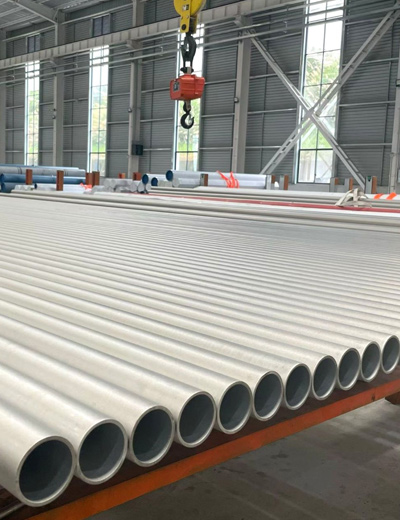
ASTM B407 Incoloy 800/800H/800HT Seamless Pipe & Tube Standard
ASTM B407 is the ASTM International standard specification for nickel-iron-chromium alloy seamless pipe and tube covering the Incoloy 800 family of alloys: UNS N08800 (Incoloy 800), N08810 (Incoloy 800H), N08811 (Incoloy 800HT), N08801, and N08120. These are the workhorse alloys for high-temperature industrial heating, petrochemical reforming, and power generation applications where temperatures reach 1100-2100°F (593-1150°C).
The specification defines chemical composition, mechanical properties, grain size requirements, dimensional tolerances, heat treatment, hydrostatic or eddy current testing, and product marking. Products are supplied in cold-worked, annealed or hot-finished conditions. The key distinction between Incoloy 800, 800H, and 800HT lies in carbon content and grain size control. These are small differences in chemical composition that produce large differences in creep and rupture life above 1100°F (593°C).
ASTM B407 Incoloy pipe and tube are specified in ethylene cracker furnaces, hydrogen reformers, ammonia reformer primary and secondary tubes, power plant superheaters, industrial heat treatment retorts, and nuclear steam generators. This guide covers every section of B407, including the alloy grades, 800 vs 800H vs 800HT differences, chemical composition, mechanical properties, tolerances, heat treatment, testing, and practical questions, providing engineers and procurement teams with the data to select the right Ni-Fe-Cr alloy.
ASTM B407 PDF Free Download ASTM B407 PDF Free Download
What is ASTM B407?
ASTM B407 is the Standard Specification that covers seamless pipe and tube made from Nickel-Iron-Chromium Alloy. It is overseen by ASTM Committee B02 on Nonferrous Metals and Alloys, Subcommittee B02.07 on Refined Nickel and Cobalt and their alloys.
The nickel-iron-chromium composition (with 30-35% Ni, 19-27% Cr, and 39.5%+ Fe) positions these alloys between austenitic stainless steels (which lack high-temperature strength) and nickel-chromium alloys like Inconel 600/601 (which cost significantly more due to higher nickel content).
Incoloy 800 (N08800) is used at temperatures up to 1100°F (593°C). Incoloy 800H (N08810), 800HT (N08811), and the related N08801 and N08120 are used above 1100°F (593°C), where creep and rupture resistance become the primary design criteria. The “H” and “HT” designations indicate higher carbon content and controlled grain size for improved elevated-temperature performance.
The ASME equivalent is SB-407, listed in the ASME Boiler and Pressure Vessel Code, Section II, Part B. Materials meeting both ASTM and ASME requirements can carry the SB-407 designation for code-stamped pressure equipment in power plants, refineries, and chemical process vessels.
Chemical Composition of ASTM B407
The chemical composition of ASTM B407 is carefully controlled to provide high strength, excellent oxidation resistance, and reliable performance at elevated temperatures. The alloy is primarily composed of nickel, chromium, and iron, with small amounts of elements such as carbon, aluminium, titanium, and manganese to improve stability and corrosion resistance. These balanced elements help ASTM B407 materials maintain durability and structural integrity in demanding industrial environments.
| GRADE | UNS Designation |
Standard | Chemical Requirement (Max unless range specified) | |||||||||||||
| C | Mn | P | S | Si | Ni | Cr | Mo | Cu | Fe | Ti | Al | Co | Other | |||
| Incoloy 800 | N08800 | B407 | 0.10 | 1.50 | 0.045 | 0.015 | 1.00 | 30.0–35.0 | 19.0–23.0 | - | 0.75 | min 39.5 | 0.15–0.60 | 0.15–0.60 | - | - |
| Incoloy 800H | N08810 | B407 | 0.05–0.10 | 1.50 | 0.045 | 0.015 | 1.00 | 30.0–35.0 | 19.0–23.0 | - | 0.75 | min 39.5 | 0.15–0.60 | 0.15–0.60 | - | - |
| Incoloy 800HT | N08811 | B407 | 0.06–0.10 | 1.50 | 0.045 | 0.015 | 1.00 | 30.0–35.0 | 19.0–23.0 | - | 0.75 | min 39.5 | 0.15–0.60 | 0.15–0.60 | - | Al+Ti: 0.85–1.20 |
| Incoloy 801 | N08801 | B407 | 0.05 | 1.50 | 0.045 | 0.015 | 1.00 | 30.0–34.0 | 19.5–23.5 | - | 1.00 | BAL | 0.75–1.50 | - | - | - |
| Alloy HR-120 | N08120 | B407 | 0.05–0.10 | 1.00 | 0.045 | 0.015 | 1.00 | 35.0–39.0 | 23.0–27.0 | - | 0.50 | BAL | - | 0.10–0.30 | 3.0 | Nb: 0.10–0.50; N: 0.20 |
Note: Iron is determined arithmetically by difference for N08800, N08810, N08811, and N08801. For N08810 (800H), carbon is controlled to 0.05-0.10%; for N08811 (800HT), carbon is 0.06-0.10% with Al+Ti held at 0.85-1.20%.
Mechanical Properties of ASTM B407
The mechanical properties of ASTM B407 define the strength and durability of the pipe and tube materials used in demanding applications. These properties include tensile strength, yield strength, and elongation, which indicate how the alloy performs under stress and deformation. The specified values ensure that ASTM B407 alloys provide reliable mechanical performance in high-temperature and corrosive environments.
| Grade | Condition & Size | Standard | Tensile Strength Min, MPa |
Yield Strength Min, MPa |
Elongation Min, % |
| N08800 | Cold-worked annealed | B407 | 520 | 205 | 30 |
| Hot-finished annealed or hot-finished | B407 | 450 | 170 | 30 | |
| N08810 | Hot-finished annealed or cold-worked annealed | B407 | 450 | 170 | 30 |
| N08811 | Hot-finished annealed or cold-worked annealed | B407 | 450 | 170 | 30 |
| N08801 | Cold-worked annealed | B407 | 520 | 205 | 30 |
| Hot-finished annealed or hot-finished | B407 | 450 | 170 | 30 | |
| N08120 | Hot-finished annealed or cold-worked annealed | B407 | 655 | 275 | 30 |
Note: These are room-temperature minimum values. The real value of 800H/800HT is seen in elevated-temperature creep data; at 1600°F (870°C), 800HT has approximately 20–30% higher 100,000-hour rupture strength than 800H, which in turn is significantly stronger than 800. Grain size (ASTM No. 5 or coarser) is verified per ASTM E 112 on every lot for N08120, N08810, and N08811. Elongation is measured in 2 in. (50 mm) or 4D gauge length.
ASTM B407 Tolerances
ASTM B407 defines two sets of dimensional tolerances: one for cold-finished pipe and tube, and one for hot-finished tube. Cold-finished products have tighter control over outside diameter (OD) and wall thickness. Hot-finished products can be made in larger diameters but have wider OD tolerances. In both cases, the standard specifies tolerances for outside (or inside) diameter, wall thickness (average or minimum), and length.
| STANDARD | OD(D) | TOLERANCE(MM) | THICKNESS(S) | TOLERANCE | LENGTH | TOLERANCE |
| MM | COMMON HIGH | MM | MM | MM | ||
| B407 (Cold-Drawn Tube) |
D<12.7 | +0.13/0 | ave. ±12.5% | min: +25.0%/0 | Cut-to-length ≤9.1m |
+3.2/0 |
| 12.7≤D≤15.9 | ±0.13 | |||||
| 15.9<D≤38.1 | ±0.13 | ave. ±10.0% | min: +20.0%/0 | |||
| 38.1<D≤76.2 | ±0.25 | ave. ±12.5% | min: +22.0%/0 | |||
| D<12.7 | ±0.13 | ave. ±12.5% | min: +25.0%/0 | Cut-to-length >9.1m |
+6.4/0 | |
| 12.7≤D≤15.9 | ±0.15 | |||||
| 15.9<D≤38.1 | ±0.19 | ave. ±10.0% | min: +20.0%/0 | |||
| 38.1<D≤50.8 | ±0.25 | ave. ±12.5% | min: +22.0%/0 | |||
| 50.8<D≤76.2 | ±0.38 | |||||
| B407 (Hot-Finished Tube) |
19≤D≤38 | +0.4/-0.8 | for nominal wall: ±12.5% | for min wall: +28.5%/0 | OD<50.8: +3.2/-0 OD≥50.8: +4.8/-0 Details refer to B829 |
- |
| 38.1<D≤102 | ±0.8 | |||||
| 102<D≤235 | +1.6/-0.8 | |||||
| B407 (Hot-Worked Pipe) |
25≤D≤48 | ±0.38 | for nominal wall: +16%/-12.5% |
for min wall: +28.5%/0 | - | - |
| 48<D≤114 | ±0.51 | |||||
| 114<D≤165 | ±0.64 | |||||
| 165<D≤235 | ±0.79 |
If you want to know more product details, please contact us!
ASTM B407 Alloy Grades: 800 vs 800H vs 800HT
ASTM B407 covers five UNS designations, but the three most commercially specified are N08800 (Incoloy 800), N08810 (Incoloy 800H), and N08811 (Incoloy 800HT). The differences between them are due to their chemical compositions but are large in high-temperature performance. Incoloy 800 is the general-purpose grade; 800H raises carbon for creep strength; 800HT raises carbon further and controls the Al+Ti ratio for maximum creep-rupture life. The table below compares all five alloys.
| UNS | Trade Name | C Range, % | Al+Ti | Grain Size | Primary Application |
| N08800 | Incoloy 800 | 0.10 max | — | No requirement | General service up to 1100°F (593°C) |
| N08810 | Incoloy 800H | 0.05–0.10 | 0.85–1.20 | ASTM No. 5 or coarser | Creep/rupture service above 1100°F (593°C) |
| N08811 | Incoloy 800HT | 0.06–0.10 | 0.85–1.20 | ASTM No. 5 or coarser | Max creep life: reformer tubes, ethylene pigtails |
| N08801 | — | 0.10 max | 0.75–1.50 (Ti) | No requirement | Carburisation resistance, thermal processing |
| N08120 | HR-120 | 0.02–0.10 | 0.40 max (Al) | ASTM No. 5 or coarser | High-temp oxidation, waste incineration |
UNS N08800 / Incoloy 800
UNS N08800 is the baseline alloy for moderate-temperature corrosion and heat resistance. It contains 30-35% nickel, 19-23% chromium, and a minimum of 39.5% iron. The balanced Ni-Fe-Cr chemical provides resistance to oxidation, carburisation, and sulfidation up to 1100°F (593°C). The common uses include heat exchanger tubing, sheathing for electrical heating elements, and process piping in mildly corrosive environments.
More About Incoloy 800 MaterialUNS N08810 / Incoloy 800H
UNS N08810 is the creep-optimised version for service above 1100°F (593°C). It is the same base alloy as 800, but with carbon restricted to 0.05-0.10% (instead of 0.10% max) and a mandatory grain size of ASTM No. 5 or coarser. The higher carbon floor creates more Cr₂₃C₆ and M₂₃C₆ carbides at grain boundaries, which pin grain boundaries during creep and slow diffusion-controlled deformation. 800H is specified for hydrogen reformer pigtails, ammonia reformer transfer lines, ethylene cracker radiant coils, and petrochemical furnace tubes operating at 1200-1800°F (650-980°C).
More About Incoloy 800H MaterialUNS N08811 / Incoloy 800HT
Alloy 800HT is the highest creep-rupture variant, with controlled Al+Ti for gamma-prime strengthening. It restricts carbon to 0.06-0.10% and controls the combined aluminium + titanium content to 0.85-1.20%. This Al+Ti window enables precipitation of gamma-prime (γ′, Ni₃(Al, Ti)) during high-temperature service, which adds precipitation strengthening on top of the carbide grain-boundary pinning. 800HT is the premium grade for ethylene pyrolysis furnace tubes, steam-methane reformer outlet pigtails, and nuclear steam generator tubing.
More About Incoloy 800HT MaterialUNS N08120 / HR-120
HR-120 is the high-chromium variant with 23-27% Cr, 35-39% Ni, and intentional nitrogen (0.15-0.30%) for solid-solution strengthening. It also contains niobium (0.4-0.9%) and molybdenum (up to 2.5%) for additional creep and pitting resistance. HR-120 is designed for temperatures up to 2000°F (1093°C) in oxidising atmospheres and waste incineration environments. Its heat treatment temperature is 2150°F (1177°C) minimum.
Heat Treatment Requirements for ASTM B407
The heat treatment of ASTM B407 alloys is directly tied to the alloy grade and the required grain size. Higher annealing temperatures produce coarser grains, which improve creep resistance but reduce room-temperature strength. The specification sets minimum annealing temperatures that must be met to achieve the required grain size.
| Alloy | Min Anneal Temp | Grain Size Requirement | Purpose |
| N08800 (Incoloy 800) | No specific minimum | No grain size requirement | General corrosion resistance up to 1100°F |
| N08810 (Incoloy 800H) | 2050°F (1121°C) | ASTM No. 5 or coarser | Creep/rupture above 1100°F |
| N08811 (Incoloy 800HT) | 2100°F (1149°C) | ASTM No. 5 or coarser | Maximum creep life, γ′ strengthening |
| N08120 (HR-120) | 2150°F (1177°C) | ASTM No. 5 or coarser | High-temp oxidation resistance |
| N08801 | No specific minimum | No grain size requirement | Carburisation resistance |
Grain size is verified per ASTM E 112 using the planimetric, comparison, or intercept method. In case of dispute, refer directly to the applicable edition of ASTM E 112 for the designated referee method. The grain size test is required once per lot for N08120, N08810, and N08811.
Testing and Inspection Requirements
ASTM B407 requires chemical analysis, tension testing, grain size testing (where applicable), and hydrostatic or eddy current testing. These create a multi-layered quality verification system for high-temperature service pipe.
Chemical Analysis
Testing follows ASTM E 1473. Product analysis is the purchaser's responsibility and must conform to the check analysis tolerances.
Tension Test
A lot is all material from the same heat, same nominal size, and same condition. Maximum lot weight when not identifiable by heat is 500 lb (227 kg). Testing follows ASTM E 8 in full tubular size or longitudinal strip/round specimens.
Grain Size Test
One grain size test per lot for alloys N08120, N08810, and N08811. Must meet ASTM No. 5 or coarser per ASTM E 112. This is a mandatory test for these three alloys.
Frequently Asked Questions
-
Can I Use Incoloy 800 Above 1100°F (593°C)?
-
How Does ASTM B407 Differ From ASTM B163?B407 is the general specification for Incoloy 800/800H/800HT seamless pipe and tube; B163 covers nickel alloy condenser and heat exchanger tubes specifically. ASTM B163 includes additional condenser-specific requirements for surface finish, dimensional control, and testing. If you are purchasing Incoloy 800-series tubing specifically for condenser or heat exchanger duty, B163 may be the more appropriate specification. For general piping, reformer tubes, and process pipe, B407 is correct.
-
What Is the ASME Equivalent of ASTM B407?ASME SB-407 is the identical specification adopted into ASME Boiler and Pressure Vessel Code, Section II, Part B (Nonferrous Materials). Material meeting both ASTM and ASME requirements can carry the SB-407 designation for code-stamped pressure vessels, heat exchangers, and piping. This is mandatory for power plant and refinery pressure equipment.
-
How Does Incoloy 800H Compare to Inconel 601 at High Temperature?Inconel 601 (ASTM B167) has superior oxidation and carburisation resistance above 1800°F (982°C) due to its higher nickel (60%) and aluminium (approximately 1.0–1.7%) content. Incoloy 800H has better cost-effectiveness and adequate performance up to about 1800°F (982°C). For petrochemical reformer pigtails and furnace tubes at 1400-1700°F, 800H is the standard choice. For applications above 1800°F or where cyclic oxidation is severe, Inconel 601 is the upgrade path.
-
What Welding Filler Metal Is Used for Incoloy 800H/800HT?The standard filler metals include ERNiCr-3 (AWS A5.14) for GTAW and ENiCrFe-2 or ENiCrFe-3 (AWS A5.11) for SMAW. Always verify filler selection against your applicable welding procedure specification (WPS). For dissimilar joints between 800H and carbon steel, ERNiCr-3 is preferred to prevent carbon migration. Post-weld heat treatment (PWHT) is generally not required for 800H/800HT in the annealed condition, but solution annealing at 2050°F+ (1121°C+) may be specified for nuclear or critical creep-service joints.
-
Is Incoloy 800 the Same as 304/321 Stainless Steel?No. Incoloy 800 contains 32% nickel compared to 8-10% in 304/321, which gives it dramatically better resistance to chloride SCC, oxidation above 1100°F, and carburisation. However, 304 and 321 cost less and are adequate for service below 800°F (425°C) without chloride exposure. The jump from stainless to Incoloy is justified when the operating temperature exceeds 1100°F or when chloride SCC is a concern.
-
What Is the Difference Between Incoloy 800, 800H, and 800HT?All three share the same base composition ranges (30–35% Ni, 19–23% Cr, 39.5% min Fe) but differ in carbon content and Al+Ti control. Incoloy 800 has 0.10% max C with no grain size requirement. 800H has 0.05-0.10% C with ASTM No. 5 grain size minimum. 800HT has 0.06-0.10% C plus Al+Ti controlled to 0.85-1.20% for gamma-prime strengthening. For service below 1100°F (593°C), use 800. Above 1100°F, where creep matters, use 800H or 800HT.