
B423 covers Incoloy 825 seamless pipe and tube for general corrosive service; B163 covers condenser and heat exchanger tubes specifically. B163 applies when purchasing tubing specifically for shell-and-tube heat exchangers or condenser bundles. B423 applies to all other piping, process tubing, and transfer lines. The chemical and mechanical requirements are similar, but B163 includes additional condenser-specific testing and surface finish requirements.

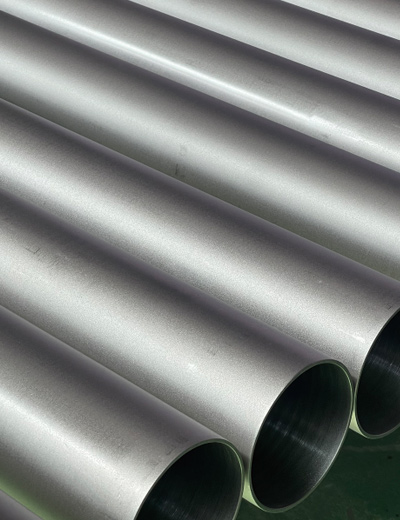
ASTM B423 Incoloy 825 (UNS N08825) Seamless Pipe & Tube Standard
ASTM B423 is the standard specification for nickel-iron-chromium-molybdenum-copper alloy (UNS N08825 and N08221) seamless pipe and tube. This material is known commercially as Incoloy 825. It is the preferred nickel alloy for wet corrosive environments where 316L stainless steel fails, but higher-nickel alloys like Inconel 625 or Hastelloy C-276 would be unnecessarily expensive.
The specification covers cold-worked and hot-finished seamless pipe and tube for general corrosive service. It defines the chemical composition for both UNS N08825 and the higher-molybdenum N08221 variant, mechanical properties in annealed and cold-worked conditions, dimensional tolerances, hydrostatic testing, and product marking. General requirements conform to ASTM B829.
Incoloy 825 pipe and tube under ASTM B423 is specified in sulfuric acid pickling plants, phosphoric acid evaporators, oil and gas sour wells, nuclear fuel reprocessing equipment, FGD scrubber systems, and seawater-cooled heat exchangers. This guide covers every section of B423, from the two alloys, their chemistry, the mechanical property differences between hot-finished and cold-worked conditions, tolerances, and testing requirements, so engineers and procurement teams can specify the correct Incoloy 825 product.
ASTM B423 PDF Free Download ASTM B423 PDF Free Download
What is ASTM B423?
ASTM B423 is the standard specification for nickel-iron-chromium-molybdenum-copper alloy (UNS N08825 and N08221) seamless pipe and tube. It falls under ASTM Committee B-2 on Nonferrous Metals and Alloys, Subcommittee B02.07 on Refined Nickel and Cobalt and Their Alloys.
The alloy consists of 38–46% Ni, 19.5–23.5% Cr, 2.5–3.5% Mo, 1.5–3.0% Cu, with iron as the balance (minimum 22%). It resists both oxidising acids (via chromium) and reducing acids (via molybdenum and copper).
Incoloy 825 stands apart from Incoloy 800-series alloys (ASTM B407) due to the addition of molybdenum and copper. Molybdenum provides pitting and crevice corrosion resistance in chloride environments. Copper adds resistance to reducing acids, particularly sulfuric acid and phosphoric acid, that 800/800H/800HT cannot handle.
The ASME equivalent is SB-423, listed in the ASME Boiler and Pressure Vessel Code, Section II, Part B. Material produced to ASTM B423 can carry the SB-423 designation for code-stamped pressure equipment in chemical plants, refineries, and nuclear facilities.
ASTM B423 vs ASTM B407
ASTM B423 and ASTM B407 are technical standards published by ASTM International that define the manufacturing requirements, chemical composition, mechanical properties, and industrial applications of nickel-iron-chromium alloy pipes and tubes. ASTM B407 applies to seamless pipes and tubes made from alloys UNS N08800, N08810, N08811, and N08120, commonly known as Incoloy 800, 800H, and 800HT, while ASTM B423 covers alloys UNS N08825 (Incoloy 825) and UNS N08221. The alloys specified under ASTM B407 belong to the “800 series”, which contain a relatively high iron content along with approximately 30–35% nickel and 19–23% chromium, providing strong resistance to oxidation and carburisation and maintaining structural stability at temperatures up to about 1500°F (816°C). The table below clarifies the differences.
| Parameter | Incoloy 825 (ASTM B423) | Incoloy 800H (ASTM B407) |
| Alloy System | Ni-Fe-Cr-Mo-Cu | Ni-Fe-Cr |
| Nickel, % | 38–46 | 30–35 |
| Molybdenum, % | 2.5–3.5 | None |
| Copper, % | 1.5–3.0 | 0.75 max |
| Primary Strength | Corrosion resistance (wet acids, chlorides) | Creep/rupture above 1100°F (593°C) |
| Max Service Temp (structural) | ≤1000°F (540°C) | 1800°F (982°C) |
| Sulfuric Acid Resistance | Good (all concentrations, moderate temps) | Poor |
| ASTM Spec | B423 | B407 |
Chemical Composition of ASTM B423
The table below presents the chemical composition requirements of ASTM B423. The composition is carefully controlled to ensure strong corrosion resistance and stable performance in demanding environments. It mainly includes nickel, chromium, and iron, along with controlled amounts of molybdenum, copper, titanium, and carbon, which help improve strength, durability, and oxidation resistance.
| GRADE | UNS Designation |
Standard | C | Mn | P | S | Si | Ni | Cr | Mo | Cu | Fe | Ti | Al | Co | Other |
| Incoloy 825 | N08825 | B423 | 0.05 | 1.00 | - | 0.030 | 0.50 | 38.0–46.0 | 19.5–23.5 | 2.5–3.5 | 1.5–3.0 | min 22.0 | 0.6–1.2 | 0.2 | - | - |
| Incoloy 825 Mod. | N08221 | B423 | 0.05 | 1.00 | - | 0.030 | 0.50 | 38.0–46.0 | 20.00-22.00 | 3.0–4.0 | 1.5–3.0 | min 22.0 | 0.6–1.0 | 0.2 | - | - |
Mechanical Properties of ASTM B423
The table below presents the mechanical properties of ASTM B423 for alloys UNS N08825 and UNS N08221 used in pipe and tube applications. These properties include minimum tensile strength ranging from 75–85 ksi (517–586 MPa), yield strength of 25–35 ksi (172–241 MPa), and elongation of 30%. These specified values ensure that ASTM B423 materials provide good strength, ductility, and reliable performance in demanding industrial environments.
| Grade | Condition & Size | Standard | Tensile Strength Min, MPa |
Yield Strength Min, MPa |
Elongation Min, % |
| N08825 | Hot-finished annealed | B423 | 517 | 172 | 30 |
| N08825 | Cold-worked annealed | B423 | 586 | 241 | 30 |
| N08221 | Cold-finished annealed | B423 | 545 | 234 | 30 |
ASTM B423 Tolerances
ASTM B423 tolerances specify the allowable variations in outside diameter, inside diameter, and wall thickness for seamless nickel-iron-chromium alloy tubing across defined OD size ranges, as outlined in the table below.
| STANDARD | OD(D) | TOLERANCE(MM) | THICKNESS(S) | TOLERANCE | LENGTH | TOLERANCE |
| MM | COMMON HIGH | MM | MM | MM | ||
| B423 (Cold-Drawn Tube) |
D<12.7 | +0.13/0 | ave. ±12.5% | min: +25.0%/0 | Cut-to-length ≤9.1m |
+3.2/0 |
| 12.7≤D≤15.9 | ±0.13 | |||||
| 15.9<D≤38.1 | ±0.13 | ave. ±10.0% | min: +20.0%/0 | |||
| 38.1<D≤76.2 | ±0.25 | ave. ±12.5% | min: +22.0%/0 | |||
| D<12.7 | ±0.13 | ave. ±12.5% | min: +25.0%/0 | Cut-to-length >9.1m |
+6.4/0 | |
| 12.7≤D≤15.9 | ±0.15 | |||||
| 15.9<D≤38.1 | ±0.19 | ave. ±10.0% | min: +20.0%/0 | |||
| 38.1<D≤50.8 | ±0.25 | ave. ±12.5% | min: +22.0%/0 | |||
| 50.8<D≤76.2 | ±0.38 | |||||
| B423 (Hot-Finished Tube) |
19≤D≤38 | +0.4/-0.8 | for nominal wall: ±12.5% | for min wall: +28.5%/0 | OD<50.8: +3.2/-0 OD≥50.8: +4.8/-0 Details refer to B829 |
- |
| 38.1<D≤102 | ±0.8 | |||||
| 102<D≤235 | +1.6/-0.8 | |||||
| B423 (Hot-Worked Pipe) |
25≤D≤48 | ±0.38 | for nominal wall: +16%/-12.5% |
for min wall: +28.5%/0 | - | - |
If you want to know more product details, please contact us!
ASTM B423 Alloy Grades
ASTM B423 covers two UNS designations: N08825 (Incoloy 825) and N08221. N08221 carries significantly higher molybdenum at 5.0–6.5%, compared to 2.5–3.5% in standard 825, providing meaningfully enhanced resistance to pitting and reducing acids. Incoloy 825 seamless pipe is a nickel-iron-chromium alloy
UNS N08825
UNS N08825 is a nickel-iron-chromium alloy with Mo and Cu additions for strong resistance to mixed acids and chloride environments. Nickel prevents chloride stress corrosion cracking, while chromium, molybdenum, and copper improve resistance to oxidising and reducing acids. Titanium stabilisation protects against intergranular corrosion, allowing reliable performance in welded and high-temperature service.
More About UNS N08825 MaterialUNS N08221
N08221 is a higher-molybdenum variant of 825 with lower carbon for enhanced corrosion resistance. It offers superior pitting, crevice corrosion, and boiling sulfuric acid resistance in aggressive chloride environments. It is specified for severely corrosive acid service where standard 825 approaches its performance limits.
Available Conditions and Finishes
ASTM B423 Appendix X2 describes the standard conditions and surface finishes for Incoloy 825 pipe and tube. The choice depends on whether the application requires a bright finish (ground OD, annealed in a protective atmosphere) or a matte finish (pickled after air annealing).
| Condition | Process | Finish / Size Range |
| Cold-worked, Annealed, Ground OD | Cold-drawn, annealed, OD ground | Bright OD; ID bright if protective atm; 1/2–4 in. (12.7–102 mm) OD |
| Cold-worked, Annealed, Pickled | Cold-drawn, annealed in air, acid pickled | Dull matte; 1/2–6-5/8 in. (12.7–168 mm) OD |
| Hot-worked, Annealed (Not Pickled) | Hot finished, annealed | Oxide surface from hot working, for machined parts |
| Hot-worked, Annealed (Pickled) | Hot finished, annealed, acid pickled | Clean surface; spot ground for minor imperfections |
| Hot-worked, Machined OD & ID | Hot finished, annealed, machined | Machined to specified dimensions |
Testing and Inspection Requirements
ASTM B423 requires chemical analysis, tension testing, and hydrostatic testing on every lot. These requirements are governed by the general specifications of ASTM B829 for nickel and nickel alloy seamless pipe and tube.
Chemical Analysis
One test per lot (one heat). Product (check) analysis, if requested by the purchaser, must conform to the composition limits with the check analysis tolerances from ASTM B829.
Tension Test
One tension test per lot. A lot is all material from the same heat, same nominal size (excluding length), and same condition. Full tubular specimens are preferred. Longitudinal strip or round specimens are used when full tubular testing is not possible.
Hydrostatic Test
Each pipe or tube is hydrostatically tested at a pressure calculated per P = 2St/D, not to exceed 1,000 psi (6.9 MPa). The fibre stress (S) values are:
The manufacturer and purchaser may agree to test at 1.5 times the calculated pressure. Any pipe or tube showing leaks during testing is rejected. Hot-forming quality material is exempt from mechanical and hydrostatic requirements.
Frequently Asked Questions
-
Difference Between ASTM B423 and ASTM B163 for Incoloy 825?
-
How Does Incoloy 825 Compare to 316L Stainless Steel?Incoloy 825 contains 42% Ni vs 10% in 316L, giving it immunity to chloride SCC at all temperatures. 825 also has significantly better resistance to sulfuric acid, phosphoric acid, and pitting in hot chloride solutions. However, 316L costs roughly 50–60% less and is adequate for mild chloride environments below 140°F (60°C). The upgrade to 825 is justified when chloride SCC, hot acid corrosion, or pitting in chloride-containing acids is a concern.
-
Can Incoloy 825 Handle Hydrochloric Acid?Incoloy 825 provides moderate HCl resistance, up to about 1–2% HCl at room temperature and dilute HCl at temperatures up to 150°F (65°C). For concentrated HCl or hot HCl service, Incoloy 825 is not recommended.
-
What is the Maximum Service Temperature for Incoloy 825?For corrosion-critical applications, Incoloy 825 is typically limited to about 1000°F (540°C). Above this temperature, the alloy loses its corrosion advantage and cannot match the creep strength of Incoloy 800H/800HT (ASTM B407).
-
Is ASTM B423 the Same as ASME SB-423?ASME SB-423 is the identical specification adopted into ASME Boiler and Pressure Vessel Code, Section II, Part B (Nonferrous Materials). Material produced to ASTM B423 can carry the SB-423 designation when all ASME requirements are met. This is mandatory for code-stamped pressure vessels, heat exchangers, and piping systems in chemical plants and refineries.
-
What Welding Filler Metal Is Used for Incoloy 825?The matching filler metal is ERNiFeCr-1 (AWS A5.14) for GTAW and GMAW. For dissimilar joints to carbon steel, ERNiCrMo-3 (Inconel 625 filler) is commonly used. Preheating is not required. Interpass temperature should be maintained below 300°F (150°C). Post-weld heat treatment (PWHT) is generally not needed because the titanium stabilisation prevents sensitisation in the HAZ. For nuclear or critical corrosion service, a solution anneal at 1700–1800°F (925–980°C) may be specified.
-
Can Incoloy 825 Resist Stress Corrosion Cracking?Yes. The 42% nickel content makes Incoloy 825 essentially immune to chloride SCC at all temperatures and concentrations, a critical advantage over 300-series stainless steels. Alloys with less than 25–30% nickel are susceptible to chloride SCC. Incoloy 825 exceeds this threshold with a wide safety margin. It is also resistant to sulfide stress cracking (SSC) in H₂S environments per NACE MR0175/ISO 15156.