
Quality Control Process at Xintongda Special Steel
We know how important quality is for pipeline and tubing projects.
At Xintongda, quality is the standard by which every decision is measured. We manufacture stainless, duplex, and nickel-alloy seamless pipes and tubes that meet or exceed the international specifications our customers work to, and we treat consistency from one order to the next as the real test of our work.
Quality Management: Our Four-Step Process
Zhejiang Xintongda Special Steel Manufacturing Co., Ltd has invested more than 300 million RMB in production and inspection equipment since 2018, building a manufacturing line that meets the international standards our customers need. Our quality management system is structured into four steps: material control, production control, inspection, and certification. The sections below walk through what we do at each step.

Equipment
Our facility is built around two hot extrusion presses, four cold-pilger rolling mills, a bright annealing furnace with hydrogen atmosphere control, and a full pickling and passivation line. Every stage of production happens inside the same plant, on equipment we own and maintain. This integration is what allows us to keep tight control over chemistry, dimensions, and surface finish from one heat to the next, without depending on outside subcontractors.
Incoming Material Control
Raw Material Verification
Quality begins at the melt. Management ensures that the stainless steel billets used have the correct chemical composition.
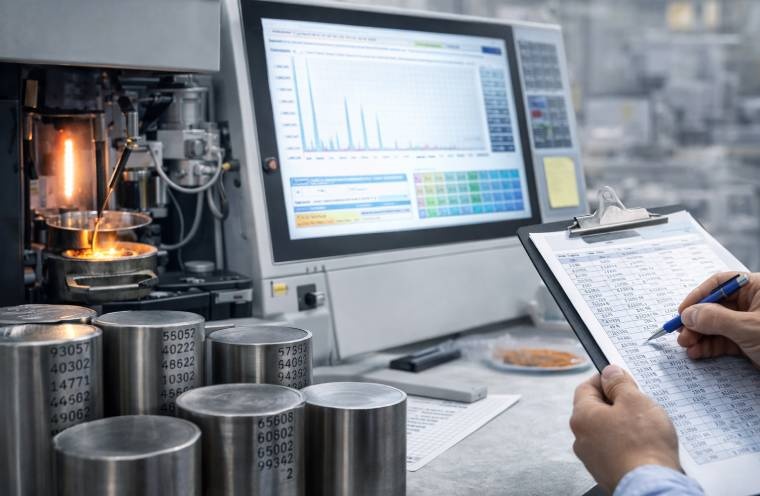
- Spectrographic Analysis Each heat is sampled on arrival and analysed by optical emission spectroscopy, with the levels of chromium, nickel, molybdenum, carbon, nitrogen and trace elements verified against the grade specification. Heats that fall outside the specification are rejected.
- Traceability Every billet is assigned a unique heat number to track its origin throughout the manufacturing lifecycle. Zhejiang Xintongda only cooperates with trustable suppliers that can make sure per pcs material can be tracked.

Production Control
- Heating Temperatures Ensuring the billet is at the optimal plasticity to prevent internal tearing during piercing.
- Dimensional Accuracy Real-time monitoring of wall thickness and outer diameter using laser measurement systems.
- Annealing & Pickling & Grinding Managing the heat treatment cycles to restore the crystalline structure of the steel and removing surface scales to ensure corrosion resistance.
Testing and Inspection Protocols
This is the most critical phase, where non-destructive and destructive tests confirm the integrity of the tube.
-
Non-Destructive Testing
Eddy Current Testing: To detect surface and sub-surface flaws.
- Ultrasonic Testing: To check for internal voids or wall thickness inconsistencies.
- Hydrostatic Testing: Pressurizing the pipe with water to ensure it won't leak or burst under service conditions.
- Destructive Testing Flattening, Flaring, and Tensile tests performed on sample "coupons" to verify ductility and strength.

Our Testing Methods
Our testing methods cover every property that determines pipe and tube performance, from chemical composition through mechanical strength to dimensional accuracy and surface condition.
Have a project to quote? Reach us by email, WhatsApp, or fill out our contact form. Include the grade, OD, wall thickness, length, and quantity, and we will get back with pricing and lead time within 24 hours.
Request a quote Request a quote