
Yes, in many cases. ASME code assigns equal allowable stress to A249 welded and A213 seamless tubes when the weld is properly inspected. The choice depends on the design code, purchaser preferences, and severity of service. For ASME Section VIII heat exchangers, A249 welded tubes are fully code-compliant. Some purchasers specify seamless (A213) for sour service (NACE MR0175) or severe cyclic duty.

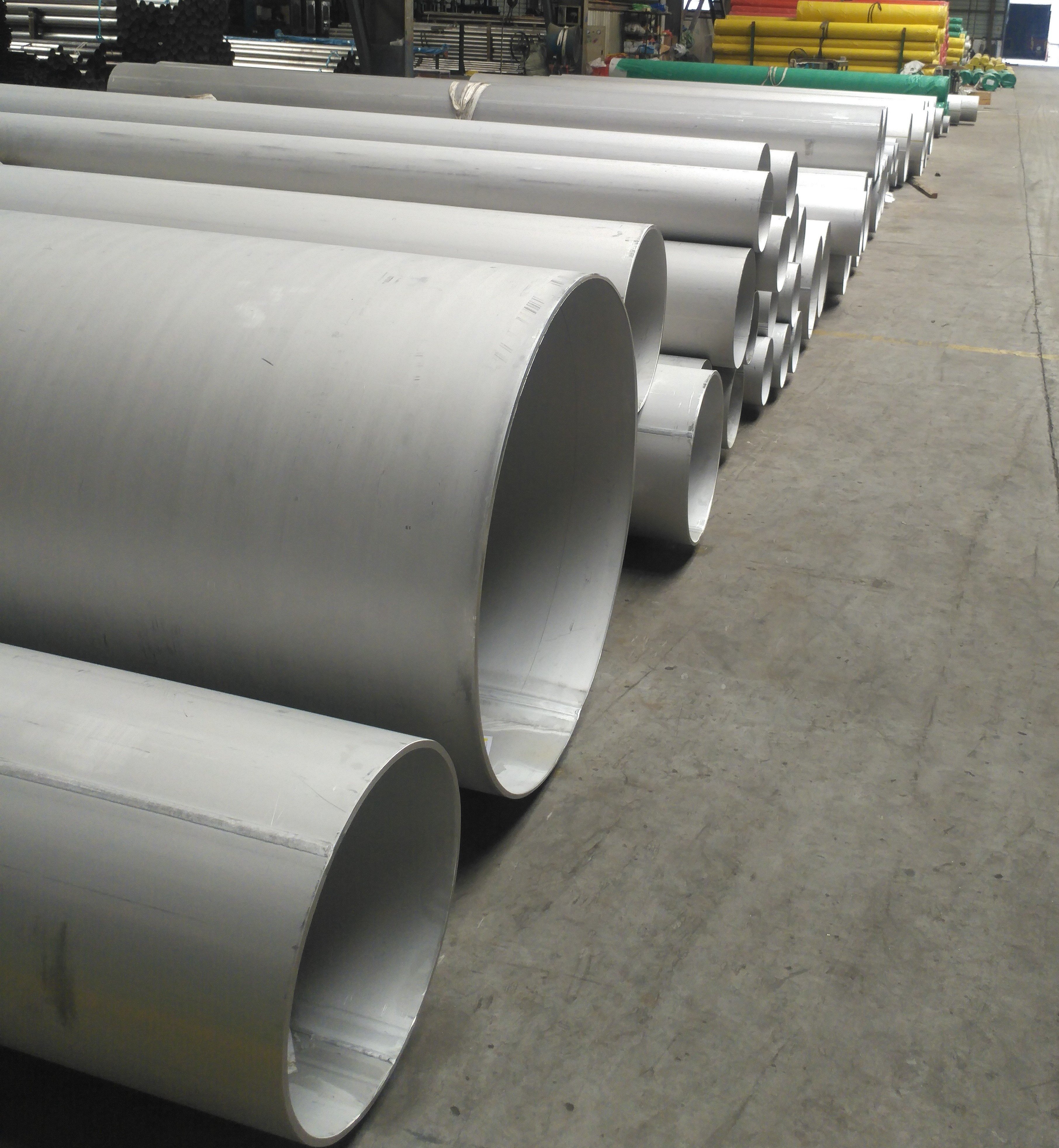
ASTM A249 Welded Stainless Steel Tube Standard
ASTM A249 is the standard specification for welded austenitic stainless steel boiler, superheater, heat exchanger, and condenser tubes. ASTM A213 covers seamless tubes for heat transfer service, and ASTM A269 handles general-service tubing. A249 fills the critical gap for welded tubes in boiler and heat exchanger applications where cost-effective manufacturing is combined with code-grade quality requirements.
The specification covers welded (WLD) and heavily cold-worked (HCW) tubes from 1/8 in. (3.2 mm) ID up to 12 in. (304.8 mm) OD, with wall thicknesses from 0.015 to 0.320 in. (0.4 to 8.1 mm). It includes standard 300-series grades (TP304, TP316L, TP321, TP347), their high-carbon H-grade variants for creep service, and super-austenitic alloys with up to 6% molybdenum.
ASTM A249 welded stainless steel tubes are specified for shell-and-tube heat exchangers, surface condensers, feedwater heaters, boiler economisers, and superheater elements across power generation, petrochemical, chemical processing, and desalination industries. This guide covers grades, chemical composition, mechanical properties, hardness limits, dimensional tolerances, heat treatment, testing protocols, and FAQs, giving engineers the data to specify the right welded tube for heat transfer service.
ASTM A249 PDF Free Download ASTM A249 PDF Free Download
What Is ASTM A249?
ASTM A249/A249M is the Standard Specification for Welded Austenitic Steel Boiler, Superheater, Heat-Exchanger, and Condenser Tubes. It falls under ASTM Committee A-1 on Steel, Stainless Steel, and Related Alloys, Subcommittee A01.10 on Stainless and Alloy Steel Tubular Products. The current edition is A249/A249M–24a. This standard has been approved for use by agencies of the U.S. Department of Defence.
The specification covers stainless steel tubes made by automatic welding without filler metal addition, followed by cold working (drawing) and solution annealing. Heavily cold-worked (HCW) tubes require a minimum 15% reduction in cross-sectional area prior to the final anneal, plus 100% radiographic inspection of the weld before cold working.
General requirements conform to ASTM A1016/A1016M. The ASME equivalent is SA-249, listed in ASME Boiler and Pressure Vessel Code, Section II. Grades TP304, TP304L, and TP347 are accepted by ASME Section VIII Division 1 for service temperatures as low as -425°F (-254°C) without impact testing.
ASTM A249 vs A213 vs A269: Which Specification to Use?
Three ASTM specifications cover austenitic stainless steel tubing for different service categories. Selecting the wrong specification leads to code non-compliance or unnecessary cost. The table below draws the line between all three.
| Parameter | ASTM A249 | ASTM A213 | ASTM A269 |
| Product | Welded tube (OD × wall) | Seamless tube (OD × wall) | Seamless & welded tube |
| Manufacturing | Welded + cold drawn | Seamless only | Seamless or welded |
| Primary Service | Boiler, heat exchanger, condenser | Boiler, superheater, heat exchanger | General service |
| Filler Metal | No addition permitted | Not applicable | No addition (welded) |
| Mechanical Tests | Tension, flattening, flange, reverse-bend | Flaring, flattening, and hardness | Flaring, flange, and hardness |
| Hardness Required? | Yes (Rockwell/Vickers) | Yes (Brinell/Rockwell) | Yes (Brinell/Rockwell) |
| Hydrostatic/NDE | Either (purchaser option) | Required | Either (producer option) |
| HCW Option? | Yes (35% min cold work) | No | No |
| ASME Code | Section I, Section VIII | Section I, Section VIII | Section VIII Div 1 |
The practical rule: if the application is a boiler, superheater, or heat exchanger and welded tubes are acceptable, specify A249. If the same application requires seamless tubes, specify A213. For general-service tubing (instrumentation, pharma, food), specify A269.
Chemical Composition of ASTM A249
Chemical composition is defined in Table 1 of the A249 specification. The chemistry mirrors A213 and A312 for equivalent grades; the key difference is that A249 is exclusively a welded-tube specification, so low-carbon L-grades are proportionally more common in procurement. The table below covers the most commonly ordered grades.
| Element | TP304 | TP304L | TP316 | TP316L | TP321 | TP347 |
| Carbon, max | 0.08 | 0.030 | 0.08 | 0.030 | 0.08 | 0.08 |
| Manganese, max | 2.00 | 2.00 | 2.00 | 2.00 | 2.00 | 2.00 |
| Phosphorus, max | 0.045 | 0.045 | 0.045 | 0.045 | 0.045 | 0.045 |
| Sulfur, max | 0.030 | 0.030 | 0.030 | 0.030 | 0.030 | 0.030 |
| Silicon, max | 1.00 | 1.00 | 1.00 | 1.00 | 1.00 | 1.00 |
| Chromium | 18.0–20.0 | 18.0–20.0 | 16.0–18.0 | 16.0–18.0 | 17.0–19.0 | 17.0–19.0 |
| Nickel | 8.0–11.0 | 8.0–12.0 | 10.0–14.0 | 10.0–14.0 | 9.0–12.0 | 9.0–12.0 |
| Molybdenum | — | — | 2.0–3.0 | 2.0–3.0 | — | — |
| Titanium | — | — | — | — | 5×C min | — |
| Niobium (Cb) | — | — | — | — | — | 10×C min |
| Iron | Bal | Bal | Bal | Bal | Bal | Bal |
Note:One analysis per heat from one length of flat-rolled stock or one tube. Product analysis tolerances follow A480/A480M, Table A1.1. For small diameter or thin walls (OD < 0.500 in. / 12.7 mm), a carbon maximum of 0.040% is necessary in TP304L and TP316L.
Mechanical Properties of ASTM A249
Tensile, yield, elongation, and hardness requirements are defined in Table 3 of A249. Standard welded grades share the same 75 ksi (515 MPa) tensile and 30 ksi (205 MPa) yield as their A213 seamless counterparts. L-grades drop to 70 ksi (485 MPa) / 25 ksi (170 MPa) due to lower carbon. Hardness limits are specified as Rockwell and Vickers maximums—a key distinction from A269, which uses Brinell/Rockwell.
| Grade | UNS | Tensile Min, ksi (MPa) | Yield Min, ksi (MPa) | Elong., % | Rockwell Max | Vickers Max |
| TP304 | S30400 | 75 (515) | 30 (205) | 35 | B90 | 200 |
| TP304L | S30403 | 70 (485) | 25 (170) | 35 | B90 | 200 |
| TP304H | S30409 | 75 (515) | 30 (205) | 35 | B90 | 200 |
| TP304N | S30451 | 80 (550) | 35 (240) | 35 | B90 | 200 |
| TP309S | S30908 | 75 (515) | 30 (205) | 35 | B90 | 200 |
| TP310S | S31008 | 75 (515) | 30 (205) | 35 | B90 | 200 |
| TP316 | S31600 | 75 (515) | 30 (205) | 35 | B90 | 200 |
| TP316L | S31603 | 70 (485) | 25 (170) | 35 | B90 | 200 |
| TP316H | S31609 | 75 (515) | 30 (205) | 35 | B90 | 200 |
| TP321 | S32100 | 75 (515) | 30 (205) | 35 | B90 | 200 |
| TP321H | S32109 | 75 (515) | 30 (205) | 35 | B90 | 200 |
| TP347 | S34700 | 75 (515) | 30 (205) | 35 | B90 | 200 |
| TP347H | S34709 | 75 (515) | 30 (205) | 35 | B90 | 200 |
| TP348 | S34800 | 75 (515) | 30 (205) | 35 | B90 | 200 |
| S31254 (t#0.187 in. [5.00mm]) | — | ≥98 ksi / 675 MPa | ≥45 ksi / 310 MPa | ≥35% | B100 | 270 |
| N08367 | — | 100 (690) | 45 (310) | 30 | B100 | 270 |
| 800 | N08800 | 75 (515) | 30 (205) | 30 | B90 | 200 |
Note: Elongation is measured in 2 in. (50 mm) gauge length. Not applicable to tubes less than 1/8 in. (3.2 mm) ID or 0.015 in. (0.4 mm) wall—mechanical properties for such small tubes are agreed between purchaser and manufacturer. For tubing less than 0.354 in. (9 mm) ID or less than 0.065 in. (1.65 mm) wall, Vickers hardness may substitute for Rockwell.
ASTM A249 Tolerances
Dimensional tolerances for A249 welded tubes are governed by ASTM A1016/A1016M. Wall thickness tolerances are tighter than pipe specifications because heat exchanger tubes must fit precisely into the tubesheet holes.
| Feature | Tolerance Requirement | Key Technical Note |
| Wall Thickness | ± 10% of nominal wall | Standard for all A249 tube sizes. |
| Weld Reinforcement | Max +6% or 0.004 in (0.1 mm) | Measured 90° from the weld; whichever is greater. |
| Outside Diameter (OD) | ± 0.005 to ± 0.010 in | For sizes up to 3 1/2 in (88.9 mm). Identical to A213. |
| Straightness | 0.030 in (0.8 mm) max deviation | Measured per 3 ft (900 mm) of length. |
| Ends | Smooth and burr-free | Necessary for proper seating in tubesheets. |
Lot Sizing for Testing
The number of tubes per heat-treatment lot depends on tube size and manufacturing method.
| Size of Tube | Size of Lot |
| 2 in. (50.8 mm) and over in OD and 0.200 in. (5.1 mm) and over in wall | Not more than 50 tubes |
| Less than 2 in. but over 1 in. in OD (25.4 mm) | Not more than 75 tubes |
| 1 in. (25.4 mm) or less in OD, 0.200 in. (5.1 mm) in wall | Not more than 125 tubes |
If you want to know more product details, please contact us!
ASTM A249 Welded Tube Grades
ASTM A249 covers the same austenitic grade families as A213 and A312 standard 300-series, Mo-bearing, stabilised, H-grades, and super-austenitic alloys. The H-grades (TP304H, TP309H, TP310H, TP316H, TP321H, TP347H, TP348H) are specifically intended for high-temperature superheater and reheater service. The table below summarises the primary grades.
| Grade | UNS | Key Feature | Typical Service |
| TP304 | S30400 | 18Cr–10Ni, general purpose | Heat exchangers, condensers |
| TP304L | S30403 | Low C (0.035% max), weldable | Welded HX, no sensitisation risk |
| TP304H | S30409 | Higher C (0.04–0.10%), creep | Superheaters, reheaters |
| TP309S | S30908 | 23Cr–13Ni, oxidation resist. | High-temp HX, furnace parts |
| TP310S | S31008 | 25Cr–20Ni, highest oxidation | Radiant tubes, kilns |
| TP316 | S31600 | 2–3% Mo, pitting resistance | Chemical HX, chloride service |
| TP316L | S31603 | Low C + Mo | Pharma HX, welded service |
| TP316H | S31609 | Higher C + Mo, creep | Refinery superheaters |
| TP321 | S32100 | Ti-stabilised | High-temp HX, 800–1500°F |
| TP321H | S32109 | Ti + higher C, creep | Refinery reheaters |
| TP347 | S34700 | Nb-stabilised | Power plant superheaters |
| TP347H | S34709 | Nb + higher C, creep | Fossil plant reheaters |
| TP348 | S34800 | Nb-stabilised, nuclear | Nuclear boiler tubes |
| S31254 | — | 6Mo super-austenitic | Seawater condensers |
| N08367 | — | 6Mo AL-6XN | Aggressive chloride HX |
TP304 & TP304L
TP304 stainless steel tube is the most widely specified A249 grade for general-service heat exchangers and condensers. TP304 contains 18–20% Cr and 8–11% Ni with 0.08% max carbon, providing reliable corrosion resistance in freshwater, steam and mild chemical environments.
TP304L stainless steel tube drops carbon to 0.035% maximum to prevent sensitisation during welding and heat treatment. Since A249 tubes are welded products, TP304L is the preferred variant, it avoids Cr₂₃C₆ precipitation in the weld zone and HAZ without requiring a separate stabilisation anneal.
TP304H
TP304H raises carbon to 0.04–0.10% for improved creep and stress-rupture strength above 1000°F (538°C). The higher carbon forms carbides that strengthen grain boundaries under sustained load at elevated temperatures. TP304H welded tubes are specified for fossil-fuel power plant superheater elements where decades of continuous high-temperature service under internal pressure is the design condition.
TP309S & TP310S
309 stainless steel tube raises chromium to 22–24% and nickel to 12–15%, pushing the oxidation resistance ceiling to approximately 2000°F (1093°C). TP309S welded tubes are used in furnace recuperators, waste heat boilers, and high-temperature gas-to-gas heat exchangers.
310 stainless steel tube has the highest Cr-Ni content in the standard 300-series: 24–26% Cr and 19–22% Ni. This delivers offers higher oxidation resistance in the A249 family—continuous service to 2100°F (1150°C). TP310S welded tubes are specified for radiant-section heat exchangers, thermal oxidiser recuperators, and catalytic converter heat recovery units.
TP316 & TP316L
316 stainless steel tube adds 2.0–3.0% molybdenum to the base chemistry for significantly better pitting and crevice corrosion resistance in chloride-bearing environments. TP316 welded tubes are the standard material for chemical plant heat exchangers, seawater-cooled condensers in coastal facilities, and any heat exchanger handling halide-containing process fluids.
316L stainless steel tube is the most specified A249 grade in the chemical and pharmaceutical sectors. The combination of molybdenum for chloride resistance and low carbon (0.035% max) for weld-zone integrity makes TP316L a common choice for welded heat exchanger bundles in corrosive service.
TP321 & TP321H
321 stainless steel tube is stabilised with titanium (Ti ≥ 5×C) to prevent intergranular corrosion in the 800–1500°F (427–816°C) sensitisation range. TP321 welded tubes are standard for refinery heat exchangers, crude oil preheaters, and catalytic reformer service, where tubes cycle through the sensitisation temperature range.
321H stainless steel tube raises carbon to 0.04–0.10% for creep strength while maintaining titanium stabilisation. It is specified for refinery superheater elements and petrochemical cracker tubes where both sensitisation resistance and long-term creep life are required above 1000°F (538°C).
TP347 & TP347H
347 stainless steel tube uses niobium (Nb ≥ 10×C) instead of titanium for stabilisation. Niobium carbides (NbC) are more thermally stable than titanium carbides (TiC), giving TP347 better weldability and higher creep strength than TP321 at temperatures above 1000°F (538°C).
347H stainless steel tube combines niobium stabilisation with higher carbon (0.04–0.10%) for maximum stress-rupture strength. TP347H is the primary grade for power plant superheater and reheater tube bundles designed for 40+ year service life at 1050–1100°F (565–593°C).
Heat Treatment Requirements for ASTM A249
All ASTM A249 tubes are furnished in the heat-treated condition per Table 2 of the specification. The standard solution anneal is 1900°F (1040°C) minimum, followed by quenching in water or rapid cooling. Several speciality grades require higher annealing temperatures.
| Grade(s) | Anneal Temp, °F (°C) | Cooling | Notes |
| TP304, 304L, 316, 316L, 321, 347, 348 and most standard grades | 1900 (1040) | Water quench or rapid cool | Standard anneal |
| TP304H, TP316H | 1900 (1040) | Water quench or rapid cool | Same as standard |
| TP309HCb | 1900 (1040) | Water quench or rapid cool | Cr-Ni-Cb grade |
| TP310H, TP310Cb, TP310HCb | 1900 (1040) | Water quench or rapid cool | High Cr-Ni |
| TP321H | 1900 (1040) / 2000 (1100) | Water quench or rapid cool | Standard or high temp |
| TP347H | 1900 (1040) / 2000 (1100) | Water quench or rapid cool | Standard or high temp |
| S31254 (6Mo) | 2100 (1150) | Water quench or rapid cool | Full Mo dissolution |
| S32654 (654 SMO) | 2100 (1150) | Water quench or rapid cool | Super-austenitic |
| N08367 (AL-6XN) | 2025 (1110) | Water quench | Rapid quench critical |
| Alloy 20 (N08020) | 1700–1850 (925–1010) | Water quench or rapid cool | Stabilisation treatment |
| 800 (N08800) | 1900 (1040) | Water quench or rapid cool | Ni-Fe-Cr alloy |
| 800H (N08810) | 2050 (1120) | Water quench or rapid cool | Higher annealing for creep |
A solution annealing temperature above 1950°F (1065°C) may impair intergranular corrosion resistance in stabilised grades (TP309HCb, TP310HCb, TP321, TP321H, TP347, TP347H, TP348, TP348H) after subsequent exposure to sensitising conditions. When specified by the purchaser, a lower-temperature stabilisation anneal shall follow the initial high-temperature solution anneal (Supplementary Requirement S4).
Testing and Inspection Requirements
ASTM A249 has the rigorous testing protocol of the three austenitic tubing specifications (A249, A213, A269) because welded tubes must demonstrate weld integrity under the severe conditions of boiler and heat exchanger service. Tests include tensile, hardness, reverse-bend, flattening, flange, and hydrostatic or NDE.
Tensile Test
One longitudinal tension test per lot for lots up to 50 tubes; two tests for lots over 50 tubes. Tensile, yield, and elongation must meet Table 3 values.
Hardness Test
Hardness is specified in Rockwell or Vickers scales on specimens from two tubes per lot. Maximum hardness for standard 300-series grades is B90 Rockwell / 200 Vickers. For tubes less than 0.354 in. (9 mm) ID or less than 0.065 in. (1.65 mm) wall, Vickers testing may substitute for Rockwell.
Reverse-Bend Test
A 4 in. (100 mm) section is split longitudinally 90° from each side of the weld, opened, and bent around a mandrel. The mandrel thickness is 4× the wall thickness. The weld must face the mandrel. No cracks or overlaps from weld-zone thinning are permitted. This is the signature test for A249; it verifies that the weld zone has adequate ductility under severe bending, simulating the expansion and contraction cycles a heat exchanger tube faces in service.
Flattening and Flange Tests
One flattening test from each end of one finished tube per lot. One flange test from the opposite end. These tests verify ductility in both the weld zone and base metal. For the flattening test, the weld is positioned at 90° to the applied load.
Hydrostatic or Non-Destructive Electric Test
Each tube is tested by either hydrostatic pressure or NDE (eddy current). The buyer may specify which test. For HCW tubes, the weld is 100% radiographically inspected before cold working per ASME Section VIII Division 1, Paragraph UW 51.
Key Applications of ASTM A249 Welded Tubes
A249 welded tubes are specified wherever heat transfer service requires austenitic stainless steel and welded manufacturing provides a cost or availability advantage over seamless (A213) tubes.
Shell-and-Tube Heat Exchangers
TP304L and TP316L welded tubes are the standard materials for shell-and-tube heat exchanger bundles in chemical plants, refineries, and pharmaceutical facilities. Welded A249 tubes are less expensive than seamless A213 tubes for the same size and grade, making them the default choice when ASME code allows welded construction.
Surface Condensers and Feedwater Heaters
TP316L and super-austenitic (S31254, N08367) welded tubes handle the chloride exposure in seawater-cooled surface condensers at coastal power plants. The 6Mo grades provide PREN values above 40, resisting pitting and crevice corrosion under the concentrated chloride conditions found beneath deposits on condenser tube surfaces.
Boiler Economisers and Superheaters
TP304H, TP321H, and TP347H welded tubes are specified for boiler economiser sections and superheater elements in fossil-fuel power plants. The H-grades provide creep strength for a 40+ year design life at elevated steam temperatures. HCW (heavily cold-worked) tubes are specified when full radiographic weld inspection combined with superior mechanical properties is required.
Desalination and Water Treatment
TP316L and S31254 (6Mo) welded tubes serve in multi-stage flash (MSF) and multi-effect distillation (MED) desalination plants. The combination of chloride resistance (Mo content), weldability (low C), and cost-effective welded manufacturing makes A249 the standard specification for desalination heat exchangers worldwide.
Physical Properties
Key physical property values for the primary ASTM A249 austenitic stainless steel grades at room temperature.
| Property | TP304/304L | TP316/316L | TP321 | TP347 |
| Density, lb/in³ (g/cm³) | 0.290 (8.03) | 0.290 (8.03) | 0.286 (7.92) | 0.288 (7.97) |
| Melting Range, °F (°C) | 2550–2650 (1400–1455) | 2500–2600 (1371–1427) | 2550–2600 (1400–1427) | 2550–2600 (1400–1427) |
| Modulus, 10&sup6; psi (GPa) | 28.0 (193) | 28.0 (193) | 28.0 (193) | 28.0 (193) |
| Thermal Cond., BTU/ft·h·°F (W/m·K) | 9.4 (16.2) | 9.4 (16.2) | 9.3 (16.1) | 9.3 (16.1) |
| Mean CTE (70–1200°F), 10&sup-6;/°F (/°C) | 9.6 (17.3) | 9.0 (16.2) | 9.2 (16.6) | 9.3 (16.7) |
| Specific Heat, BTU/lb·°F (J/kg·K) | 0.12 (500) | 0.12 (500) | 0.12 (500) | 0.12 (500) |
| Magnetic Properties | Non-magnetic | Non-magnetic | Non-magnetic | Non-magnetic |
Frequently Asked Questions
-
Can A249 Welded Tubes Replace A213 Seamless Tubes in Heat Exchangers?
-
What Is the Difference Between A249 WLD and HCW Tubes?WLD (welded) tubes are made by automatic welding, followed by cold drawing and annealing. HCW (heavily cold-worked) tubes receive a minimum 35% cross-sectional area reduction before the final anneal, plus 100% radiographic weld inspection before cold working. HCW tubes have superior mechanical properties and are specified for the most critical boiler and pressure vessel applications.
-
What Is the Reverse-Bend Test and Why Is It Important?The reverse-bend test splits a 4 in. (100 mm) tube section 90° from each side of the weld, opens it flat, and bends it around a mandrel with the weld facing the mandrel. No cracking is permitted. This is the most demanding weld-integrity test in the austenitic tube specifications. It verifies that the weld zone can withstand the severe plastic deformation that occurs during tube expansion into tubesheets and during thermal cycling in service.
-
Is A249 Suitable for Cryogenic Service?Yes. Grades TP304, TP304L, and TP347 are accepted by ASME Section VIII Division 1 for service temperatures as low as -425°F (-254°C) without impact testing. Other austenitic grades are generally accepted for service to -325°F (-198°C). A249 welded tubes in TP304L are commonly specified for LNG vaporiser tube bundles and cryogenic heat exchangers.
-
What Heat Treatment Is Required After Welding A249 Tubes Into a Tubesheet?A249 tubes are delivered fully solution-annealed. Tube-to-tubesheet welding in the field or fabrication shop does not normally require post-weld heat treatment (PWHT) for L-grade (TP304L, TP316L) tubes. For standard or H-grades, the applicable design code (ASME Section VIII, TEMA) determines whether PWHT is required based on tube thickness, service temperature, and corrosion environment.
-
What Is the Maximum Weld Reinforcement Allowed in A249?The weld thickness measured 90° from the weld must not exceed the specified wall thickness by more than 6% or 0.004 in. (0.1 mm), whichever is greater. This limit is tighter than general pipe welding standards because excessive weld reinforcement in heat exchanger tubes creates local stress concentrations, reduces heat transfer efficiency, and interferes with tube insertion through baffle plates.
-
How Does A249 Compare to A269 for Heat Exchanger Service?A249 is the proper specification for welded tubes in boiler and heat exchanger service. It includes reverse-bend testing, flattening, and flange tests specific to heat transfer applications. A269 is for general-service tubing and has less rigorous testing. Using A269 tubes in ASME-code heat exchangers may not satisfy the fabrication code requirements. Always specify A249 for code-stamped heat exchanger construction.
-
Does A249 Cover Duplex Stainless Steel Welded Tubes?No. ASTM A249 covers only austenitic grades. Welded duplex stainless steel tubes for heat exchanger service are covered by ASTM A789. Ferritic stainless steel welded tubes are covered by ASTM A688. Nickel alloy welded tubes are covered by ASTM B704.