
Yes, in many cases. ASME code assigns equal allowable stress to B704 welded and B163 seamless nickel alloy tubes when the weld is properly inspected. The choice depends on the design code, purchaser preferences, and service severity. For NACE MR0175/ISO 15156 sour service, some end users require seamless (B163) only.

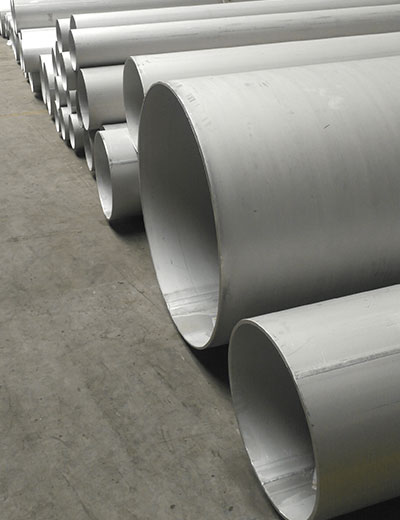
ASTM B704 Welded Nickel Alloy Tube Standard
ASTM B704 is the standard specification for welded nickel alloy boiler, heat exchanger, and condenser tubes. If ASTM B163 covers seamless nickel alloy tubes and ASTM A249 covers welded austenitic stainless steel tubes for the same service, B704 fills the gap for welded nickel alloy tubes where the corrosion environment exceeds the capability of stainless steel grades.
The specification covers five alloys: UNS N06625 (Inconel 625), UNS N08825 (Incoloy 825), UNS N06219, UNS N08642, and UNS N08827. Tube sizes range from 1/8 in. to 5 in. (3.18–127 mm) OD with wall thicknesses from 0.015 to 0.500 in. (0.38–12.70 mm). Dimensional requirements follow ASTM B751 (General Requirements for Nickel and Nickel Alloy Welded Tube).
ASTM B704 welded nickel alloy tubes are specified for chemical plant heat exchangers, FGD scrubber condensers, seawater-cooled surface condensers, sour gas service, sulfuric/phosphoric acid heat exchangers, and any heat transfer application where chloride pitting, crevice corrosion, or high-temperature acid attack makes stainless steel inadequate. This guide covers alloy grades, chemical composition, mechanical properties, NDE class requirements, testing, tolerances, and FAQs.
ASTM B704 PDF Free Download ASTM B704 PDF Free Download
What Is ASTM B704?
ASTM B704 is the Standard Specification for Welded Nickel Alloy Tubes for boiler, heat exchanger, and condenser service. It falls under ASTM Committee B02 on Nonferrous Metals and Alloys, Subcommittee B02.07 on Refined Nickel and Cobalt and Their Alloys. The current edition is B704–23, originally approved in 1982.
The specification covers nickel alloy tube made from flat-rolled alloy by an automatic welding process with no filler metal addition. After welding and before final annealing, tubes are cold-worked in either the weld metal only or both weld and base metal. Tubes are furnished with oxide removed; when bright annealing is used, descaling is not necessary.
General requirements conform to ASTM B751 (General Requirements for Nickel and Nickel Alloy Welded Tube). The ASME equivalent is SB-704 in ASME Boiler and Pressure Vessel Code, Section II, Part B.
Chemical Composition of ASTM B704
Chemical composition is defined in Table 1 of B704. One test per lot is required, as defined in ASTM B751. The table below lists the complete composition limits for all five alloys.
| Element | N06625 | N06219 | N08642 | N08825 | N08827 |
| Nickel | 58.0 min | Bal | 42.0–46.0 | 38.0–46.0 | 39.0–43.0 |
| Chromium | 20.0–23.0 | 18.0–22.0 | 21.0–23.0 | 19.5–23.5 | 21.0–23.0 |
| Iron | 5.0 max | 2.0–4.0 | Bal | 22.0 min | Bal |
| Molybdenum | 8.0–10.0 | 7.0–9.0 | 5.0–6.5 | 2.5–3.5 | 4.5–6.5 |
| Niobium (Nb) | 3.15–4.15 | — | 0.15 max | — | 0.15 max |
| Carbon, max | 0.10 | 0.05 | 0.030 | 0.05 | 0.015 |
| Manganese, max | 0.50 | 0.50 | 1.0 | 1.0 | 0.5–0.9 |
| Silicon | 0.50 max | 0.70–1.10 | 0.75 max | 0.50 max | 0.2–0.5 |
| Sulfur, max | 0.015 | 0.010 | 0.010 | 0.030 | 0.005 |
| Copper | — | — | 0.50 max | 1.5–3.0 | 0.5–2.0 |
| Titanium | 0.40 max | 0.50 max | — | 0.6–1.2 | — |
| Aluminum | 0.40 max | 0.50 max | 0.2 max | 0.2 max | 0.06–0.25 |
| Cobalt | 1.0 max | 1.0 max | 1.0–3.0 | — | 0.5 max |
Note: Product analysis tolerances follow ASTM B751. Where "Bal" (balance) appears, the element may be determined arithmetically by difference. The terms Niobium (Nb) and Columbium (Cb) are alternate names for the same element.
Mechanical Properties of ASTM B704
Mechanical properties are defined in Table 2 of B704. One tension test per lot is required, as defined in B751. Yield strength is determined by the 0.2% offset method per ASTM E8/E8M.
| Alloy | Grade / Condition | Tensile Min, ksi (MPa) | Yield Min, ksi (MPa) | Elong. Min, % |
| N06625 | Grade 1 (annealed) | 120 (827) | 60 (414) | 30 |
| N06625 | Grade 2 (solution annealed) | 100 (690) | 40 (276) | 30 |
| N06219 | — | 96 (660) | 39 (270) | 30 |
| N08642 | — | 85 (586) | 35 (241) | 30 |
| N08825 | — | 85 (586) | 35 (241) | 30 |
| N08827 | — | 85 (586) | 35 (241) | 30 |
N06625 Grade 1 (annealed) has the highest tensile strength in the specification at 120 ksi (827 MPa). This is roughly 60% higher than the N08xxx alloys. This strength comes from Nb-rich γ″ (gamma double-prime) precipitation during the annealing cycle. Grade 2 (solution annealed at 2000°F / 1093°C) dissolves these precipitates, trading strength for maximum corrosion resistance.
ASTM B704 Tolerances
Dimensional tolerances for B704 welded tubes are governed by ASTM B751 (General Requirements for Nickel and Nickel Alloy Welded Tube). B704 covers tubes from 1/8 in. to 5 in. (3.18–127 mm) OD and 0.015 to 0.500 in. (0.38–12.70 mm) wall.
Wall Thickness Tolerance
| Type | Tolerance |
| Average wall | +15% / −0 |
| Specified minimum wall | +15% / −0 |
| Weld zone | Shall not exceed specified wall by more than the amount permitted for base metal |
Outside Diameter Tolerance
| OD range | Tolerance (in) | Tolerance (mm) |
| Up to 1 in. (25 mm) | ±0.004 in. | ±0.1 mm |
| 1–2 in. (25–50 mm) | ±0.006 in. | ±0.15 mm |
| 2–3 in. (50–75 mm) | ±0.008 in. | ±0.2 mm |
| 3–5 in. (75–127 mm) | ±0.010–0.015 in. | ±0.25–0.38 mm |
Length and Straightness
| Parameter | Value |
| Cut-length tolerance (lengths up to 24 ft / 7.3 m) | +1/8 in. (3 mm) / −0 |
| Surface finish | Oxide removed, smooth ends, free of burrs |
| Straightness | Reasonably straight |
Non-Destructive Testing Classes
ASTM B704 defines two NDE classes. The purchaser specifies which class is required; if not specified, the manufacturer selects the class.
| Class | Leak Test | Electric Test | Application |
| Class 1 | Hydrostatic, pneumatic, eddy current, OR ultrasonic (any one) | — | Standard commercial HX service |
| Class 2 | Hydrostatic OR pneumatic (air underwater) | Eddy current OR ultrasonic | Critical service (boiler, nuclear, ASME code) |
Class 2 is more rigorous. It requires both a leak test and an electric volumetric test. Class 1 requires only a single test from any of the four methods. For ASME code applications and critical heat exchanger service, Class 2 is typically specified. For commercial-grade heat exchangers, Class 1 is sufficient.
Heat Treatment
All B704 tubes are furnished in the annealed or solution-annealed condition. Heat treatment requirements depend on the alloy and grade.
| Alloy | Condition | Anneal Temperature | Notes |
| N06625 Grade 1 | Annealed | Mill anneal | Higher strength, Nb precipitates retained |
| N06625 Grade 2 | Solution annealed | 2000°F (1093°C) min | Max corrosion resistance, precipitates dissolved |
| N06625 Grade 2 | Optional stabilisation | 1800°F (982°C) min | After solution anneal, improves sensitisation resistance |
| N06219 | Annealed | Per B751 | Si-bearing, standard anneal |
| N08642 | Annealed | Per B751 | Co-bearing, standard anneal |
| N08825 | Annealed | Per B751 | Ti-stabilised, standard anneal |
| N08827 | Annealed | Per B751 | Mg micro-alloyed, standard anneal |
For N06625 Grade 2, the solution anneal at 2000°F (1093°C) minimum dissolves Nb-rich δ (delta) phase and γ″ precipitates, giving maximum ductility and corrosion resistance. The optional stabilisation anneal at 1800°F (982°C) precipitates NbC carbides in a controlled manner, tying up carbon and improving resistance to sensitisation during subsequent welding or service in the 1000–1400°F (538–760°C) range.
Testing and Inspection Requirements
B704 requires mechanical testing, flattening, flange, and NDE testing per the specified class. All test procedures follow ASTM B751 and E8/E8M.
Tensile Test
One longitudinal tension test per lot per B751. Tensile, yield (0.2% offset), and elongation must meet Table 2 values.
Flattening Test
A flattening test on each end of one tube per lot. The tube section is flattened between parallel plates. Superficial ruptures from surface imperfections are not a cause for rejection.
Flange Test
A flange test on each end of one tube per lot. The tube must form a flange at a right angle to the body without cracking.
Certification
The manufacturer furnishes a certificate stating the material was manufactured, tested, and inspected per B704. A test report with actual results is included.
Key Applications of ASTM B704 Welded Tubes
Chemical Plant Heat Exchangers
Inconel 625 welded tube (welded per B704) is the standard material for shell-and-tube heat exchangers handling chloride-bearing process streams, mixed acids, and FGD condensate. The 9% Mo content provides high resistance to pitting and crevice corrosion in environments that destroy 316L and 6Mo super-austenitics.
Seawater-Cooled Condensers
N06625 Grade 2 welded tubes are specified for surface condensers at coastal power plants where seawater cooling creates severe chloride exposure on the tube OD. The fully solution-annealed condition gives maximum pitting resistance under the concentrated chloride conditions found beneath deposits on condenser tube surfaces.
Sulfuric and Phosphoric Acid Service
Incoloy 825 welded tube (welded per B704) is the cost-effective choice for heat exchangers in sulfuric acid plants, phosphoric acid concentrators, and fertiliser manufacturing. The 1.5–3.0% copper content gives Incoloy 825 its resistance to reducing acids, an environment where even Inconel 625 (which has no copper) shows higher corrosion rates.
FGD Scrubber Systems
N06219 welded tubes serve in FGD scrubber condensers, waste heat recovery boilers, and reheater bundles downstream of wet limestone scrubbers. The silicon addition (0.70–1.10%) improves resistance to sulfuric acid condensate that forms when flue gas cools below the acid dew point.
Physical Properties
Key physical property values for the primary B704 nickel alloys at room temperature.
| Property | N06625 (Inconel 625) | N08825 (Incoloy 825) |
| Density, lb/in³ (g/cm³) | 0.305 (8.44) | 0.294 (8.14) |
| Melting Range, °F (°C) | 2350–2460 (1290–1350) | 2500–2600 (1371–1427) |
| Modulus, 10⁶ psi (GPa) | 29.8 (205) | 28.0 (193) |
| Thermal Cond., BTU/ft·h·°F (W/m·K) | 5.7 (9.8) | 6.6 (11.4) |
| Mean CTE (70–1200°F), 10⁻⁶/°F (/°C) | 7.7 (13.9) | 8.0 (14.4) |
| Specific Heat, BTU/lb·°F (J/kg·K) | 0.098 (410) | 0.105 (440) |
| Magnetic Properties | Non-magnetic | Non-magnetic |
If you want to know more product details, please contact us!
ASTM B704 Alloy Grades
B704 covers five nickel alloys spanning two metallurgical families:
nickel-chromium-molybdenum (N06625, N06219) and nickel-iron-chromium-molybdenum (N08825, N08642, N08827). N06625 is available in two grades: Grade 1 (annealed) for higher strength and Grade 2 (solution annealed) for maximum corrosion resistance.
| Alloy | UNS | Ni, % | Cr, % | Mo, % | Key Feature |
| Inconel 625 Gr.1 | N06625 | 58 min | 20–23 | 8–10 | Highest strength (120 ksi tensile) |
| Inconel 625 Gr.2 | N06625 | 58 min | 20–23 | 8–10 | Max corrosion resistance (100 ksi) |
| Alloy 219 | N06219 | Bal | 18–22 | 7–9 | Si-bearing (0.70–1.10%) for FGD |
| — | N08642 | 42–46 | 21–23 | 5–6.5 | Co-bearing (1–3%), high-temp HX |
| Incoloy 825 | N08825 | 38–46 | 19.5–23.5 | 2.5–3.5 | Cu-bearing, sulfuric/phosphoric acid |
| — | N08827 | 39–43 | 21–23 | 4.5–6.5 | Controlled Mn/Si, Mg micro-alloyed |
UNS N06625 / Inconel 625
Inconel 625 welded tube is one of the most popular alloys covered by B704. The combination of 20–23% Cr, 8–10% Mo, and 3.15–4.15% Nb gives exceptional resistance to pitting, crevice corrosion, and chloride stress corrosion cracking in seawater, FGD condensate, and mixed-acid environments.
Grade 1 (Annealed): 120 ksi (827 MPa) tensile and 60 ksi (414 MPa) yield — highest strength in the B704 family, used in high-pressure heat exchanger bundles.
Grade 2 (Solution Annealed): 100 ksi (690 MPa) tensile and 40 ksi (276 MPa) yield — provides maximum corrosion resistance by dissolving Nb-rich carbides. Optional stabilisation at 1800°F improves sensitisation resistance.
UNS N08825 / Incoloy 825
Incoloy 825 welded tube is a cost-effective nickel alloy with 38–46% Ni, 19.5–23.5% Cr, 2.5–3.5% Mo, 0.6–1.2% Ti, and 1.5–3.0% Cu. Copper improves resistance to reducing acids like sulfuric and phosphoric acid.
Titanium stabilises against intergranular corrosion, making it suitable for fertiliser plants and refinery applications.
Typically 30–50% more economical than Inconel 625, widely used where 316L is insufficient but full 625 performance is not required.
UNS N06219 / Alloy 219
Alloy 219 is a Ni-Cr-Mo alloy with 0.70–1.10% silicon addition. Silicon enhances resistance to sulfuric acid condensate and aggressive FGD environments.
This alloy is specifically designed for high-sulfur flue gas conditions where acid condensation is severe.
Common applications include FGD scrubber condensers and waste heat boilers downstream of sulfur recovery units.
UNS N08642
N08642 is a cobalt-bearing Ni-Fe-Cr-Mo alloy with 42–46% Ni, 21–23% Cr, and 5–6.5% Mo, along with 1–3% cobalt.
The cobalt addition improves high-temperature strength and oxidation resistance, making it suitable for demanding thermal environments.
Used in heat exchangers operating in aggressive chemical processing conditions.
UNS N08827
N08827 enhances alloy performance with controlled additions of 0.5–0.9% Mn, 0.2–0.5% Si, and 0.006–0.015% Mg.
These micro-alloying elements significantly improve weldability and hot workability.
It is designed for heat exchanger service in corrosive environments where standard 825 lacks sufficient molybdenum.
Frequently Asked Questions
-
Can B704 Welded Tubes Replace B163 Seamless Tubes?
-
What is the Difference between N06625 Grade 1 and Grade 2?Grade 1 is annealed (mill anneal), retaining Nb-rich precipitates that give 120 ksi (827 MPa) tensile strength. Grade 2 is solution annealed at 2000°F (1093°C) minimum, dissolving these precipitates to give maximum corrosion resistance at 100 ksi (690 MPa) tensile. If neither grade is specified on the purchase order, Grade 1 is supplied by default.
-
What is the Difference between Class 1 and Class 2 NDE?Class 1 requires one NDE test (any of: hydrostatic, pneumatic, eddy current, or ultrasonic). Class 2 requires two tests: a leak test (hydrostatic or pneumatic) and an electric test (eddy current or ultrasonic). Class 2 provides higher confidence in weld integrity and is specified for boiler, nuclear, and ASME-code heat exchanger applications.
-
Why does B704 cover only 5 Alloys while B163 covers many more?B163 covers the full range of nickel and nickel alloy seamless tubes, including Nickel 200/201, Monel 400, Inconel 600/601/625, and Incoloy 800/800H/825. B704 covers only the alloys where welded manufacturing has been validated for boiler and heat exchanger service. Not all nickel alloys are suitable for autogenous welding without filler metal. The B704 alloys have demonstrated adequate weldability and weld-zone properties for this manufacturing method.
-
When should I specify Incoloy 825 vs Inconel 625?Specify Incoloy 825 for reducing acid environments (sulfuric, phosphoric) where the copper content (1.5–3.0%) provides corrosion resistance. Specify Inconel 625 for oxidising acid environments, chloride pitting, seawater, and FGD service where 8–10% Mo and 3–4% Nb give superior resistance. Incoloy 825 is 30–50% less expensive than Inconel 625. Specify 825 whenever the corrosion conditions permit.
-
What General Requirements Specification Governs B704?ASTM B751 (General Requirements for Nickel and Nickel Alloy Welded Tube) governs B704. This is the nickel alloy equivalent of A1016 (which governs stainless steel tubes). B751 defines dimensional tolerances, NDE procedures, test methods, and marking requirements for all welded nickel alloy tube specifications.
-
Is B704 Suitable for Sour Gas (H₂S) Service?N06625 and N08825 are listed in NACE MR0175/ISO 15156 for sour service, but the acceptability of welded tubes depends on the specific environmental conditions (H₂S partial pressure, temperature, chloride concentration, pH). Some operators require seamless (B163) tubes for sour service. Always verify the welded tube's compliance with the applicable NACE/ISO material requirements document before specifying B704 for sour gas heat exchangers.
- What is ASTM B704?
- ASTM B704 Alloy Grades
- Chemical Composition of ASTM B704
- Mechanical Properties of ASTM B704
- ASTM B704 Tolerances
- Non-Destructive Testing Classes
- Heat Treatment
- Testing and Inspection Requirements
- Key Applications of ASTM B704 Welded Tubes
- Physical Properties
- Frequently Asked Questions
- Other ASTM Standards