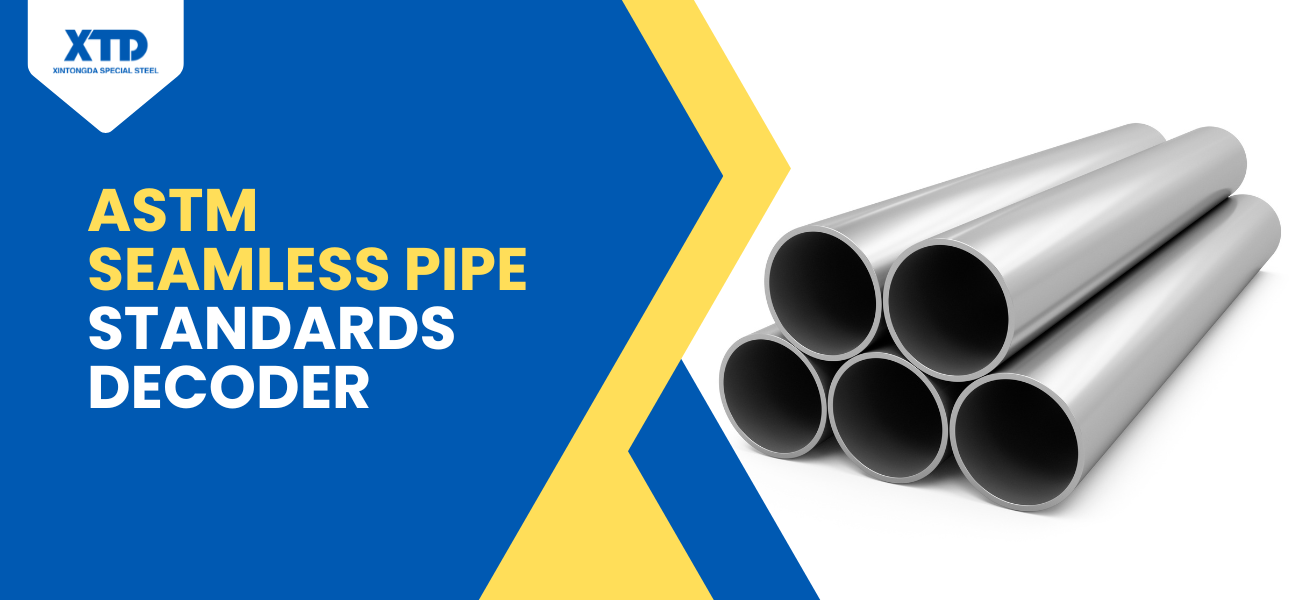
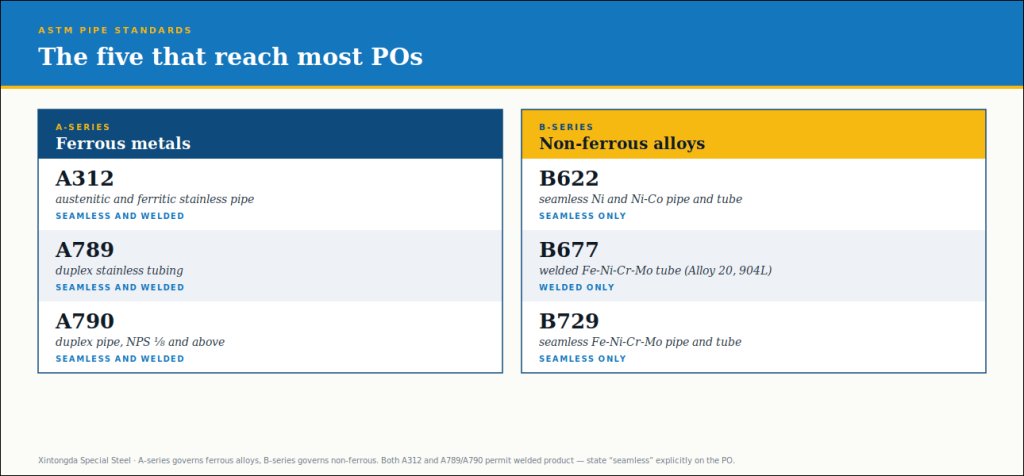
The ASTM standard written on a purchase order determines chemistry, mechanical testing, non-destructive examination, heat treatment, and marking requirements for every pipe or tube shipped against it. Choose the wrong one, and the delivery either arrives over-tested and overpriced, or under-tested and rejected at inspection. This guide decodes five standards buyers encounter most often: A312 for austenitic and ferritic stainless pipe, A789 and A790 for duplex tube and pipe, B622 for nickel and Ni-Co alloy pipe and tube, and B677 alongside its seamless counterpart B729 for Fe-Ni-Cr-Mo austenitics. The convention holds throughout: A-series standards govern ferrous metals, and B-series standards govern non-ferrous alloys.
Why the Right ASTM Matters on the PO
Each standard fixes the chemistry range, mechanical property minimums, NDE method, hydrotest pressure, marking requirements, and CMTR content that a mill must deliver against. Cite the wrong one, and the mill runs the wrong tests. That single error produces two outcomes, both bad: an over-specified pipe carrying unnecessary cost, or an under-specified pipe that fails inspection on site. The A-series covers ferrous metals such as stainless and carbon steel, while the B-series covers non-ferrous alloys that consist of nickel, copper, and titanium.
A stainless seamless pipe standards comparison exposes a costly mistake buyers often make: assuming the standard alone guarantees seamless supply. A312 and the A789/A790 pair both permit welded products under the same standard number, so the PO must state the manufacturing process explicitly.
The Five Standards at a Glance
Scope, alloy coverage, and product form separate these five standards more than any single test method does. The table below summarizes each one against verified UNS ranges.
| Standard | Scope | Typical UNS Examples | Product Form |
| A312 | Austenitic and ferritic stainless pipe | S30400, S30403, S31600, S31603, S32100, S34700, N08904 | Seamless and welded |
| A789 | Duplex stainless tube (OD up to 9 in) | S31803, S32205, S32750, S32760, S32707 | Seamless and welded tube |
| A790 | Duplex stainless pipe (NPS 1/8 in and above) | S31803, S32205, S32750, S32760, S32707 | Seamless and welded pipe |
| B622 | Seamless nickel and Ni-Co alloy pipe and tube | N06600, N06601, N06625, N08810, N08825, N10276, N06022 | Seamless only |
| B677 | Welded austenitic Fe-Ni-Cr-Mo tube | N08020, N08904 | Welded only (B729 is the seamless counterpart) |
Comparing ASTM A789 vs A790 side by side makes the pattern clear. Same alloy families, same chemistry tables, entirely different product forms.
ASTM A312: The Austenitic Stainless Workhorse
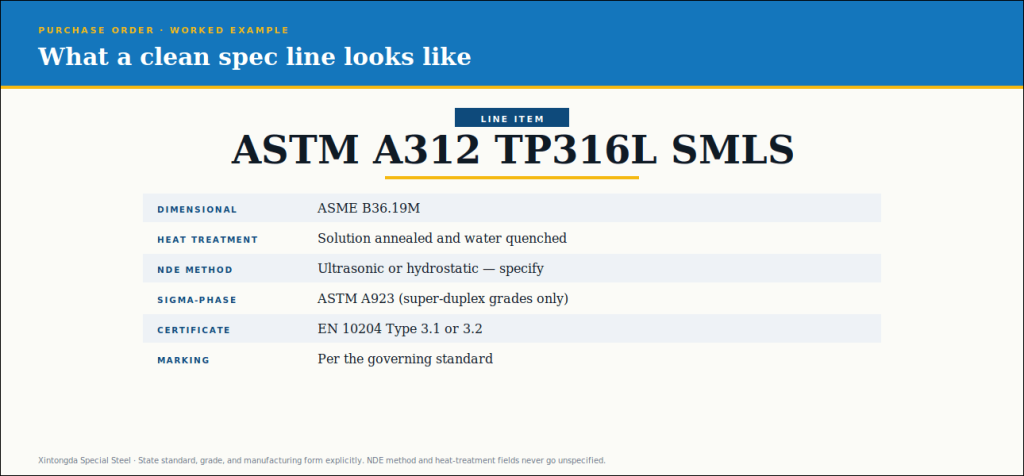
The ASTM A312 page in most mill catalogs covers both seamless and welded austenitic and ferritic stainless pipe under one standard number. Specify “ASTM A312 TP316L seamless” on the PO, not just “ASTM A312,” because the grade prefix alone never confirms the manufacturing route. Grades run through the TP series: TP304L, TP316L, TP321, TP347, and further variants beyond. NDE options include hydrostatic testing or a non-destructive electric test using eddy current or ultrasonic methods, and the buyer must specify a preference rather than leave it open. Hydrotest can be waived in writing, but waiving it by default invites risk on pressure-critical lines.
ASTM A789 and A790: The Duplex Pair
ASTM A790 and ASTM A789 reference share identical grade families and chemistry requirements. Product form is the only real distinction. A789 governs duplex tube up to 9 inches outside diameter, while A790 governs duplex pipe dimensioned to NPS and schedule under ASME B36.19M. Solution annealing followed by water quenching isn’t optional under either standard; it’s a spec requirement that belongs on the mill certificate, not just on a procurement checklist.
Super-duplex grades like S32750 and S32760, along with hyper-duplex S32707, need something A790 alone won’t catch: an ASTM A923 sigma-phase test added to the PO, since poor mill heat treatment produces detrimental sigma phase that standard testing under A790 misses entirely.
ASTM B622: Seamless Nickel and Ni-Co Alloy Pipe
ASTM B622 serves as the umbrella standard for seamless nickel-alloy pipe and tube, covering Ni-Cr-Mo grades N10276 and N06022, Inconel 600, 601, and 625, and Incoloy 800H and 825. Several of these alloys carry dedicated standards of their own: B444 governs N06625 (Inconel 625), B423 governs N08825 (Incoloy 825), and B983 governs N09925 (Incoloy 925). When a PO references both B622 and a dedicated standard, the dedicated standard takes precedence. NDE runs as hydrostatic testing or ultrasonic examination, with UT typical for tubular product, so state which method the order requires. High-temperature grades like N08810 Incoloy 800H carry supplementary grain size and carbon requirements that need separate confirmation on the certificate.
ASTM B677 vs B729: The Fe-Ni-Cr-Mo Austenitics
Both standards cover the same alloy class: N08020 (Alloy 20) and N08904 (904L). B677 governs welded tube. ASTM B677 seamless is a phrase that doesn’t actually exist within the standard itself, because the seamless equivalent carries its own number, B729, which buyers should specify for high-pressure or sour-service duty. One recurring error deserves attention here. Ordering “904L pipe to A312” creates ambiguity, since N08904 falls under both A312’s austenitic scope and B677/B729’s Fe-Ni-Cr-Mo scope, and different mills interpret the overlap differently. State the exact standard number rather than the alloy name alone.
Additional Standards
A handful of related standards cover narrower applications outside the five detailed above.
- A213: small-diameter stainless boiler and heat-exchanger tube
- A269: general-service stainless tube
- A270: sanitary tubing for food and pharmaceutical processing, graded SF1 through SF6
- A358: large-diameter welded stainless pipe above NPS 8
- B983: Incoloy 925 (N09925) seamless pipe and tube
Procurement Checklist for a Clean PO
A purchase order that names every required element up front eliminates most disputes before they start. Six line items separate a clean PO from one that invites confusion at receiving inspection.
| PO Item | Required Wording |
| Standard, grade, and form | “ASTM A312 TP316L seamless” (state form explicitly) |
| Dimensional standard | ASME B36.19M for stainless; ASME B36.10M for carbon and alloy |
| Heat treatment | Solution annealed plus water quenched |
| NDE method | UT or hydrostatic, specify which |
| Sigma-phase test | ASTM A923 Method A, B, or C for super-duplex and hyper-duplex grades |
| Mill certificate | EN 10204 Type 3.1 or 3.2 |
Conclusion
These five standards each cover a distinct scope: A312 covers austenitic and ferritic stainless pipe, A789 covers duplex tube, A790 covers duplex pipe, B622 covers nickel alloys, and B677 covers welded high-alloy Fe-Ni-Cr-Mo austenitics, with B729 serving as the seamless counterpart. A clean purchase order names the standard, grade, form, dimensional spec, heat treatment, NDE method, and certificate type without leaving any of them to interpretation. Request a quote for seamless pipe manufactured to any of these five standards with EN 10204 3.1 or 3.2 mill test certificates. Zhejiang Xintongda Special Steel Manufacturing Co., Ltd. produces across all five standards from its mill in Songyang, Zhejiang.