Today’s pressurized water reactors run steam generator tubes made almost entirely from thermally treated Alloy 690. That single material change, moving away from Alloy 600, is one of the most consequential material changes in commercial nuclear history. The reason comes down to one failure mode: primary water stress corrosion cracking. Understanding nuclear steam generator tubing material choices means understanding why Alloy 600 cracked, why Alloy 690TT resists it, and where Alloy 800 fits as an alternate path.
What is a steam generator tube?
A steam generator tube forms the pressure boundary between the reactor’s radioactive primary coolant and the non-radioactive secondary steam that spins the turbine. Thousands of these tubes bundle together inside a single steam generator, and collectively they make up the largest heat-transfer surface in the entire reactor system. Each tube wall carries two jobs at once. It has to survive corrosion damage from hot borated primary water on the inside and from secondary-side chemistry and sludge deposits on the outside, while also resisting creep, vibration, and fretting damage from flow-induced tube-to-support contact over a 40 to 60-year service life. A single through-wall crack breaches the barrier between primary and secondary systems, which is why tube material selection carries so much engineering weight.
The Alloy 600 problem: PWSCC
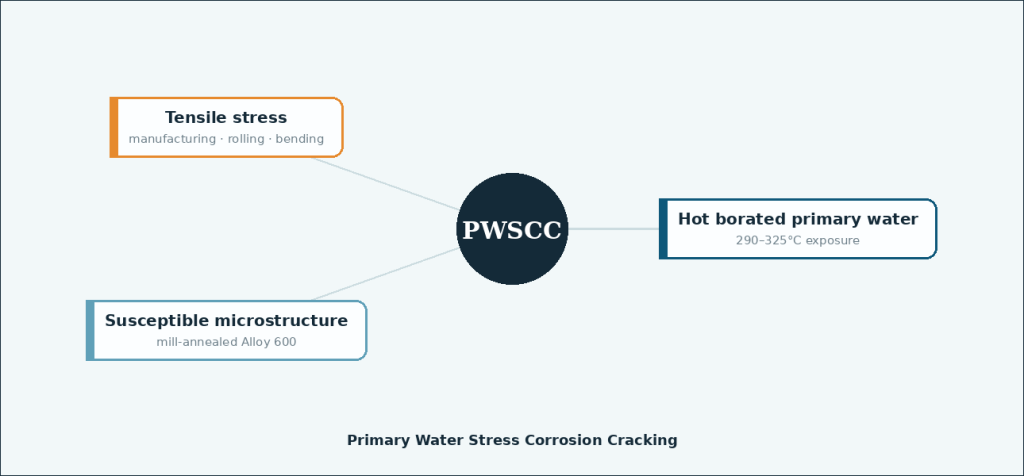
Alloy 600 (UNS N06600) was the default PWR steam generator tube material through the 1970s and into the 1980s. Its nickel-chromium-iron composition performed well in early testing. Field service data presented a different picture. Tubes began cracking from the inside out, a mechanism now called primary water stress corrosion cracking, or PWSCC. Three conditions combine to drive it: tensile stress in the tube wall (from manufacturing, rolling, or bending), a susceptible microstructure, and prolonged exposure to hot borated primary water, with cracking accelerating as temperature rises across the roughly 290 to 325°C primary range. Once cracks initiate, operators plug or sleeve affected tubes to keep them out of service. Enough plugged tubes reduce a steam generator’s heat-transfer capacity past economic limits, and several utilities ended up replacing entire steam generators years ahead of schedule. That cost, measured in outage time and capital spend, is what pushed the industry toward a replacement alloy.
The Alloy 690TT solution
Alloy 690 (UNS N06690) answers the PWSCC problem with chemistry. Its chromium content runs close to 30%, roughly double that of Alloy 600, and higher chromium content correlates directly with PWSCC resistance in nickel-based alloys. Thermal treatment, a controlled heat cycle applied after tube forming, precipitates chromium carbides along the grain boundaries and further stabilizes the microstructure against cracking. This combination is what 690TT refers to: a high-temperature solution anneal followed by a separate thermal treatment near 700°C that builds a chromium-carbide network along the grain boundaries. That thermally treated (TT) condition is distinct from, and more crack-resistant than, the older mill-annealed (MA) temper.
Nearly all replacement steam generators installed since the late 1980s use thermally treated Alloy 690, and operating experience across that fleet shows no confirmed PWSCC failures to date. For plant owners weighing steam generator tube material Alloy 690 vs 600, the field record settles the question in 690TT’s favor for new construction and replacements alike.
The alternate: Alloy 800NG
Not every reactor design followed the same path. Siemens/KWU PWR units in Germany and several other markets, along with later CANDU pressurized heavy water reactors built under AECL designs, standardized on Alloy 800NG (nuclear grade), UNS N08800. This iron-nickel-chromium alloy carries a lower nickel content than Alloy 690 but compensates with a tightly controlled titanium-to-carbon ratio, generally held at or above 12:1, which stabilizes the alloy against intergranular attack and stress corrosion cracking. The iron-nickel-chromium balance in 800NG gives it a different corrosion profile than the nickel-rich 690, better suited in some cases to specific secondary-side water chemistries used in KWU and CANDU designs. Alloy 800 nuclear steam generator tubing remains in active service across these reactor fleets, proof that PWSCC resistance can come from more than one metallurgical route.
Steam Generator Tube Material Comparison

Selecting between these three alloys comes down to reactor design, secondary chemistry, and decades of accumulated operating data rather than a single performance number. Alloy 600 answers to history now, not to new procurement. Alloy 690TT dominates current PWR construction and replacement programs worldwide, and Alloy 800NG holds its ground in the reactor designs that originally specified it. The table below lines up role, corrosion behavior, and governing specification for each.
| Alloy (UNS) | Role in SG history | Corrosion behavior | Governing spec | XTD supplies |
| Alloy 600 (N06600) | Original PWR SG tube (1970s to 1980s) | Susceptible to PWSCC; largely superseded | ASTM B163 / ASME SB-163 | Yes (600) for industrial duty, not nuclear SG |
| Alloy 690 / 690TT (N06690) | Current standard PWR SG tube (since ~1989) | High Cr (~30% ) drives strong PWSCC resistance; thermal treatment adds stability | SB-163 + ASME Section III | No; not in XTD’s range |
| Alloy 800NG / 800 Mod (N08800) | Alternate: Siemens/KWU PWR & CANDU PHWR | Good IGA/SCC resistance; controlled Ti/C ratio | ASTM B163 / SB-163 (nuclear grade) | Yes (800-series) for industrial, not nuclear-qualified |
Standards & specifications
ASTM B163 and its ASME counterpart, SB-163, cover seamless nickel-alloy tube for condenser and heat-exchanger service, covering the base material properties, dimensional tolerances, and mechanical testing that any 600, 690, or 800-series tube must meet. Nuclear SG applications add a second, stricter layer on top: ASME Boiler and Pressure Vessel Code Section III sets fabrication, examination, and material qualification requirements specific to nuclear components, and French-designed reactors follow the equivalent RCC-M code. A base material spec confirms the tube meets chemistry and mechanical targets. Nuclear-code qualification confirms the tube, its welds, and its full fabrication history meet the traceability and testing burden a reactor operator’s licensing basis demands. XTD supplies seamless 600 and 800-series tube to ASTM B163 / ASME SB-163 for industrial heat-exchanger and process duty; nuclear SG-qualified 690TT tube sits outside XTD’s current product range.
FAQ
What are nuclear steam generator tubes made of?
Alloy 690TT is the primary material in current PWR fleets; Alloy 800NG serves as the alternate in Siemens/KWU and CANDU designs.
Why was Alloy 600 replaced?
PWSCC. Alloy 600 tubes developed cracks under primary-water exposure, driving costly tube plugging and steam generator replacements.
What is PWSCC?
Primary water stress corrosion cracking is a corrosion mechanism where tensile stress, susceptible microstructure, and hot borated primary water combine to crack tube walls from the inside.
Is Alloy 800 used for SG tubing?
Yes. Siemens/KWU PWR units and CANDU PHWR reactors specify Alloy 800NG as their steam generator tube material.