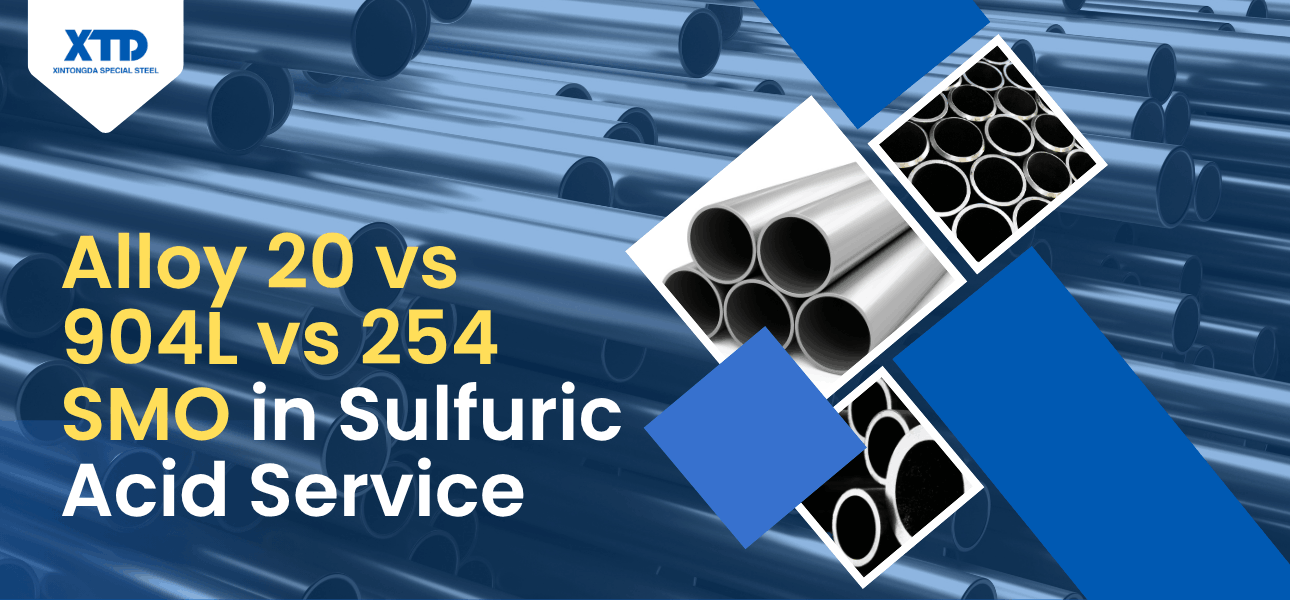
Alloy 20 resists pure and high-concentration sulfuric acid better than either 904L or 254 SMO, and copper explains most of that gap. 904L follows closely, covering a wider spread of reducing acids at lower cost. 254 SMO is best when the acid solution also contains chlorides. Read the alloy 20 vs 904L vs 254 SMO sulfuric acid comparison as a copper question first, then check nickel and molybdenum against your chloride load.
Why sulfuric acid attacks stainless steel
Sulfuric acid changes character with concentration. Below roughly 20% it behaves as a reducing acid and strips the chromium oxide film that keeps austenitic grades passive, while above about 85% it turns oxidizing and helps that film reform. Corrosion rates climb between those two points, and temperature widens the damaging band further. A grade that survives 96% acid at ambient temperature can lose millimeters per year in 50% acid at 80°C, which is why 316L seamless pipe rarely reaches acid duty. Chromium alone cannot cover the range. Molybdenum limits pitting and crevice attack where halides are present, and copper suppresses corrosion in the reducing region.
The role of copper
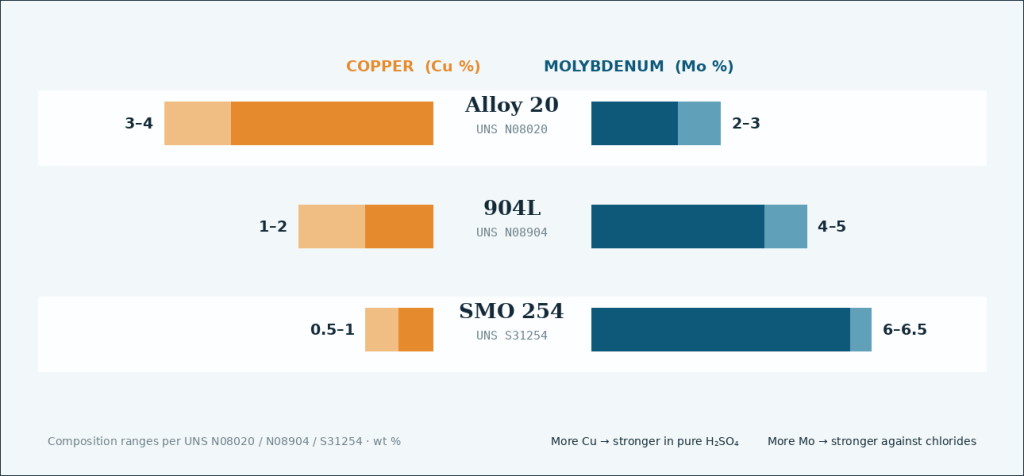
Copper separates these three grades more cleanly than any other element. Alloy 20 carries 3.0 to 4.0%, 904L holds 1.0 to 2.0%, and 254 SMO sits between 0.50 and 1.00%. That order matches their ranking in sulfuric service.
The mechanism is electrochemical. Copper plates out as a thin metallic layer on the corroding surface and slows the cathodic hydrogen reduction reaction that drives dissolution in non-oxidising acids. Less cathodic activity means less metal loss. Because copper slows down acid attack, a grade with 3.5% copper performs better in hot dilute acid than a 6% molybdenum grade with only 0.7% copper. Specifiers working in copper-bearing stainless steel acid service treat that figure as the primary screening number.
Alloy 20: the sulfuric specialist
Alloy 20 (N08020) combines 3.0 to 4.0% copper with 32 to 38% nickel, 19 to 21% chromium and 2 to 3% molybdenum. ASTM B729 covers the seamless product, and Alloy 20 seamless pipe ships in the stabilized-annealed condition. Niobium additions prevent intergranular corrosion in welded joints by binding free carbon into stable niobium carbides during fabrication. This process ensures welded spools retain the base metal’s full corrosion resistance. Nickel content plays a vital role as well; exceeding 30% nickel renders austenitic alloys virtually immune to chloride-induced stress corrosion cracking. Alloy 20 sulfuric acid resistance therefore spans the full concentration range, including hot mid-strength acid.
904L: the versatile reducing-acid choice
904L (N08904) was specifically developed to handle dilute sulfuric acid. Its chemical composition includes 1.0% to 2.0% copper, 23% to 28% nickel, 19% to 23% chromium, and 4% to 5% molybdenum. ASTM A312 covers the seamless form, with ASTM B677 available for welded product where the project spec requires it. Higher molybdenum lifts the PREN above 34, so 904L seamless pipe handles moderate chloride levels that Alloy 20 tolerates without targeting. Specify a 904L sulfuric acid pipe where the line carries mixed or dilute acids, hot phosphoric acid, or organic acids alongside sulfuric. Lower nickel content keeps the price below Alloy 20, which decides many fertilizer and CPI jobs on cost rather than chemistry.
254 SMO: chloride-first, sulfuric-second
254 SMO (S31254) holds 6.0 to 6.5% molybdenum, 0.18 to 0.22% nitrogen and 0.50 to 1.00% copper, lifting its PREN to roughly 43. Published critical pitting temperature typically reaches 70°C under ASTM G48 Method A, with critical crevice temperature above 35°C under Method B. ASTM A312 covers the seamless product, and 254 SMO seamless pipe ships solution annealed and water quenched. That combination targets seawater, brine and bleach systems rather than clean acid duty. 254 SMO sulfuric acid performance holds up in dilute and mid-range concentrations, though the modest copper addition puts it behind both Alloy 20 and 904L on pure acid. Use it primarily where high chloride levels cause failure and sulfuric acid is only a secondary concern (e.g., flue gas scrubbers and tall oil distillation).
Sulfuric acid: alloy selection
Copper content and acid fit vary between vendor datasheets, so confirm the heat analysis on the mill certificate before you close a specification. Figures below follow ASTM composition limits rather than typical mill values. XTD stocks all three grades as seamless pipe against ASTM B729 (Alloy 20), ASTM A312 (904L) and ASTM A312 (254 SMO).
| Alloy (UNS) | Copper | Sulfuric acid fit | Best when | XTD |
| Alloy 20 (N08020) | 3.0 to 4.0% | Strongest of the three in pure and high-concentration sulfuric | Sulfuric and phosphoric CPI duty with chloride-SCC risk | Yes |
| 904L (N08904) | 1.0 to 2.0% | Close behind, with broad reducing-acid coverage | Mixed or dilute acids carrying moderate chloride | Yes |
| 254 SMO (S31254) | 0.50 to 1.00% | Adequate, but chloride-optimised rather than acid-optimised | Sulfuric service that also carries high chlorides | Yes |
Choosing for your service
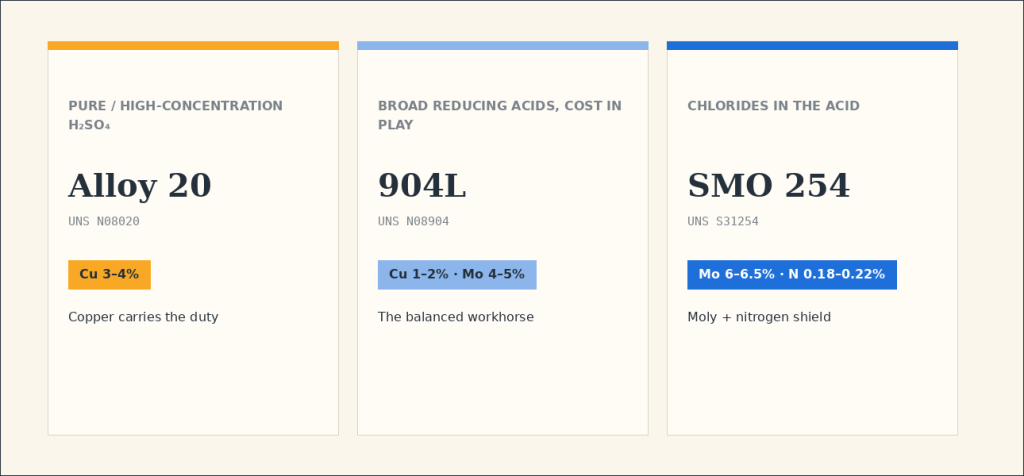
Alloy 20 is required for high-strength acid above 80%, as well as mid-strength acid operating above 60°C. Dilute acid below 20% at moderate temperature runs safely in 904L, and the saving justifies that choice on non-extreme duty. Chloride content overrides both rules. Once chlorides pass a few hundred ppm and pitting becomes the likely failure mode, 254 SMO takes priority despite its lower copper. Aeration, flow velocity, and oxidizers can change these limits. Always run coupon tests on borderline cases before committing to a material.
FAQ
Which is the best stainless steel for sulfuric acid?
Alloy 20 leads in pure and high-concentration acid, thanks to 3.0 to 4.0% copper. 904L follows closely, and 254 SMO trails.
Why does copper improve acid resistance?
Copper slows the cathodic hydrogen reaction driving metal loss in reducing acids, cutting corrosion current without depending on the passive film.
Is 254 SMO suitable for sulfuric acid?
It performs adequately in dilute acid, though 0.50 to 1.00% copper makes it a chloride grade first and an acid grade second.
How does Alloy 20 compare with 904L?
Alloy 20 carries more copper and more nickel. 904L costs less and covers a wider mix of reducing and organic acids.