
No. B829 supplements the product specification. In case of conflict, the product specification takes precedence. B829 provides the common framework; the product specification (B161, B163, B167, B407, B423, B444, etc.) defines grade-specific chemistry, mechanical properties, and heat treatment.

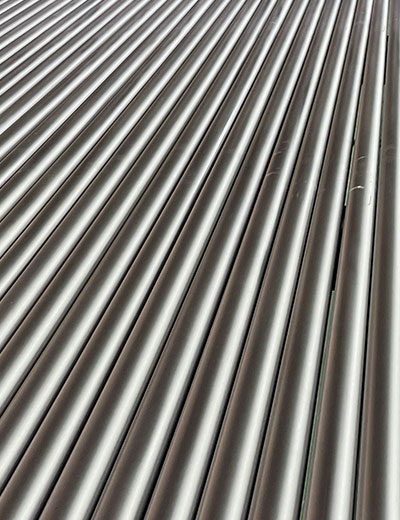
ASTM B829 Seamless Nickel Alloy Pipe & Tube Standard
ASTM B829 is the Standard Specification for General Requirements for Nickel and Nickel Alloy Seamless Pipe and Tube. If A1016 is the umbrella general requirements specification for stainless steel tubes and A999 is its counterpart for stainless steel pipe, B829 is the equivalent for nickel and nickel alloy seamless pipe and tube. Every seamless nickel alloy pipe or tube produced to an ASTM B-series specification follows the common rules of B829.
B829 defines the common requirements for chemical analysis, mechanical testing (tension, hardness, grain size, flare test), dimensional tolerances (OD, wall, length), hydrostatic testing, non-destructive electric testing (eddy current, ultrasonic), workmanship, sampling, lot definitions, certification, and marking for nickel alloy tube and nickel alloy pipe.
The current edition is B829–24, published in November 2024 under ASTM Committee B02 on Nonferrous Metals and Alloys, Subcommittee B02.07 on Refined Nickel and Cobalt and Their Alloys. The ASME equivalent is SB-829 in Section II, Part B.
ASTM B829 PDF Free Download ASTM B829 PDF Free Download
What Is ASTM B829?
ASTM B829 is the general requirements specification that provides the common technical framework for all nickel and nickel alloy seamless pipe and tube specifications under Committee B02. It consolidates requirements that would otherwise be repeated across 16 individual product specifications, from B161 (Nickel 200/201 pipe/tube) through B729 (Alloy 20 pipe/tube).
In case of conflict between B829 and a product specification, the product specification takes precedence. This hierarchy gives the product specification final authority on grade-specific requirements, while B829 provides the common framework for dimensions, testing, NDE, and certification.
Product Specifications Governed by ASTM B829
B829 applies to 16 ASTM seamless nickel alloy pipe and tube specifications. Each covers specific alloy families and service conditions.
| ASTM Designation | Title / Alloys Covered | Product |
| B161 | Nickel Seamless Pipe and Tube (N02200, N02201) | Pipe/Tube |
| B163 | Seamless Nickel Alloy Condenser and Heat Exchanger Tubes (N02200, N04400, N06600, N06625, N08800, N08825, etc.) | Tube |
| B165 | Nickel-Copper Alloy (N04400 / Monel 400) Seamless Pipe and Tube | Pipe/Tube |
| B167 | Ni-Cr-Fe Alloys (N06600, N06601, N06690, etc.) Seamless Pipe and Tube | Pipe/Tube |
| B407 | Ni-Fe-Cr Alloy (N08800, N08810, N08811) Seamless Pipe and Tube | Pipe/Tube |
| B423 | Ni-Fe-Cr-Mo-Cu (N08825, N08221, N06845) Seamless Pipe and Tube | Pipe/Tube |
| B444 | Ni-Cr-Mo-Nb (N06625, N06852) and Ni-Cr-Mo-Si (N06219) Pipe and Tube | Pipe/Tube |
| B535 | Ni-Fe-Cr-Si (N08330, N08332) Seamless Pipe | Pipe |
| B622 | Seamless Nickel and Nickel-Cobalt Alloy Pipe and Tube | Pipe/Tube |
| B668 | UNS N08028 and N08029 Seamless Pipe and Tube | Pipe/Tube |
| B677 | UNS N08925, N08354, N08926 Seamless Pipe and Tube | Pipe/Tube |
| B690 | Fe-Ni-Cr-Mo Alloys (N08367 / AL-6XN) Seamless Pipe and Tube | Pipe/Tube |
| B722 | Ni-Cr-Mo-Co-W-Fe-Si (N06333) Seamless Pipe and Tube | Pipe/Tube |
| B729 | UNS N08020, N08026, N08024 (Alloy 20) Nickel-Alloy Pipe and Tube | Pipe/Tube |
When specifying nickel seamless pipe or tube to B161, B163, B167, B407, B423, B444, or any other covered specification, the dimensional tolerances, NDE procedures, hydrostatic test formula, and certification requirements all come from B829.
ASTM B829 vs A1016 vs B751: Nickel vs Stainless General Requirements
Three general requirements specifications govern different product families. Understanding which one applies is critical for correct specification.
| Parameter | ASTM B829 | ASTM A1016 | ASTM B751 |
| Product | Nickel alloy seamless pipe/tube | Stainless steel tube | Nickel alloy welded tube |
| Committee | B02.07 (Nickel/Cobalt) | A01.10 (Steel Tubular) | B02.07 (Nickel/Cobalt) |
| Covered Specs | B161–B729 (16 specs) | A213–A1098 (11 specs) | B704, B725, etc. |
| Manufacturing | Seamless only | Seamless and welded | Welded only |
| Hydrostatic Formula | P = 2St/D (1000 psi cap) | P = 32,000 t/D (1000 psi cap) | Per B751 |
| Fiber Stress Basis | Lower of 2/3 yield or 1/4 UTS | Fixed formula | Per B751 |
| Flare Test | 30% OD increase, 60° tool | Table-based % by ID/OD ratio | Per B751 |
| Lot Size Max | 20,000 lb (9,100 kg) | Per product spec | Per B751 |
The key difference between B829 and A1016 is the hydrostatic test fiber stress basis. B829 uses the lower of 2/3 of minimum yield strength or 1/4 of minimum ultimate tensile strength—a more conservative dual criterion that accounts for the higher work-hardening rate of nickel alloys.
Chemical Analysis Requirements
B829 Section 4 defines the chemical analysis methods by UNS prefix: E39 for N02 (nickel), E76 for N04 (nickel-copper), and E1473 for N06/N08 (nickel-chromium and nickel-iron-chromium alloys). Ladle analysis must conform to the product specification. Product (check) analysis tolerances follow ASTM B880.
Dimensional Tolerances
B829 defines four tolerance tables covering three manufacturing methods: Table for seamless cold-worked pipe and tube, Table for hot-finished tube, Table for seamless hot-worked pipe, and Table for cut length. Pipe dimensions follow ANSI B36.19.
Seamless Cold-Worked Pipe and Tube
OD and wall thickness tolerances for cold-finished seamless nickel alloy pipe and tube.
| OD Range, in. (mm) | OD (±), in. (mm) | Min Wall Over / Under (%) | Nom Wall Over / Under (%) |
| Up to 0.400 (10) | ±0.004 (0.10) | +15 / −15 | +30 / 0 |
| 0.400 to 5/8 (10–16) | ±0.005 (0.13) | +15 / −15 | +30 / 0 |
| 5/8 to 1-1/2 (16–38) | ±0.0075 (0.19) | +10 / −10 | +22 / 0 |
| 1-1/2 to 3 (38–76) | ±0.010 (0.25) | +10 / −10 | +22 / 0 |
| 3 to 4-1/2 (76–114) | ±0.015 (0.38) | +10 / −10 | +22 / 0 |
| 4-1/2 to 6 (114–152) | ±0.020 (0.51) | +12.5 / −12.5 | +28 / 0 |
| 6 to 6-5/8 (152–168) | ±0.025 (0.64) | +12.5 / −12.5 | +28 / 0 |
| 6-5/8 to 8-5/8 (168–219) | ±0.031 (0.79) | +12.5 / −12.5 | +28 / 0 |
| 8-5/8 to 14 (219–356) | ±0.062/0.031 (1.57/0.79) | +15 / −12.5 | +30 / 0 |
| 14 to 24 (356–610) | ±0.125/0.031 (3.18/0.79) | +15 / −12.5 | +30 / 0 |
Note: For thin-wall pipe and tube (wall ≤3% of OD), the mean OD must conform to tolerances, but individual measurements (including ovality) may deviate by the table values plus 0.5% of nominal OD. For OD >4-1/2 in. (114 mm) with wall >3% of OD, individual measurements shall not exceed twice the table values.
Hot-Finished Tube and Hot-Worked Pipe
Hot-finished tube tolerances are wider than cold-worked: OD ±0.015–0.062 in. (0.4–1.6 mm), nominal wall ±12.5%, minimum wall +28.5% / 0. Hot-worked pipe tolerances follow a similar pattern with OD ±0.015–0.062 in. and nominal wall +16% / −12.5%.
Length Tolerances
| Outside Diameter (OD) | Specified Length | Over-Tolerance (Plus) | Under-Tolerance (Minus) |
| Under 2 in (50.8 mm) | 24 ft (7.3 m) or less | 1/8 in (3.2 mm) | 0 |
| 2 in (50.8 mm) and Over | 24 ft (7.3 m) or less | 3/16 in (4.8 mm) | 0 |
| All Diameters | Over 24 ft (7.3 m) | Base + 1/8 in (3.2 mm) per 10 ft | 0 |
Test Requirements (Section 5)
B829 Section 5 defines five test methods. One or more apply only if specified in the product specification or purchase order.
Flare Test (Section 5.1)
A test specimen is flared with an expanding tool having a 60° included angle until the OD has increased by 30%. The flared specimen must not crack through the wall. This 30% expansion is more demanding than A1016's graduated table (21–68% based on ID/OD ratio) because nickel alloys have higher ductility and work-hardening capacity.
Hydrostatic Test (Section 5.2)
Each pipe or tube is tested to an internal pressure of 1000 psi (6.9 MPa) provided the fiber stress (calculated from P = 2St/D) does not exceed the allowable fiber stress. The allowable stress S is the lower of 2/3 of specified minimum 0.2% offset yield strength or 1/4 of specified minimum ultimate tensile strength. Test pressure is held for a minimum of 5 seconds. Testing at pressures above 1000 psi is permitted by agreement.
NDE — Eddy Current and Ultrasonic (Section 5.3)
Eddy current testing per ASTM E426 or E571 using a 0.031 in. (0.79 mm) drilled hole or notch at 12.5% of wall / 0.004 in. (0.1 mm) deep (whichever is greater). Ultrasonic testing per E213 using OD and ID longitudinal notches at the same depth. Calibration is required at the start and end of each production run, every 4 hours during testing, and after any equipment change or malfunction.
Tension and Hardness Tests (Sections 5.5 and 5.6)
Tension testing per ASTM E8/E8M. Full cross-section testing is preferred; when not possible, longitudinal strip specimens or the largest possible round section. Hardness testing per ASTM E18 (Rockwell), made on the inside diameter surface of a cut specimen or on the inside of the pipe near the end.
Lot Definition and Sampling
A lot for chemical analysis consists of one heat. A lot for all other testing (tension, hardness, grain size, flare, NDE) consists of all material from the same heat, nominal size, and condition (temper). When final heat treatment is in a batch furnace, only material from the same furnace charge. When in a continuous furnace, all material at the same temperature, time, and speed during one production run.
Maximum lot size: 20,000 lb (9,100 kg). When material cannot be identified by heat, a lot is limited to 500 lb (227 kg) of the same alloy, condition, and nominal size. This 20,000 lb cap is more restrictive than A1016 (which has no explicit weight limit) and reflects the higher value and criticality of nickel alloy products.
Key Applications of B829-Governed Specifications
Chemical and Petrochemical Heat Exchangers
Inconel 625 seamless tube (B444) and Incoloy 825 tube (B423) are the primary materials for heat exchangers in chemical plants handling chloride-bearing, mixed-acid, and FGD environments. B829 provides the tolerance framework that ensures these tubes fit precisely into tubesheet holes during bundle fabrication.
Power Plant Condensers and Feedwater Heaters
B163 condenser tubes in Inconel 600 (N06600), Monel 400 (N04400), and Inconel 625 (N06625) are specified for seawater-cooled surface condensers at coastal power plants. B829's hydrostatic test and NDE requirements verify weld-free tube integrity for decades of service in aggressive chloride conditions.
Oil and Gas Downhole and Process Service
Incoloy 825 seamless tube (B423) and Alloy 20 pipe (B729) serve in sour gas production, sulfuric acid alkylation units, and offshore topside piping. B829's conservative hydrostatic fiber stress calculation (lower of 2/3 yield or 1/4 UTS) provides the safety margin required for high-pressure, high-consequence nickel alloy service.
Nuclear and Aerospace
B167 Inconel 600/690 seamless tube for nuclear steam generator tubing and B407 Incoloy 800H for nuclear and aerospace high-temperature piping follow B829 for dimensional tolerances and NDE standards. The specification's grain size provisions (per E112) are critical for creep-life prediction in these high-temperature applications.
Physical Properties of Common Nickel Alloy Grades
Key physical properties for the primary alloys covered by B829-governed specifications.
| Property | N06625 (Inconel 625) | N08825 (Incoloy 825) | N06600 (Inconel 600) |
| Density, lb/in³ (g/cm³) | 0.305 (8.44) | 0.294 (8.14) | 0.304 (8.42) |
| Melting Range, °F (°C) | 2350–2460 (1290–1350) | 2500–2600 (1371–1427) | 2470–2575 (1354–1413) |
| Modulus, 10⁶ psi (GPa) | 29.8 (205) | 28.0 (193) | 31.0 (214) |
| Thermal Cond., BTU/ft·h·°F (W/m·K) | 5.7 (9.8) | 6.6 (11.4) | 8.7 (15.0) |
| Mean CTE (70–1200°F), 10⁻⁶/°F (/°C) | 7.7 (13.9) | 8.0 (14.4) | 7.4 (13.3) |
| Magnetic Properties | Non-magnetic | Non-magnetic | Non-magnetic (ferromagnetic at low temperatures) |
Certification and Product Marking
When specified in the purchase contract, the manufacturer furnishes a certification stating the material was manufactured, tested, and inspected per the specification. A test report with actual results is included when specified.
Each piece 3/4 in. (19 mm) OD and larger, and lengths over 3 ft (914 mm), is marked with: manufacturer's name or brand, material name or UNS number, "ASTM," product specification number, heat number, class (if applicable), and nominal size. Marking shall not result in harmful contamination—a critical requirement for nickel alloys that are sensitive to low-melting-point metal contamination (zinc, lead, copper) during fabrication and welding.
If you want to know more product details, please contact us!
Frequently Asked Questions
-
Does B829 Replace the Product Specification?
-
What is the Difference Between B829 and B751?B829 is the general requirements specification for seamless nickel alloy pipe and tube. B751 is the general requirements specification for welded nickel alloy tube. B829 covers specifications like B161, B163, B167, B407, B423, B444. B751 covers specifications like B704 and B725. The key difference: B829 is for seamless products (no weld seam), B751 is for welded products.
-
How does the B829 Hydrostatic Test Differ from A1016?B829 calculates allowable fiber stress as the lower of 2/3 of minimum yield or 1/4 of minimum UTS. A1016 uses a simpler formula (P = 32,000 t/D) without referencing yield or UTS directly. Both cap the test pressure at 1000 psi (6.9 MPa) unless agreed otherwise. B829's dual criterion is more conservative and appropriate for the higher-value nickel alloy products.
-
What is the Maximum Lot Size in B829?20,000 lb (9,100 kg) per lot for mechanical testing. When material cannot be traced to a specific heat, the lot is limited to 500 lb (227 kg). This weight cap is more restrictive than stainless steel tube specifications and reflects the higher criticality and unit cost of nickel alloy tubular products.
-
Does B829 Define Chemical Composition?No. Chemical composition requirements are defined in the individual product specifications. B829 defines only the analysis methods by UNS prefix (E39 for N02, E76 for N04, E1473 for N06/N08) and references B880 for product analysis tolerances.
-
How Many Reheat Treatments Does B829 Allow?A maximum of two reheat treatments. After two cycles, the material must be rejected. Each reheat risks grain coarsening—particularly problematic for nickel alloys where grain size specifications (per E112) directly affect creep life and mechanical properties.
-
Does B829 Cover Welded Nickel Alloy Products?No. B829 covers only seamless pipe and tube. Welded nickel alloy tubes are covered by ASTM B751 (general requirements) and product specifications like B704 (welded Ni alloy boiler/HX tubes) and B725 (welded Ni alloy pipe).
-
What NDE Methods Does B829 Define?Eddy current per E426 or E571, and ultrasonic per E213. When specified by the purchaser, NDE may substitute for the hydrostatic test. Calibration standards use the same 0.031 in. (0.79 mm) drilled hole or 12.5%/0.004 in. notch depth as A1016, with calibration checks at start/end of each run, every 4 hours, and after any equipment change.
- What is ASTM B829?
- Product Specifications Governed by ASTM B829
- ASTM B829 vs A1016 vs B751
- Chemical Analysis Requirements
- Dimensional Tolerances
- Test Requirements
- Lot Definition and Sampling
- Key Applications
- Physical Properties
- Certification and Product Marking
- Frequently Asked Questions
- Other ASTM Standards