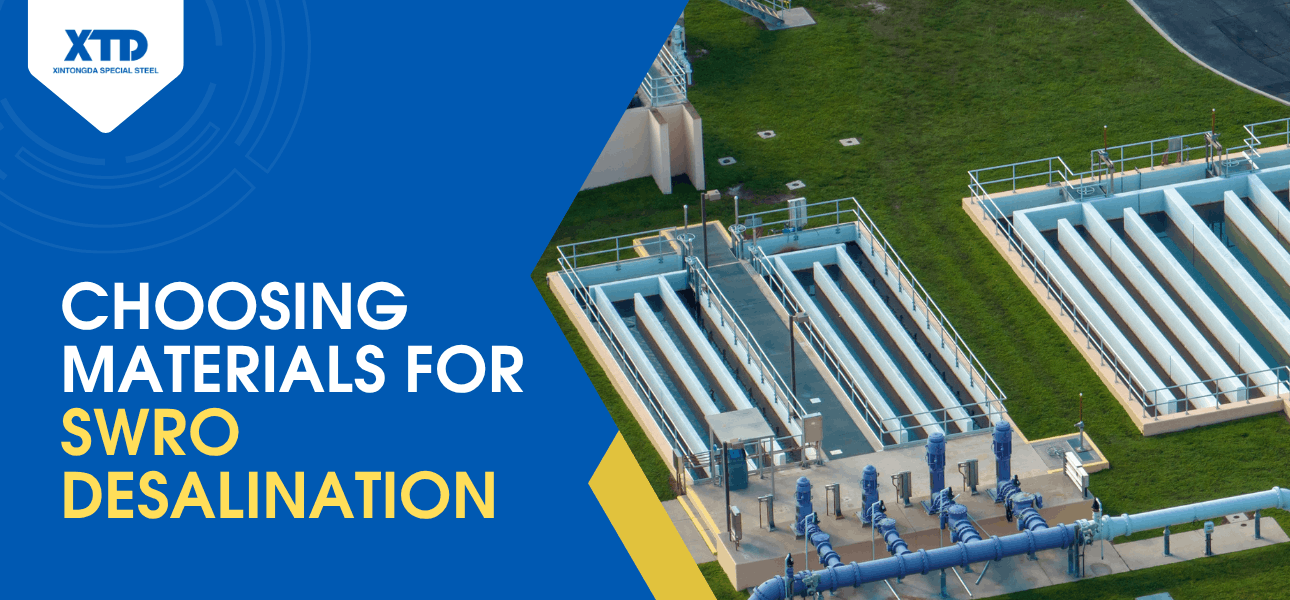
Seawater feed and brine reject lines fail for one reason above all others: chloride ions damage stainless steel until pitting or crevice corrosion breaks through. The right answer depends on where the pipe is placed in the train. Low-pressure intake lines tolerate standard duplex grades, but high-pressure feed and brine reject piping needs super duplex or 6Mo super-austenitic alloys with a PREN above the seawater threshold.
Why Seawater Is So Aggressive to Piping
Seawater carries roughly 19,000 ppm of chloride, and chloride ions punch through the thin chromium oxide film that protects stainless steel. Dissolved oxygen accelerates the damage. Add chlorination for biofouling control and warm intake temperatures in Gulf or Red Sea plants, and the corrosion rate climbs further. 304 and 316 stainless are unsuitable for high-pressure seawater service under these conditions. Both grades pit and crevice-corrode within months in continuous seawater contact, which is why SWRO high-pressure piping material selection starts by ruling them out entirely rather than treating them as a baseline option.
The Selection Metric: PREN and Pitting Resistance
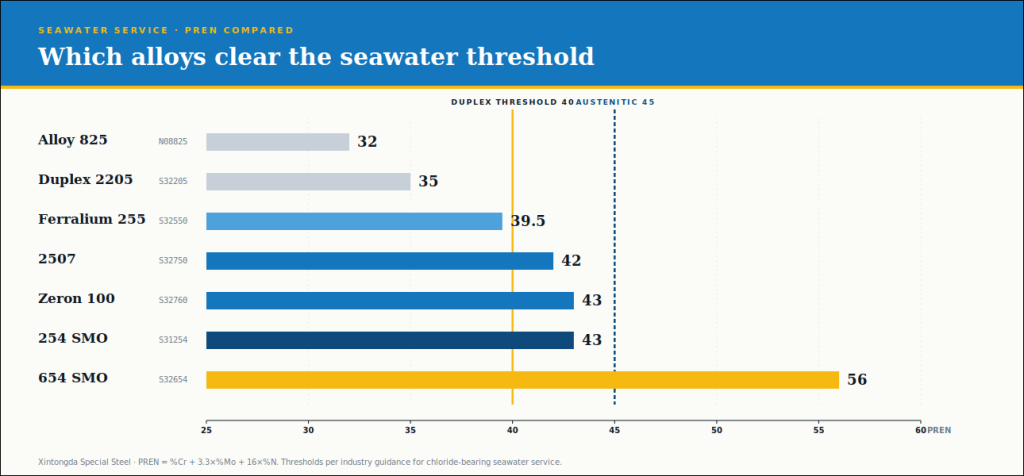
Pitting Resistance Equivalent Number, or PREN, ranks an alloy’s resistance to chloride attack using its chromium, molybdenum, and nitrogen content. Higher numbers mean better resistance. Critical Pitting Temperature, or CPT, measured in seawater test loops, confirms what PREN predicts on paper. For seawater desalination pipe material selection, the accepted guideline sets a minimum PREN of 40 for duplex grades and 45 for super-austenitic grades. Anything below that threshold risks localized damage at welds, flanges, and stagnant zones.
PREN Formula
PREN = %Cr + 3.3 × %Mo + 16 × %N
XTD’s PREN calculator lets specifiers plug in heat chemistry from a mill certificate and check the actual number against project specs before ordering.
Candidate Alloy Families for SWRO
Four families cover almost every SWRO high-pressure application. 6Mo super-austenitic stainless steel seawater grades, namely 254 SMO (UNS S31254) and 654 SMO (UNS S32654), deliver PREN values from the low 40s to above 55. Super duplex desalination pipe grades, including 2507 (UNS S32750), Zeron 100 (UNS S32760), and Ferralium 255 (UNS S32550), range from 39.5 to 43 and combine high strength with good weldability. Standard duplex 2205 (UNS S31803/S32205) works well in lower-severity zones but falls short of the high-pressure threshold at a PREN near 35. Nickel Alloy 825 (UNS N08825) serves reducing-acid and specific chemistry duties rather than raw seawater pitting resistance, since its PREN of roughly 31 to 33 trails every other option on this list. Titanium Grade 2 remains the reference benchmark for extreme-duty seawater service, though XTD does not supply titanium pipe.
Selection Table: Matching Alloy to Service Zone
The table below maps each alloy family to the zone where it performs, based on typical published PREN values.
| Alloy family | Grade (UNS) | Typical PREN | Pitting/crevice resistance | Typical SWRO use zone | XTD supplies |
| Duplex | 2205 (S31803/S32205) | ~35 | Good, but below the ~40 seawater threshold | Intake/lower-pressure lines; not high-pressure raw seawater | Yes |
| Super-duplex | Ferralium 255 (S32550) | ~39.5 | High, lowest of the super-duplex group | HP feed & brine reject; verify margin vs. temperature | Yes |
| Super-duplex | 2507 (S32750) | ~42 | High | HP seawater feed & brine reject, industry mainstream | Yes |
| Super-duplex | Zeron 100 (S32760) | ~43 | High | HP seawater feed & brine reject, industry mainstream | Yes |
| 6Mo super-austenitic | 254 SMO (S31254) | ~43 | Very high | HP seawater feed & brine reject, original accepted 6Mo | Yes |
| 6Mo super-austenitic | 654 SMO (S32654) | ~55+ | Highest of the stainless grades | Warm/high-salinity, most severe seawater duty | Yes |
| Nickel alloy | Alloy 825 (N08825) | ~31-33 | Modest for seawater pitting | Reducing-acid/specific chemistry duties, not first choice for HP seawater | Yes |
| Titanium (benchmark) | Grade 2 | N/A | Excellent in seawater | Extreme-service reference | No |
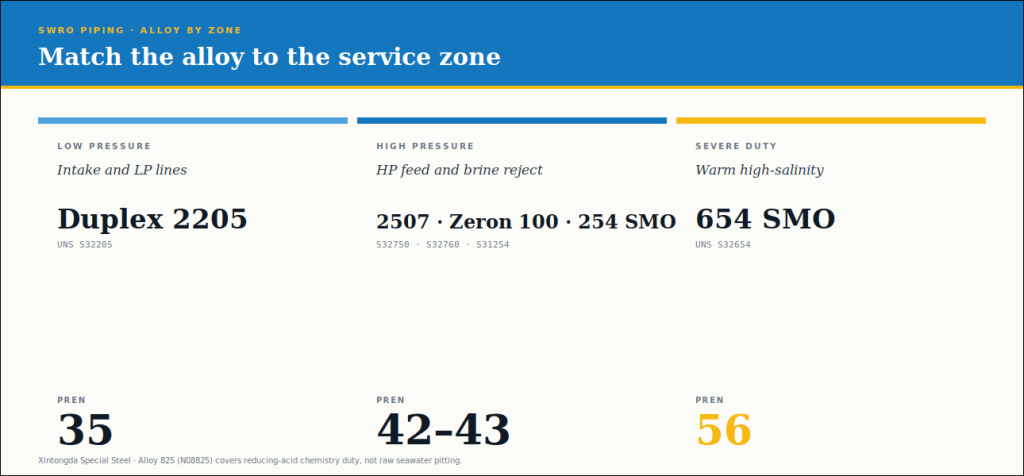
Duplex 2205 handles intake lines well, but it is not suitable for high-pressure raw seawater service. Alloy 825 covers chemistry-driven duties, not general seawater pitting resistance. The real high-pressure recommendation runs through super duplex or 6Mo.
Common Failure Modes to Design Against
Crevice corrosion strikes hardest at flanges, gaskets, and trapped against metal, crevice corrosion can initiate at lower chloride concentrations than open-surface pitting requires. Chloride stress corrosion cracking threatens austenitic grades under tensile stress in hot chloride environments, which duplex and super-duplex microstructures resist thanks to their mixed ferrite-austenite structure. Microbiologically influenced corrosion, or MIC, develops where biofilms form in low-flow or dead-leg sections and creates localized acidic conditions beneath the film. Erosion-corrosion damages high-velocity lines carrying suspended particulate, stripping the passive layer faster than it can reform. Each mode points to a design detail, not just a material choice: minimize crevices, control flow velocity, and flush dead legs regularly.
Fabrication and Practical Notes
Super duplex responds to welding and annealing differently than standard austenitic grades. It needs tight heat input control and proper solution annealing to maintain the balanced ferrite-austenite ratio that gives it strength and corrosion resistance together. Seamless pipe removes the weld seam as a potential crevice or initiation site, which matters most in high-pressure feed lines running above 60 bar. Size and spec availability vary by grade: 6Mo super-austenitic pipe typically ships in smaller diameter ranges than super duplex, so specifiers should confirm mill lead times against project schedules.
FAQ
What is the best pipe material for SWRO desalination?
It depends on the zone. Intake and lower-pressure lines run well on duplex 2205, while high-pressure feed and brine reject need super duplex 2507, Zeron 100, Ferralium 255, or 6Mo grades like 254 SMO.
Why is super duplex used in seawater?
Super duplex grades combine a PREN above 39 with roughly double the yield strength of standard austenitic stainless, which cuts wall thickness and material cost on high-pressure lines.
What PREN is needed for seawater?
Industry guidance sets a minimum PREN of 40 for duplex grades and 45 for austenitic grades in seawater service.
Is 316L stainless suitable for SWRO high-pressure lines?
No. 316L pits and crevice-corrodes in continuous high-chloride seawater and falls well short of the PREN needed for high-pressure feed or brine reject duty.
Contact Zhejiang Xintongda Special Steel for seamless super duplex, 6Mo, and nickel alloy pipe specs matched to your SWRO train’s pressure zones.