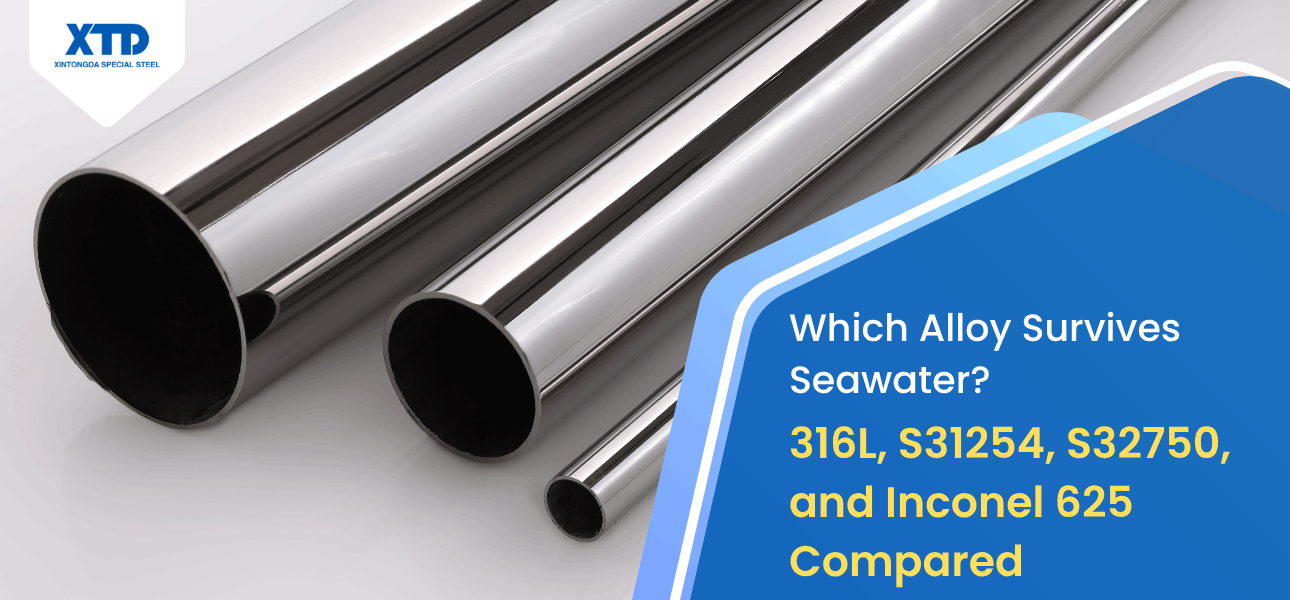
Seawater at roughly 19,000 ppm chloride damages standard stainless steels, and material selection mistakes show up as pitting failures within months of commissioning. This guide compares four candidate alloys for seawater piping: UNS S31603 (316L), UNS S31254 (6Mo super-austenitic), UNS S32750 (super-duplex), and UNS N06625 (Inconel 625). Below you will find a side-by-side comparison table, a per-alloy verdict, and a selection matrix to match each alloy to the right service condition.
Why Seawater Destroys Stainless Steel
Seawater is not just salt water. At around 19,000 ppm chloride, combined with dissolved oxygen, biological growth, and surfaces that form crevices (flange faces, gaskets, deposits, weld backing rings), it creates one of the most aggressive environments a piping system can face. Standard stainless steels rely on a thin passive oxide layer for corrosion resistance, and chloride ions are extremely effective at breaking that layer down locally.
This results in four recurring failure modes in seawater service: pitting, where chloride punches through the passive film at weak points; crevice corrosion, which behaves similarly but is hidden inside gaps and joints; microbially influenced corrosion (MIC), where biofilms create localized chemistry that accelerates attack; and chloride stress corrosion cracking, where tensile stress and chloride exposure combine to crack susceptible alloys. Stagnant seawater is consistently worse than flowing seawater, because crevices and deposits allow chloride to concentrate locally, pushing the local environment to be far more aggressive than the bulk seawater chemistry would suggest.
Four Alloys at a Glance
The table below compares all four alloys on pitting resistance, critical pitting temperature, strength, cost, and governing standards, using only verified published values.
| Alloy (UNS) | PREN | CPT | Min. Yield Strength | Relative Cost | Governing Standard |
| S31603 (316L) | approx. 24-26 | approx. 15°C | 170 MPa | 1.0x (baseline) | ASTM A312 |
| S31254 (6Mo) | approx. 42-44 | spec min 50°C (6% FeCl3); typical approx. 70°C | approx. 300 MPa | approx. 4-5x | ASTM A312 |
| S32750 (super-duplex) | approx. 42 | approx. 75-80°C (lab data) | 550 MPa | approx. 3-4x | ASTM A790 |
| N06625 (Inconel 625) | above 50 | above 85°C | 414 MPa | approx. 8-10x | ASTM B444 / B705 |
S31254’s chemistry (Cr 19.5-20.5, Ni 17.5-18.5, Mo 6.0-6.5, N 0.18-0.22) is what drives its CPT well above ambient seawater temperatures, making the S31254 vs super-duplex comparison less about corrosion resistance and more about strength, weldability, and cost.
316L: Why It Keeps Failing in Seawater
A CPT of approximately 15°C means 316L can begin pitting at or below typical ambient seawater temperature, which is exactly the environment it is so often (mistakenly) specified for. The main reason people choose 316L is its lower upfront cost, but this often leads to visible pitting from seawater corrosion after just a few months of continuous use. As a procurement note rather than a product pitch: 316L seamless pipe belongs in fresh water washdown lines or systems with brief, intermittent seawater contact only, never in permanent seawater service.
S31254: The 6Mo Workhorse for Ambient Seawater
The 6% molybdenum content, combined with nitrogen alloying, pushes the CPT of S31254 comfortably above ambient seawater temperatures, closing the gap that makes 316L unsuitable. Because it remains fully austenitic, it welds and fabricates much like a standard stainless steel, without the procedural complexity that duplex grades demand. This makes S31254 seamless pipe a strong fit for desalination second-pass systems, condenser and heat exchanger tubing, and ballast or firewater piping in moderate climates. Its main limitation is strength: at approximately 300 MPa minimum yield, systems often need thicker walls than an equivalent duplex design for the same pressure rating.
S32750: Best Strength-to-Cost for Structural Seawater
With a minimum yield of 550 MPa, nearly double that of S31254, S32750 allows noticeably thinner walls and lighter overall systems for the same pressure class. This makes S32750 seamless pipe a preferred choice for firewater ring mains, seawater lift systems, and structural seawater piping where weight and cost both matter. The caveat is welding: poor heat input during fabrication can form sigma phase, which quietly destroys the corrosion resistance this alloy is chosen for in the first place. ASTM A923 testing should be required on every welded joint. NORSOK MDS coverage (D51, D55, D57, D58) also makes super-duplex seawater piping easier to get approved on North Sea projects.
Inconel 625: When Temperature or H2S Enters the Equation
When seawater service moves beyond what the three stainless options can handle, with a PREN above 50 and CPT above 85°C, Inconel 625 is the escalation path. Typical duties for Inconel 625 seawater service include hot seawater above 50°C, splash-zone components subject to wetting and drying cycles, and sour seawater injection where H2S is present. At approximately 8-10x baseline cost, it should be reserved for service conditions that genuinely defeat the cheaper alloys rather than specified by default. Order Inconel 625 pipe to ASTM B444, specifying Grade 1 annealed for piping applications, since Grade 2 solution annealed has lower strength and is not the right choice for pressure-retaining pipe.
Selection Matrix by Service Condition
Matching the alloy to the actual service condition, rather than defaulting to one grade, is the single biggest factor in avoiding premature failure.
| Service Condition | Recommended Alloy |
| Fresh water washdown | S31603 provides adequate performance for fresh water washdown duty only. |
| Ambient seawater piping | S31254 or S32750 both suit ambient seawater, with the choice driven mainly by cost. |
| Cold firewater systems | S32750 is the recommended choice for cold firewater piping systems. |
| FPSO topsides seawater injection | S32750 or S31254 are both suitable for FPSO topsides seawater injection lines. |
| Hot seawater above 50°C | N06625 or S32707 hyper-duplex should be specified above 50°C. |
| Sour seawater with H2S | N06625 is recommended, subject to NACE MR0175 review for the application. |
| Splash zone and wave loading | N06625 is the recommended alloy for splash zone and wave-loaded components. |
Classification and Certification
For buyers, DNV, Lloyd’s Register, ABS, and NORSOK approvals are not just paperwork. They confirm that a mill’s quality systems have been audited and that specific material grades have been formally qualified for marine and offshore use. For marine and desalination applications, sourcing from an unapproved mill can mean costly requalification testing and project schedule delays. Xintongda Special Steel holds DNV, Lloyd’s Register, and NORSOK certifications, with mill test certificates issued to EN 10204 3.1/3.2 on every order.
Conclusion
The selection ladder is straightforward once service conditions are defined: 316L for fresh water only, S31254 for ambient seawater where fabrication ease and weldability matter, S32750 where strength and cost efficiency drive the decision, and Inconel 625 when high temperature or H2S exposure rules out everything cheaper. Get in touch to request a quote for seawater-service seamless pipe complete with classification certificates and full mill documentation, and if you need help comparing grades in detail, see our PREN calculation guide.