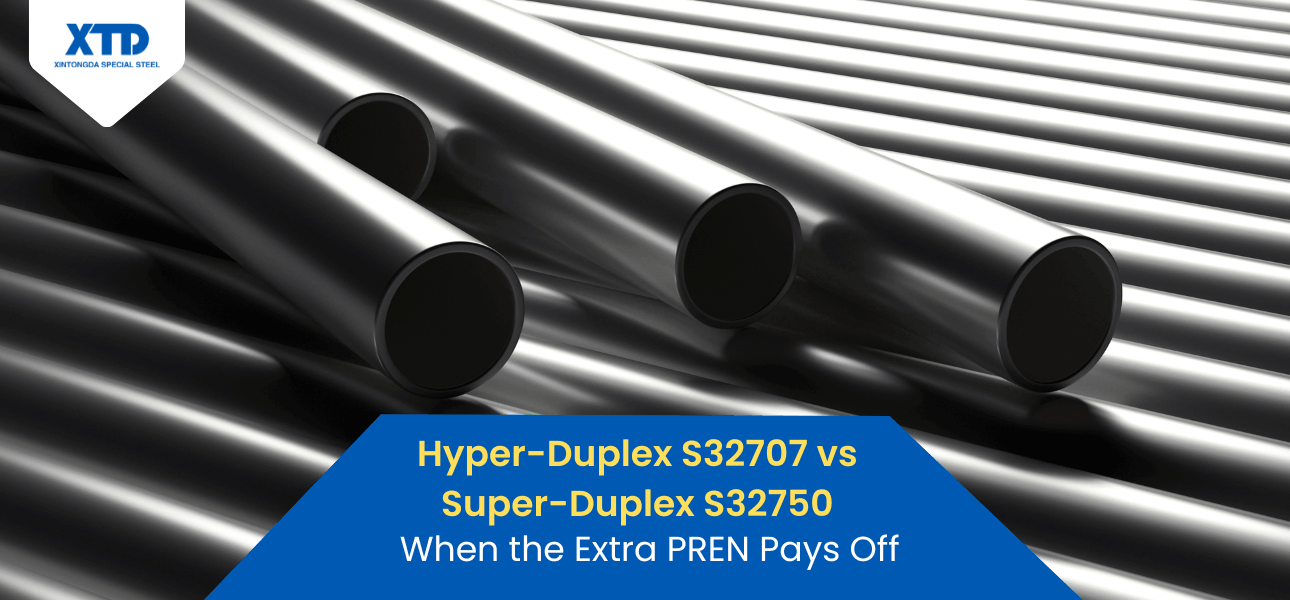
You are specifying a pipe for a chloride-intensive service, and super-duplex S32750 is starting to look marginal. The process temperature is rising, the chloride load is high, or the fluid is sour. At that point, two grades are commonly specified, UNS S32750 and UNS S32707. Both are at the very top of the duplex family. Both handle conditions that would destroy standard austenitic grades within months. The decision between them depends on a handful of variables: critical pitting temperature, chemistry, yield advantage, and whether the cost justifies the alternative, which is almost always a nickel alloy. This article gives a direct comparison of all these variables and suggestions you can use before the next project review.
What Is Hyper-Duplex Stainless Steel?
PREN (Pitting Resistance Equivalent Number) defines the boundary. Super-duplex grades have a PREN of 40+. Hyper-duplex stainless steel starts at PREN 49, which has its own performance band despite sharing the same 50:50 austenite-ferrite microstructure. The chemical difference drives everything: higher chromium, higher molybdenum, and elevated nitrogen push the PREN past 49 and shift the critical pitting temperature roughly 10 to 15°C beyond what super duplex can handle.
UNS S32707 is the most widely specified hyper-duplex grade family and is covered by ASTM A789 for seamless tubes and ASTM A790 for seamless pipes. It exists because certain chloride environments operate at high temperatures or carry enough sour contaminants to eat through S32750 in field service. When that happens, the next step without S32707 is a nickel alloy at two to three times the material cost. That context matters when evaluating the price premium.
S32707 vs S32750 At a Glance
The key chemistry and mechanical properties of both grades are compared in the table below.
| Property | S32750 (Super-Duplex) | S32707 (Hyper-Duplex) |
| PREN minimum | 40 | 49 |
| Chromium (%) | 24.0 – 26.0 | 26.0 – 29.0 |
| Nickel (%) | 6.0 – 8.0 | 5.5 – 9.5 |
| Molybdenum (%) | 3.0 – 5.0 (ASTM A790) / 3.0 – 4.5 (EN 10088-3) | 4.0 – 5.0 |
| Nitrogen (%) | 0.24 – 0.32 (ASTM A790) / 0.24 – 0.35 (EN 10088-3) | 0.30 – 0.50 |
| Min 0.2% Yield Strength | 550 MPa (ASTM) / 530 MPa (EN) | ~700 MPa |
| Min UTS | 800 MPa (ASTM) / 730 MPa (EN) | ~900 – 1,000 MPa |
| Min Elongation | 15% (ASTM) / 25% (EN) | ~25% |
| Max Hardness | 300 HB / 32 HRC (ASTM A790) | ~32 HRC |
| CPT (ASTM G48 Method A) | ~75 – 80°C | ~90°C |
Mo and N ranges for S32750 follow ASTM A790 as shown in the table above. EN 10088-3 narrows Mo to 3.0 – 4.5% and widens N to 0.24 – 0.35%. Always confirm which standard governs your order and verify against the mill certificate. For S32750 seamless pipe specifications and current stock availability, contact the Xintongda technical team directly.
Where the Extra PREN Pays Off
Hot chloride service cleanly separates the two grades. S32707 holds a CPT of approximately 90°C under ASTM G48 Method A conditions, while S32750 is at approximately 75 to 80°C. That 10-15°C margin sounds modest. In practice, it determines whether the line survives a summer temperature spike in a subsea injection riser or fails due to pitting attack inside 18 months.
Sour seawater injection and high-chloride-produced water lines push S32750 toward its limit when operating temperatures exceed 60°C and hydrogen sulfide partial pressure climbs. A hyper-duplex seamless pipe in S32707, carrying PREN 49 chemistry, keeps corrosion current nearly zero, whereas S32750 begins showing measurable mass loss in coupon testing.
HPAL (High Pressure Acid Leach) autoclave service combines acid, chloride, and elevated temperature simultaneously. That combination defeats super-duplex grades. S32707 or a nickel alloy becomes mandatory, and S32707 at roughly 50 to 100% over S32750 pricing still undercuts nickel alloys substantially.
Subsea umbilicals and small-bore tubing face a compounding risk: crevice corrosion intensifies with depth due to differential oxygen concentration, and chloride concentration at the metal surface rises under deposits. The higher PREN 49 floor on S32707 provides the reserve margin that those geometries demand.
Yield strength adds a separate argument. Published industry data puts the minimum 0.2% yield for S32707 at approximately 700 MPa against 550 MPa (ASTM) for S32750. That roughly 25 to 30% higher minimum yield allows wall thickness reduction on pressure-governed designs, which partially closes the cost gap on large-bore runs where material weight dominates fabrication cost.
Where S32750 Is Still the Right Call
Ambient-temperature seawater piping rarely justifies S32707. S32750 carries a CPT of approximately 75 to 80°C against typical seawater service temperatures of 20 to 35°C. That margin is more than sufficient and pays nothing extra to widen it further.
Size availability and lead time favor super duplex pipe heavily. S32750 is on most specialty pipe distributor shelves in sizes from ½” NB through 24″ NB, with seamless availability across most schedules. S32707 production runs are project-driven, and lead times of 16 to 24 weeks on seamless tube and pipe are normal. That difference can determine the project schedule for fast-track work.
Welding qualification maturity also remains with S32750. Procedures are widely published, consumables are stocked at welding supply houses globally, and most fabrication shops have S32750 WPS packages already qualified. S32707 requires project-specific consumable selection and tighter interpass temperature control, which adds qualification cost and schedule.
NORSOK MDS coverage makes a significant difference on North Sea projects. MDS D51, D55, D57, and D58 all cover S32750, which means project approval moves on a standard technical basis. S32707 enters every NORSOK project as a project-specified deviation, requiring additional documentation and client technical authority sign-off.
The cost gap is worth stating plainly. S32707 carries a 50 to 100% premium over S32750, varying with size, quantity, and lead time. On ambient-temperature seawater service, that premium buys no measurable corrosion benefit.
Decision Matrix by Service Condition
| Service Condition | Recommended Grade | Rationale |
| Ambient seawater piping | S32750 | CPT is sufficient; broader size availability and shorter lead time |
| Hot brine / sour seawater injection | S32707 | 10 to 15°C extra CPT margin; PREN 49 floor handles sour conditions |
| Subsea umbilicals at depth | S32707 | Crevice severity plus chloride concentration demand PREN 49 |
| Topside firewater, cold service | S32750 | Lower cost; CPT well above service temperature |
| HPAL autoclave service | S32707 or nickel alloy | Acid plus chloride plus temperature exceeds S32750 limits |
| Wall-thickness reduction goal | S32707 | Roughly 25 to 30% higher minimum yield reduces the required wall on pressure-governed designs |
Specification and Sourcing Notes
Both grades are ordered to ASTM A789 for seamless tube or ASTM A790 for seamless pipe. Specify seamless explicitly on the purchase order. Welded and welded-and-drawn product is commercially available under the same UNS designations and ASTM covers both, so the designation alone does not lock in seamless supply.
Solution anneal plus water quench is mandatory for both grades. A slow cool through the 700 to 1,000°C range precipitates sigma phase and chi phase intermetallics that destroy corrosion resistance without any visible surface change. Verify the heat treatment cycle on the mill certificate; a line item is not enough. Ask for the actual furnace records or confirmation of compliance on the 3.1 certificate.
Require ASTM A923 sigma-phase testing on every heat for both grades. Sigma formation from inadequate heat treatment can take a tested, in-specification tube and reduce its CPT by 20 to 30°C in service. For oil and gas applications where line replacement is measured in millions of dollars, A923 testing adds negligible cost against the risk it eliminates.
Request EN 10204 Type 3.1 certificates as a minimum, with 3.2 available for NORSOK and certain downstream projects requiring a third-party inspection witness. For desalination applications under specific authority requirements, 3.2 inspection is common and should be confirmed at the time of inquiry rather than the time of delivery. Use a PREN calculator to verify the heat (ladle) chemistry against the minimum requirement before accepting the heat.
NORSOK projects using S32750 move on to MDS D51, D55, D57, or D58 without deviation requests. S32707 requires a project-specific material data sheet, which needs client technical authority approval and, for some operators, a concession process that can run six to eight weeks. Factor that into the project schedule before specifying S32707 on NORSOK work.
Conclusion
S32750 remains the default grade for ambient seawater, cold chloride service, and projects where lead time and fabrication cost govern the specification. It covers the majority of duplex applications without compromise. S32707 earns its premium in a specific band: service temperatures above 75°C in chloride environments, sour seawater injection, HPAL autoclave duty, and subsea geometries where crevice severity demands PREN 49. In those conditions, S32707 is not the expensive option. Compared to nickel alloys, it is the more economical one.
Request a quotation for S32707 or S32750 seamless pipe and tube manufactured to ASTM A789 or A790, with EN 10204 3.1 or 3.2 mill test certificates and ASTM A923 test results, directly from Zhejiang Xintongda Special Steel Manufacturing Co., Ltd. If you are still working through grade selection, use the free PREN calculator to confirm whether your service chemistry clears the PREN 40 or PREN 49 threshold before finalizing the specification.