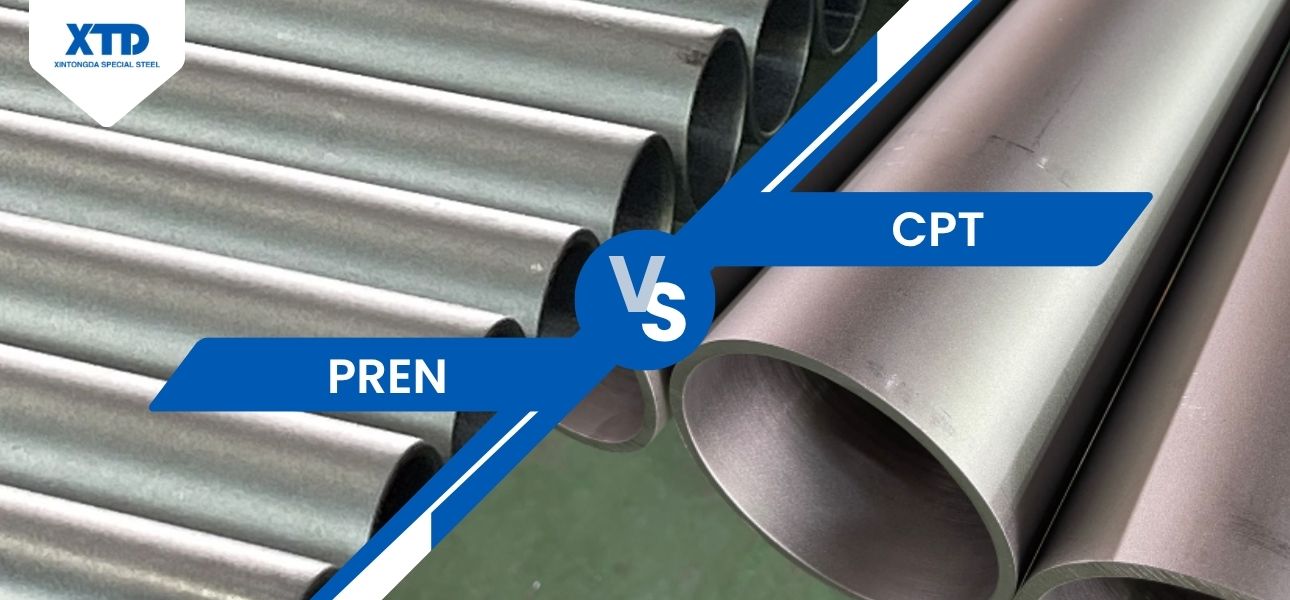
PREN (Pitting Resistance Equivalent Number) is a calculated score based on chemistry, the formula %Cr + 3.3×%Mo + 16×%N is used to compare stainless steels on paper. CPT (Critical Pitting Temperature) is the measured temperature at which pitting begins under standardised lab tests (ASTM G48 or G150). Use PREN to shortlist candidate grades, then specify CPT testing on the actual production heat to qualify it.
At Zhejiang Xintongda Special Steel Manufacturing Co., Ltd. (XTD), we manufacture high-performance seamless stainless steel pipes for corrosion-critical applications like oil and gas, desalination, and petrochemical processing. When you choose materials for harsh chloride environments, two key metrics usually dictate your selection: PREN and CPT. You will often see these terms used in material specifications, but they are measuring entirely different things.
PREN is a theoretical ranking of corrosion resistance based only on chemical composition. But CPT gives you an actual temperature at which pitting will start to occur. They are related but not interchangeable. This guide will break down what PREN is, explain what CPT means in practice, look at the key differences between them, compare common steel grades, and help you decide when to use each metric. Since 1985, XTD has 40+ years of manufacturing experience, assuring your pipeline choices will withstand severe field conditions.
What Is Pitting Resistance Equivalent Number (PREN)?
Pitting Resistance Equivalent Number, or PREN, is a theoretical score calculated from the chemical composition of a stainless steel alloy to estimate its resistance to localized pitting corrosion. For standard austenitic and duplex stainless steels, the standard formula used is:
PREN = %Cr + 3.3 X %Mo + 16 X %N
For super duplex grades that contain tungsten, we modify the equation to account for that specific element:
PREN = %Cr + 3.3 X (%Mo + 0.5 X %W) + 16 X %N
The chromium-rich passive oxide film on the steel surface is reinforced by molybdenum and nitrogen. In the PREN formula, molybdenum carries a weighting factor of 3.3, while nitrogen has the highest weighting at 16, reflecting its strong stabilising effect on the passive film against chloride attack. Standard seawater and oil & gas services require a PREN of >32. Offshore environments require a PREN of >40. PREN is only applicable to the comparison of alloys of the same microstructural family. It completely ignores external factors like surface finish, poor heat treatment or microscopic inclusions in the material.
What Is Critical Pitting Temperature (CPT)?
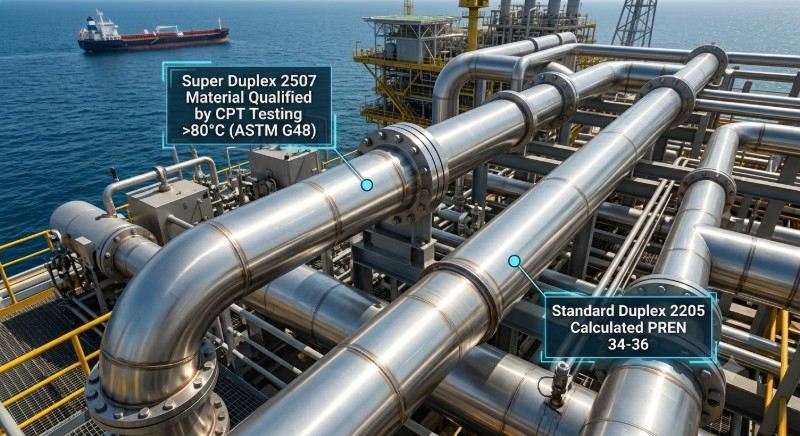
Critical Pitting Temperature (CPT) is the lowest temperature at which stable, irreversible pitting corrosion initiates on a metal surface under strictly controlled laboratory conditions. Engineers determine this value using standard tests like ASTM G48, which involves a ferric chloride solution immersion with temperature steps of 5°C, or the electrochemical ASTM G150 test using a sodium chloride solution. Small metastable pits can form below the CPT threshold but they quickly repassivate and self-heal. If the film is passive beyond the CPT, it breaks down permanently and propagates in an uncontrolled way. The beauty of CPT is that it can detect physical realities that PREN can’t see, like microstructure defects, poor heat treatment, rough surface finishes or harmful chemical inclusions. For example, 304L will pit below 15°C, 316L will fail at about 20°C to 25°C, Duplex 2205 will go up to about 50°C to 60°C and Super Duplex 2507 will remain safe above 80°C under standard ASTM G48 testing. This CPT value is a basic design limitation for processing plants with the safety margin.
PREN vs CPT: Key Differences
There are 5 key differences between PREN and CPT that you must keep in mind during project design.
| Basis | PREN | CPT |
| Type of Metric | Theoretical calculation | Empirical laboratory test |
| Governing Standard | Chemical composition formulas | ASTM G48 / ASTM G150 |
| Variables Tracked | Only Cr, Mo, N, W percentages | Microstructure, surface finish, chemistry |
| Main Limitation | Ignores processing and defects | Test takes time and destroys samples |
| Primary Use Case | Initial material screening | Final batch quality qualification |
Essentially, PREN serves as an initial screening tool, while CPT acts as a final empirical confirmation tool. This distinction matters because raw chemistry numbers can mislead you. A recent study published in Nature compared two different batches of Duplex 2205 stainless steel. One batch with a higher calculated PREN actually had a lower CPT in testing due to hidden inclusions of calcium oxide. These physical flaws just are not detected by PREN and this is why physical CPT testing is still required.
PREN and CPT Values for Common Stainless Steel Grades
The table below shows typical PREN values and approximate laboratory CPT ranges for several common stainless steel grades for aggressive chloride services.
| Grade | UNS Designation | Typical PREN | Approximate CPT (°C, ASTM G48) |
| 304L | S30403 | 18–20 | Below 15 |
| 316L | S31603 | 23–28 | 20–25 |
| 904L | N08904 | 34–36 | 40–50 |
| Duplex 2205 | S32205 | 34–36 | 50–60 |
| Super Duplex 2507 | S32750 | 41–43 | Above 80 |
| Super Duplex S32760 | S32760 | 41–43 | Above 80 |
| SMO 254 | S31254 | 42–44 | 60–75 |
The actual values will always depend a lot on the specific heat chemistry and the mill processing, and you should always check these figures against the mill test certificate for the actual mill.
When to Use PREN and When to Use CPT
PREN is most useful in the early stages of material selection when you need to narrow down candidate alloys from a large list. The best workflow is to use PREN to narrow down commercial grades that meet your baseline requirements, e.g., a minimum of 32 for seawater pipelines, or 40 for hot, sour chloride environments. Then you specify physical CPT testing by ASTM G48 Method E or ASTM G150 to qualify the specific production heat from the mill. This is exactly the approach often demanded by major international standards such as the NORSOK material data sheets (MDS) that require a minimum PREN on the mill certificate in addition to actual CPT testing. XTD possesses a complete production line and a strong quality management system, both fully certified according to NORSOK M-650. This allows us to offer you both rigorous chemical PREN verification and physical CPT corrosion testing during your pipe production.
Frequently Asked Questions
What Does PREN Stand For?
PREN stands for Pitting Resistance Equivalent Number. This is a numerical index based on the actual weight percentages of certain elements in the alloy (chromium, molybdenum, nitrogen, and sometimes tungsten).
What Is a Good PREN Value for Seawater?
For standard marine or raw seawater applications, you will typically require a minimum PREN of above 32 to avoid localized pitting. In the case of highly aggressive offshore piping or hot sour service, projects will always call for a value greater than 40, requiring the use of super duplex materials such as S32750 or S32760.
Can Two Alloys With the Same PREN Have Different CPT Values?
Yes, and it happens regularly in real-world production. A 2024 study published in npj Materials Degradation (Ran et al., 2024) compared two commercial heats of Duplex 2205 stainless steel and showed that a higher theoretical PREN does not guarantee a higher CPT if the batch has manufacturing problems. Physical defects such as calcium oxide inclusions or improper heat treatment will lower the measured CPT while leaving the PREN calculation completely unchanged.
Is PREN or CPT More Reliable?
CPT is a much more reliable measure of the actual performance of the field, as it empirically confirms, by physical testing, the finished pipe under actual electrochemical stress. PREN is still useful, but as a theoretical screening tool only in the early planning phase. Always check both metrics together for critical projects.