The PREN calculation gives engineers a single number for comparing the chloride pitting resistance of stainless and duplex alloys without juggling 3 separate element ranges. This post covers the formula, 5 worked examples with the full arithmetic shown, what the resulting brackets mean in practice, and where PREN produces misleading answers. The math takes 30 seconds with a mill certificate in hand.
What Is PREN and Why It Matters
The pitting resistance equivalent number is an empirical index that estimates resistance to chloride-induced pitting by combining the 3 elements that most influence it: chromium, molybdenum, and nitrogen. Each contributes differently: chromium builds the passive film, molybdenum stabilizes it at high chloride concentrations, and nitrogen acts as a solid-solution strengthener at the pit initiation site.
PREN stainless steel values appear in NORSOK M-001, materials selection guides, and purchase specifications, where a minimum PREN guarantees a grade capable of the service chloride environment. A single number makes grade shortlisting faster than reading 3 separate element ranges per alloy.
Set the caveat now: PREN ranks alloys on one axis. It does not account for heat treatment quality, crevice geometry, temperature, or chloride concentration. The limitations section below covers where that matters.
The PREN Formula
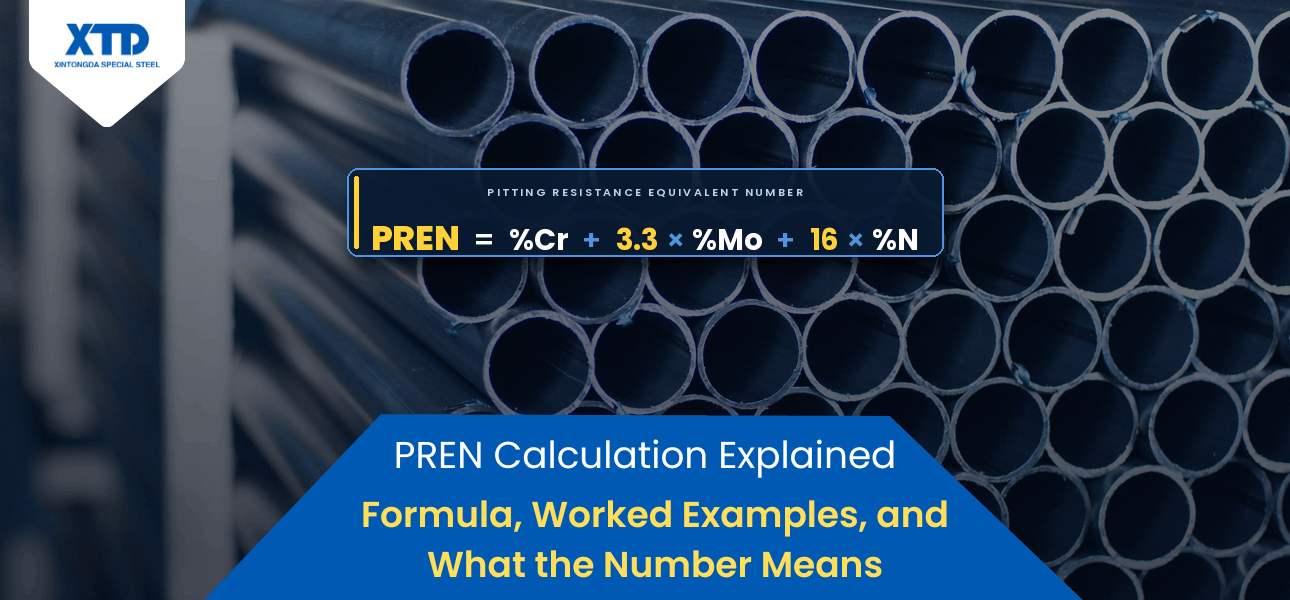
PREN = %Cr + 3.3 x %Mo + 16 x %N
For tungsten-bearing grades, the PREW variant adds tungsten with a 0.5 weighting factor:
PREW = %Cr + 3.3 x (%Mo + 0.5 x %W) + 16 x %N
Nitrogen factor note: published literature reports values ranging from 12 to 30 for the nitrogen coefficient; this post uses the widely adopted PREN equation, PREN = %Cr + 3.3×%Mo + 16×%N, which IMOA, NORSOK, and industry literature commonly reference.
Input the chemistry from a mill test certificate for an as-delivered result, or use the UNS specification midpoint to compare grades on paper before ordering.
Worked Examples by UNS Designation
Every calculation uses the UNS specification midpoint chemistry. The arithmetic appears in full.
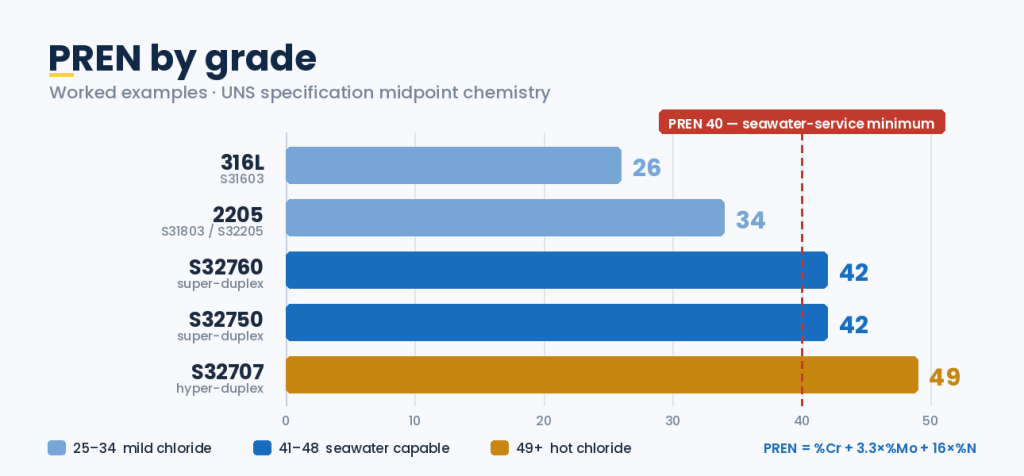
UNS S31603 (316L austenitic) 17.0 + (3.3 x 2.5) + (16 x 0.05) = 17.0 + 8.25 + 0.80 = PREN 26
316L seamless pipe sits at the lower boundary of mild-chloride service. Coastal atmosphere and process water applications at moderate temperatures suit it; sustained seawater immersion does not.
UNS S31803 / S32205 (22Cr duplex) 22.0 + (3.3 x 3.0) + (16 x 0.15) = 22.0 + 9.90 + 2.40 = PREN 34
Note for procurement: S31803 lower-bound chemistry can calculate to PREN 33, while S32205 tighter compositional limits guarantee approximately 34 minimum. That 1-point difference explains why S32205 duplex pipe dual-certifies as S31803, but the reverse does not hold true.
UNS S32750 (super-duplex) 25.0 + (3.3 x 3.8) + (16 x 0.27) = 25.0 + 12.54 + 4.32 = PREN 42
S32750 seamless pipe clears the 40-point threshold that most seawater service specifications require. Offshore topside piping, seawater cooling lines, and desalination high-pressure circuits sit comfortably within this bracket.
UNS S32760 (tungsten-bearing super-duplex, PREW applies) 25.0 + 3.3 x (3.5 + 0.5 x 0.75) + (16 x 0.25) = 25.0 + 12.79 + 4.00 = PREW 42
S32760 seamless pipe reaches the same bracket as S32750 via a different alloy route. Tungsten substitutes partially for molybdenum, and the PREW formula captures that equivalence.
UNS S32707 (hyper-duplex) 27.5 + (3.3 x 4.5) + (16 x 0.40) = 27.5 + 14.85 + 6.40 = PREN 49
S32707 seamless pipe enters the hyper-duplex bracket at 49. The brief on hyper-duplex vs. super-duplex separation: super-duplex grades cluster between 41 and 48; hyper-duplex grades exceed 48, targeting hot chloride and sour seawater environments where even S32750 falls short of the corrosion margin required.
PREN Brackets and What They Mean
| PREN range | Typical service | UNS examples |
| Below 25 | Fresh water, indoor atmospheric | S30400, S30403 |
| 25 to 34 | Mild chloride, process water | S31603, S31703, S31000 |
| 35 to 40 | Moderate chloride, brackish water | S31803 / S32205, N08904 |
| 41 to 48 | Seawater capable | S32750, S32760, S31254 |
| 49 and above | Hot chloride, sour seawater | S32707, S32654 |
The bracket boundary at 40 appears in most offshore materials selection standards as the minimum for seawater-wetted service. A grade calculating to 39 may still corrode in the application a 42-PREN grade handles without incident.
PREN duplex stainless steel grades span 3 brackets depending on whether the grade is lean duplex, standard duplex, super-duplex, or hyper-duplex. The worked examples above cover the range from 34 to 49.
When PREN Can Mislead You
Microstructure overrules chemistry. Sigma-phase precipitation from incorrect solution annealing or slow cooling can reduce a super-duplex grade’s practical pitting resistance below that of 316L, even when the chemistry calculates to PREN 42. Require ASTM A923 testing on all duplex and super duplex material to confirm microstructure quality before accepting mill cert chemistry at face value.
Crevice corrosion doesn’t follow open-surface pitting behavior. PREN tracks open-surface pitting initiation and crevice-dominated service needs assessment with CCT (ASTM G48 Method B), which tests the crevice condition directly.
Temperature and chloride concentration don’t enter the formula. PREN ranks alloys against each other; it says nothing about whether any of them will last 20 years at 80°C in a 50,000 ppm chloride stream. Critical pitting temperature (CPT) testing fills that gap.
Scope: PREN applies to stainless steels and Ni-Cr-Mo alloys. Applying it to titanium or copper alloys produces a meaningless number because their corrosion mechanisms don’t follow the same elemental model.
Run Your Numbers on the PREN Calculator
Enter Cr, Mo, N, and W values from a mill certificate or specification sheet into the free PREN calculator and get the PREN with bracket interpretation instantly. Two uses cover most engineering workflows: comparing candidate grades on paper before issuing a purchase order and verifying that delivered material chemistry meets the PREN your specification assumed.
Conclusion
PREN ranks chloride pitting resistance in 30 seconds with a mill certificate in hand, and the bracket table converts the number into a service environment read immediately. But microstructure quality determines whether the chemistry the formula uses reflects reality in service. Always pair PREN with ASTM A923 testing on duplex and super-duplex grades.
Run your alloy chemistry through the PREN calculator now, or request a quote with full mill test certificates to verify actual heat chemistry against your PREN specification requirement.