A mill test certificate lands on your desk, full of numbers and codes, and the real question isn’t whether it exists; it’s whether what’s written on it actually matches what you ordered. At Zhejiang Xintongda Special Steel Manufacturing Co., Ltd., we see buyers treat an MTC as a formality, particularly when larger orders involve material sourced from multiple mills. As a stainless steel seamless pipe manufacturer in China, we use MTC review and heat traceability as important parts of material verification. This guide goes through what to check on that document, section by section, so the certificate becomes a verification tool rather than a formality you file away unread.
What Is a Mill Test Certificate (MTC)?
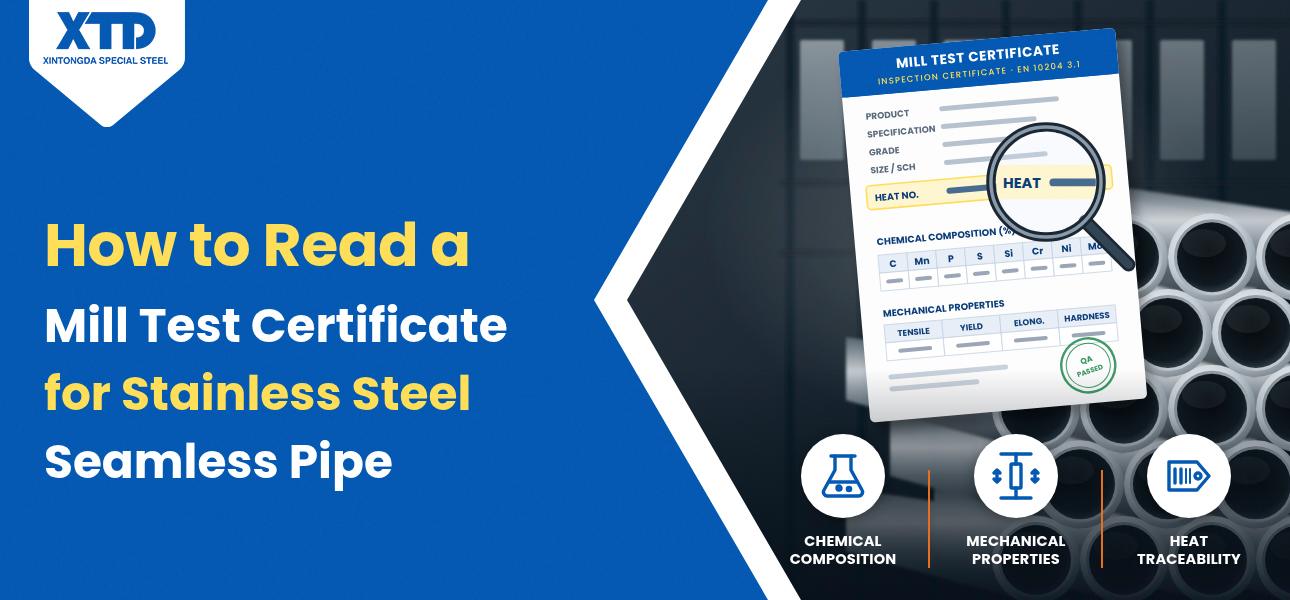
An MTC, sometimes called an MTR (Material Test Report), is the mill’s own record of what a specific batch of pipe actually is: its chemical composition, mechanical properties, dimensions, and the standard it was produced against. Think of it less as paperwork and more as the pipe’s identity document. Every legitimate stainless steel seamless pipe shipment should arrive with one, tied to a specific heat number that traces the material back to its production batch. The catch is that having a certificate doesn’t guarantee it’s accurate for the material in front of you, which is exactly why knowing how to read one matters.
Key Information Found on an MTC
Heat Number
The heat number is the identification of the specific batch of metal used to construct the pipe. The marking shall be identical to that on the pipe and on the certificate so that the material can be traced back to its production records.
Grade and Applicable Specification
The MTC should state the grade of stainless steel and the material specification, such as ASTM A312 for seamless and welded austenitic stainless steel pipe, for example. Compare this information with the purchase order and accept the material.
Chemical and Mechanical Test Results
Verify that the mechanical properties and reported chemical composition are in conformity with the appropriate specification. Mechanical properties such as tensile strength, yield strength, elongation, etc. The chemical results will indicate the percentage each of the distinct alloying elements is.
How to Check Chemical Composition
Compare every listed element, chromium, nickel, molybdenum, carbon, and others, against the specification’s allowable range rather than skimming for a rough match. A composition that’s technically within range but sitting at the weak end of that range can still affect corrosion performance, particularly for chloride-heavy service. If you’re evaluating resistance to pitting or crevice corrosion specifically, a PREN calculation can provide an additional comparison because it considers chromium, molybdenum, and nitrogen together.
How to Check Mechanical Properties
Yield strength, tensile strength, elongation, and hardness should all appear on the certificate, each with a pass/fail threshold set by the applicable specification. These numbers matter because they confirm the pipe can handle the pressure and stress it’s being installed for, not just that it’s the right alloy family. A pipe can carry the correct chemical composition and still fail mechanical requirements if the mill’s processing wasn’t controlled properly, so checking both sections independently is worth the extra few minutes.
Understanding Heat Numbers and Traceability
The heat number is what ties a specific length of pipe back to the exact production batch it came from, and it should match between the physical pipe marking and the certificate in your hand. Mismatched heat numbers or a certificate that doesn’t correspond to the pipe actually delivered is one of the more common issues we flag when working with buyers importing from multiple mills across globally. If a shipment mixes pipe from different heats, each heat needs its own certificate; a single blanket MTC covering several distinct batches isn’t a substitute for proper traceability.
How to Verify Standards and Specifications
Confirm the certificate references the exact specification your project calls for, not a broadly similar one. ASTM, EN, and JIS standards cover overlapping but distinct requirements, and a pipe certified to one doesn’t automatically satisfy a project that specifies another; understanding the practical differences between these standards is worth reviewing separately if your project involves cross-border sourcing. Where the specification itself has multiple grade options within it, decoding exactly which sub-grade the certificate lists matters just as much as confirming the parent standard.
Common MTC Mistakes Buyers Should Avoid
Accepting the Certificate Without Cross-Checking
MTC should not be seen as a stand-alone document. Compare the certificate to the purchase order, pipe marks, grade, dimensions, and applicable specification to ensure that the documented material is as ordered.
Heat Number Discrepancies Ignored
If the heat number on the pipe does not match the MTC the direct traceability relationship is broken. The material paperwork should be reviewed before the shipment is accepted if the numbers do not match.
Overlooking Missing Test Information
A certificate may contain test findings but not enough information to adequately evaluate the results. Verify that the material supplied is supported by the required test methods, specification criteria, and relevant results. These checks are also part of broader procurement considerations, including supplier credentials, material specifications, inspection requirements, and delivery terms.
MTC Verification Checklist
Check that the heat number on the shipment matches the pipe marking and that the specification fits the purchase order before receiving any kind of shipment. Chemical composition shall be within range, mechanical qualities are within minimum criteria, dimensions are within NPS and schedule requirements, and the name and origin of the producer are clearly stated. This will be beneficial if the pipe is used for long-term maintenance or warranty. Review the test techniques and results and maintain the heat number certificate for future reference.
Each shipment takes a few extra minutes to read an MTC accurately, but it is the difference between validating what you received and believing the label matches the contents. At XTD, we view MTC review as a part of material verification, not a bureaucratic exercise. We are a dependable stainless steel seamless pipe manufacturer in China, and we provide material paperwork that may allow buyers to verify the supplied grade, specification, test results and heat traceability before the pipe enters service.