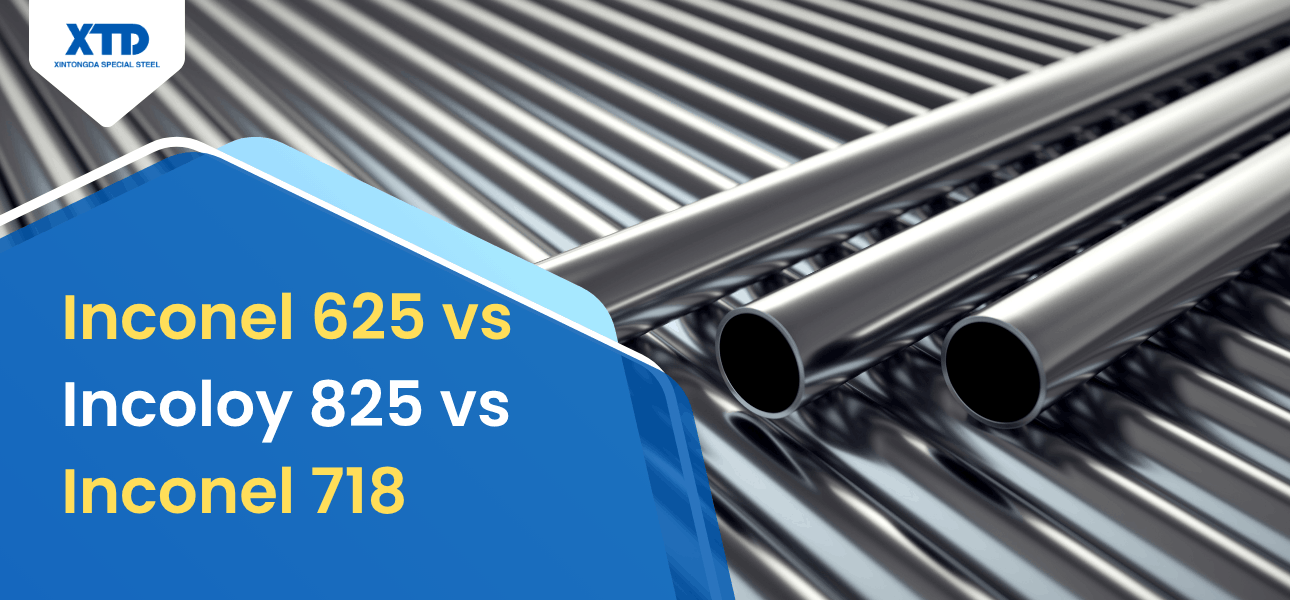
Inconel 625 and Inconel 718 share a nickel base, but Incoloy 825 does not, despite a similar name. That single distinction governs how each alloy behaves under corrosion and heat, well before the chemistry tables begin dividing on molybdenum and niobium content. UNS N06625, N08825, and N07718 serve applications ranging from subsea flowlines to downhole completions, and specifying one in place of another carries a real financial cost. This article examines chemistry, mechanical properties in both annealed and aged states for grade 718, corrosion behavior, cost ranking, and a selection matrix suited to piping decisions.
Each alloy serves different requirements
Inconel 625 (UNS N06625) is a solid-solution-strengthened Ni-Cr-Mo alloy, and corrosion resistance stands as its defining trait. It reaches usable strength without heat treatment, which simplifies fabrication scheduling considerably. Inconel 718 (UNS N07718) is precipitation-hardenable Ni-Cr-Nb, and after age hardening, it retains extreme strength to approximately 650°C, a property established in aerospace applications and subsequently adapted for piping through downhole use.
Incoloy 825 (UNS N08825) follows a different path: an Fe-Ni-Cr-Mo composition with a copper addition, priced below the Inconel grades on account of its lower nickel content, and it performs reliably in sulfuric acid and sour-service duty.
Inconel and Incoloy remain industry-standard family names, used consistently in procurement documents, yet the naming convention causes frequent confusion: 825 is Incoloy, not Inconel, and any comparison of Incoloy 825 vs Inconel 625 should begin from its iron-based distinction.
Composition Compared
Approaching these three as engineering decisions, rather than spec sheet entries, resolves most of the confusion. High molybdenum content in N06625 vs N07718 accounts for 625’s chloride pitting resistance. Copper accounts for 825’s performance in sulfuric acid. Niobium enables 718’s precipitation hardening and the strength that follows.
| Property | N06625 (Inconel 625) | N08825 (Incoloy 825) | N07718 (Inconel 718) |
| Family | Ni-Cr-Mo, solid-solution | Fe-Ni-Cr-Mo, Cu-bearing | Ni-Cr-Nb, precipitation hardenable |
| %Ni | 58.0 min | 38.0 – 46.0 | 50.0 – 55.0 |
| %Cr | 20.0 – 23.0 | 19.5 – 23.5 | 17.0 – 21.0 |
| %Fe | 5.0 max | balance | balance |
| %Mo | 8.0 – 10.0 | 2.5 – 3.5 | 2.8 – 3.3 |
| %Nb + Ta | 3.15 – 4.15 | – | 4.75 – 5.50 |
| %Ti | 0.40 max | 0.6 – 1.2 | 0.65 – 1.15 |
| %Al | 0.40 max | 0.2 max | 0.20 – 0.80 |
| %Cu | – | 1.5 – 3.0 | 0.30 max |
This is a nickel chromium alloy comparison in its most literal sense: each percentage point above corresponds to a specific service outcome rather than a marketing claim.
Mechanical Properties in Annealed and Aged Conditions
These figures carry meaning only when read alongside the heat treatment condition, particularly for 718. Every 718 datapoint below carries its condition label, since the same UNS number represents two distinct materials depending on the treatment applied.
| Property | N06625 annealed | N08825 annealed | N07718 annealed | N07718 aged |
| Min 0.2% yield (MPa) | 414 (B444 Grade 1) | 241 (B423) | approx. 410 | approx. 1035 |
| Min UTS (MPa) | 827 (B444 Grade 1) | 586 (B423) | approx. 725 | approx. 1240 |
| Max structural service temp (°C) | approx. 650 | approx. 540 | approx. 650 | approx. 650 |
| Typical hardness | approx. 25 HRC | approx. 22 HRC | approx. 25 HRC | approx. 40 HRC |
The increase from 410 MPa to 1035 MPa yield demonstrates the purpose of Inconel 718 age hardening: identical chemistry, markedly different service capability. ASTM B444 Grade 2 solution-annealed 625 carries lower minimums, 276 MPa yield and 690 MPa UTS, so piping specifications should reference Grade 1 annealed explicitly to secure the full 414/827 strength.
Corrosion Performance
Chloride pitting resistance belongs decisively to 625, owing to its molybdenum content. 825 withstands moderate chloride exposure without difficulty, while 718’s lower molybdenum level restricts its use in the same service. Sour service reverses this ranking to some degree: 825 stands as the cost-effective, qualified choice for sour gas tubing, 625 carries broad qualification as well, and 718 encounters
NACE hardness restrictions require aging into a specific window to remain compliant. Sulfuric acid handling belongs to 825 on account of its copper content; 625 performs adequately in dilute conditions, while 718 is not suited to this service. At elevated temperatures, 625 offers the strongest oxidation resistance of the three, a relevant property for any nickel alloy high temperature pipe application. Detailed hardness compliance questions are addressed in the NACE MR0175 guide rather than repeated here.
Standards, Cost, and Availability
Standards differ by grade in ways that carry weight on a purchase order. Inconel 625 pipe in seamless form falls under ASTM B444 as a dedicated standard, with B622 serving as a broader umbrella, and Grade 1 should be specified to secure full piping strength. Incoloy 825 pipe in seamless form falls under ASTM B423, its own dedicated standard. Inconel 718 pipe references ASTM B637 for bar and forgings, though seamless tubulars are typically project-specified, so the applicable standard should be confirmed directly on the purchase order rather than assumed.
Cost ranks from lowest to highest as 825, then 625, then 718; multipliers are omitted here, as 718 pricing varies considerably with size and heat treatment condition. Availability follows a similar pattern: 825 and 625 are held in stock at most nickel-alloy distributors in common sizes, while 718 is typically produced to order, often with extended lead times for seamless tubulars.
Selection Matrix
| Service | Recommended UNS |
| Subsea umbilicals and sour seawater | N06625 |
| Sour gas downhole tubing | N08825 (N09925 Incoloy 925, where higher strength is required) |
| Sulfuric acid handling | N08825 |
| Chemical plant heat exchanger tubes | N08825 for cost, N06625 for severity |
| High-pressure high-temperature downhole completions | N07718 aged to NACE qualifying hardness |
| FPSO topsides hot seawater | N06625 |
Conclusion
Specify Inconel 625 when corrosion resistance is the primary concern. Select Incoloy 825 when sour service requirements must align with budget constraints. Choose Inconel 718 when strength at elevated temperature governs the design, and NACE hardness can be achieved through age hardening. Request a quote for Inconel 625, Incoloy 825, or Inconel 718 seamless pipe with mill test certification and NACE-compliant documentation. Xintongda Special Steel manufactures across the nickel alloy family at its mill in Songyang, Zhejiang.