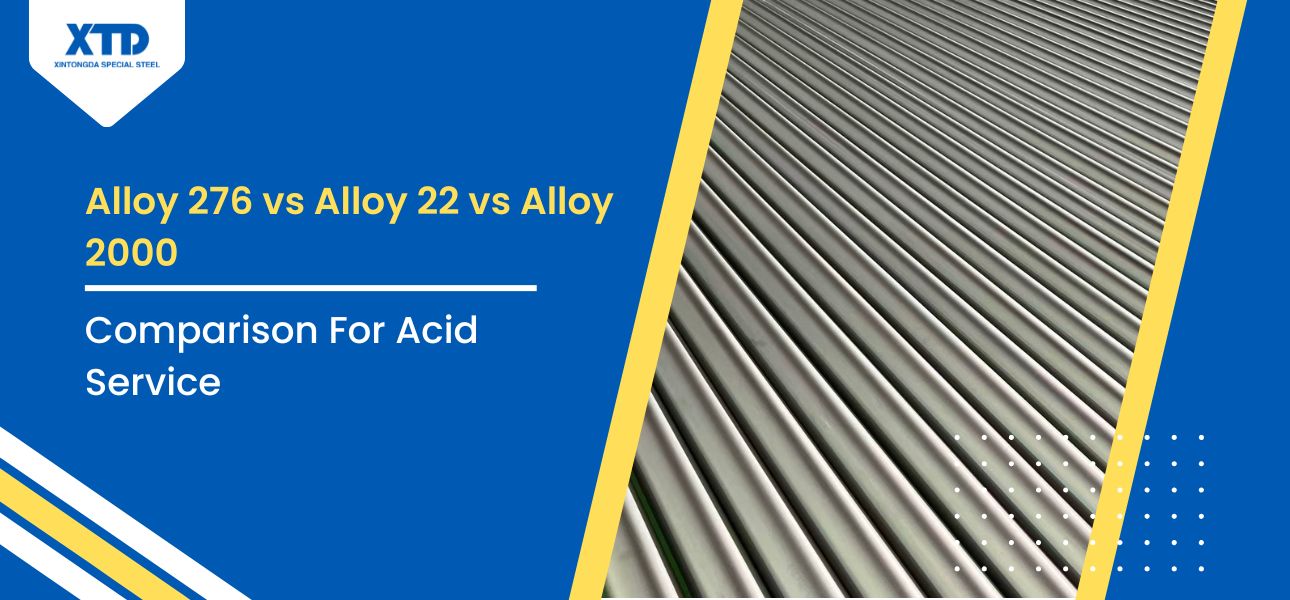
Hot hydrochloric acid, mixed pickling baths, wet chlorine scrubbers, and flue gas desulfurization (FGD) media share one trait: they compromise super-duplex stainless steel. When acid service defeats super-duplex, the Alloy 276 vs Alloy 22 decision is where most engineers start, with Alloy 2000 entering the comparison whenever sulfuric acid drives the specification.
Three grades that cover the widest range of these aggressive conditions are Alloy 276 (UNS N10276), Alloy 22 (UNS N06022), and Alloy 2000 (UNS N06200). This article covers their chemistry, acid-by-acid performance verdicts, weldability differences, and a service-matched selection matrix.
The Ni-Cr-Mo Alloy Family at a Glance
Nickel-chromium-molybdenum alloy design rests on three metallurgical levers. High nickel shuts down chloride stress corrosion cracking. Molybdenum delivers resistance to reducing acids, particularly hydrochloric and dilute sulfuric streams. Chromium serves as the oxidizing agent, handling nitric acid and mixed-acid media containing oxidizing species.
Alloy 276 has one of the longest and best-documented field service records among modern Ni-Cr-Mo corrosion-resistant alloys. Engineers reach for it when acid chemistry is unclear or mixed, because its balanced Cr and Mo content tolerates both reducing and mild oxidizing conditions. Alloy 22 increases chromium content for oxidizing service, making it the nickel-chromium-molybdenum alloy of choice where nitric acid or FGD media dominate. Alloy 2000 keeps molybdenum high and adds copper, targeting sulfuric acid across a wider concentration band. All three fall under ASTM B622 for seamless pipe and tube, and procurement documents reference them by UNS designation throughout.
Composition Compared
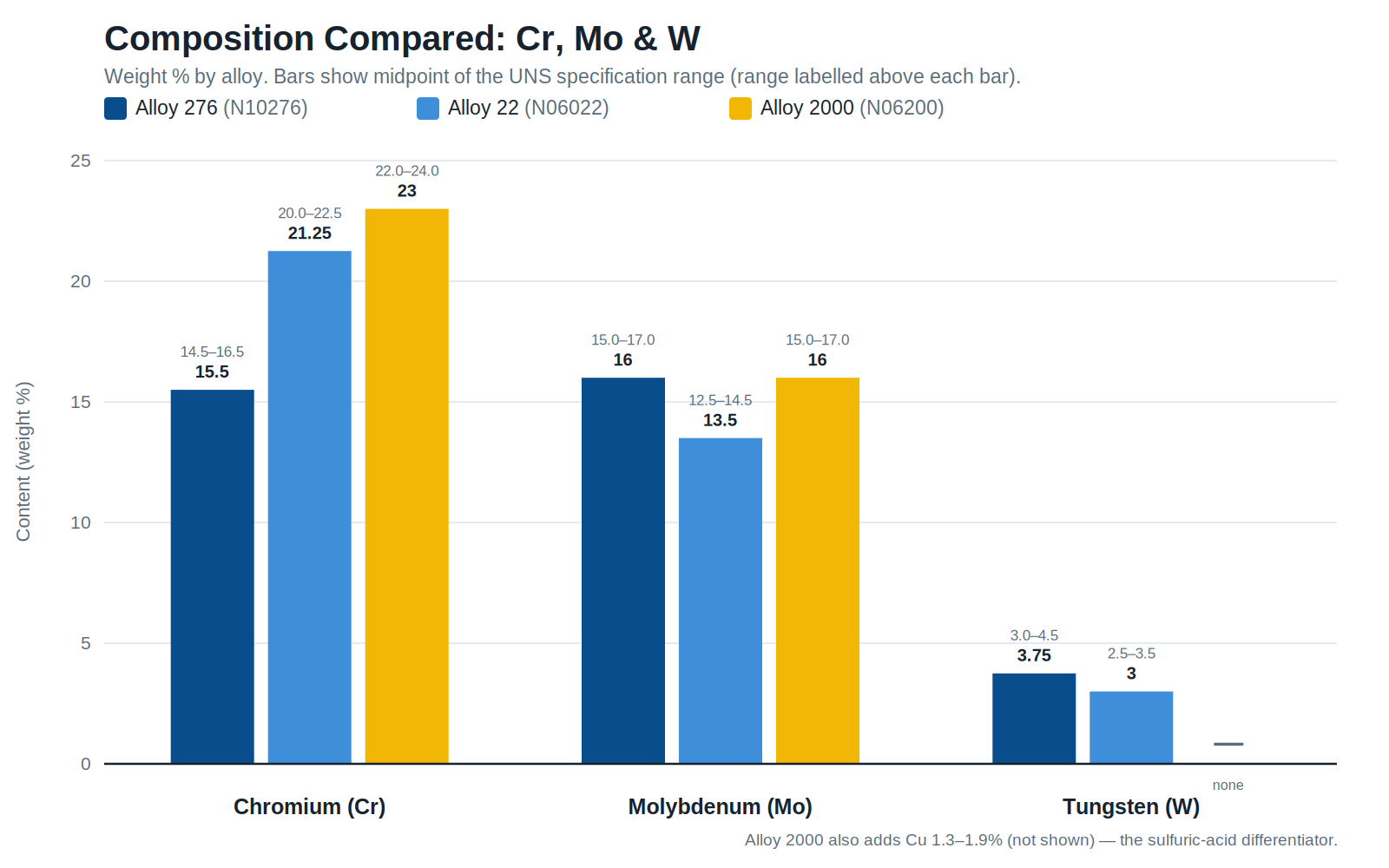
Each chemistry difference encodes a specific corrosion engineering decision.
| Grade | UNS | %Cr | %Mo | %W | %Fe | Other |
| Alloy 276 | N10276 | 14.5 – 16.5 | 15.0 – 17.0 | 3.0 – 4.5 | 4.0 – 7.0 | — |
| Alloy 22 | N06022 | 20.0 – 22.5 | 12.5 – 14.5 | 2.5 – 3.5 | 2.0 – 6.0 | — |
| Alloy 2000 | N06200 | 22.0 – 24.0 | 15.0 – 17.0 | — | 3.0 max | Cu 1.3 – 1.9% |
Reading N10276 vs N06022 side by side: Alloy 22 trades roughly 2.5 percentage points of molybdenum for 6 additional points of chromium, shifting performance from reducing-acid dominance toward oxidizing-acid resistance. Alloy 2000 recovers high molybdenum, drops tungsten entirely, and introduces copper at 1.3 to 1.9%. That copper addition raises performance in the intermediate sulfuric acid concentration range where neither purely reducing nor purely oxidizing conditions govern. Alloy 276 remains the balanced standard: mid-chromium, the highest combined Mo plus W loading, and the largest published corrosion database behind it.
Which Alloy for Which Acid
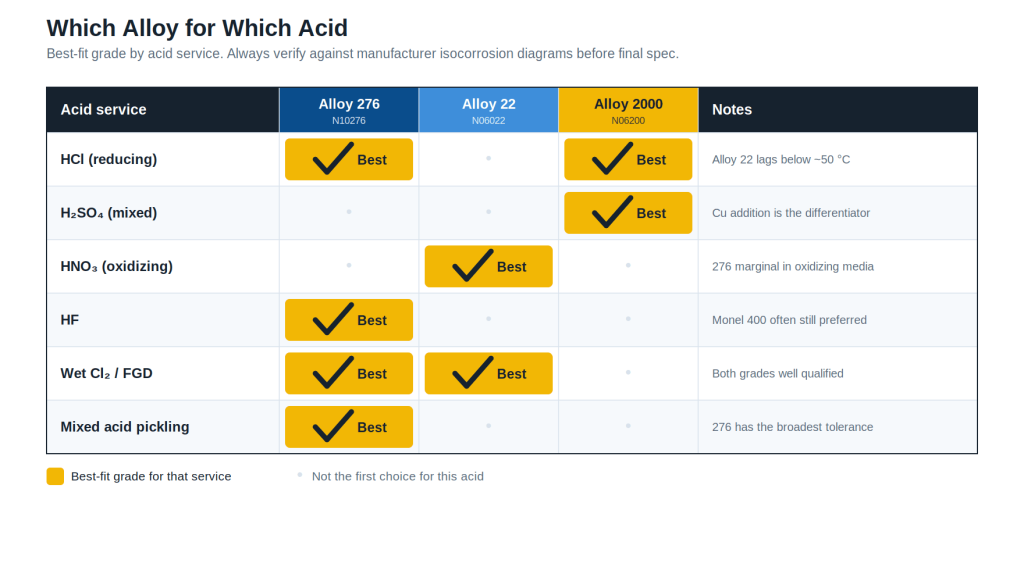
Match acid service to chemistry first; verify against manufacturer-published isocorrosion diagrams before finalizing the specification.
| Acid service | Best choice | Notes |
| HCl (reducing) | Alloy 276 or 2000 | Alloy 22 performance lags below approximately 50°C |
| H2SO4 (mixed) | Alloy 2000 | Cu addition is the differentiator |
| HNO3 (oxidizing) | Alloy 22 | Alloy 276 shows marginal behavior in oxidizing media |
| HF | Alloy 276 | Monel 400 is often still preferred for HF service |
| Wet Cl2 / hypochlorite (FGD) | Alloy 22 or 276 | Both grades carry strong qualification records |
| Mixed acid pickling | Alloy 276 | Broadest tolerance across mixed baths |
Engineers specifying Alloy 276 pipe for HCl or pickling service should confirm the exact temperature and concentration against the alloy producer’s isocorrosion diagram before committing to a wall schedule. No tabular summary substitutes for those curves in a critical service decision. FGD scrubber alloy selection for inlet ducting typically resolves to Alloy 22 or 276 depending on chloride loading and inlet temperature; both acid-resistant nickel alloy grades carry published field qualification data for that duty, and the final decision often rests on local fabricator experience with the grade rather than metallurgical performance alone.
Weldability and Fabrication
All three grades weld in solution-annealed condition with matching filler and require solution anneal plus water quench after hot working. Confirm the sequence on the mill certificate before releasing the pipe to a fabricator.
The sharpest distinction in the Ni-Cr-Mo group is between Alloy 276 and Alloy 22 during multi-pass welding. Alloy 276’s higher molybdenum raises the risk of TCP (topologically close-packed) phase precipitation in weld heat-affected zones when wall thickness accumulates heat input across passes. Alloy 22 pipe carries lower molybdenum and higher chromium, which reduces the precipitation tendency without sacrificing corrosion performance in oxidizing service. Heavy-section fabricators specifying thick nozzles or multi-pass welds on acid reactor internals regularly choose Alloy 22 for exactly this weldability advantage.
Alloy 2000 presents a different challenge: it is the newest of the three, so qualified welders and logged N06200 procedures are scarcer in most fabrication shops than the decades of N10276 and N06022 practice. Procurement teams should verify welder qualification records and confirm procedure qualification tests before releasing Alloy 2000 pipe to a new fabrication source. For projects where the schedule is tight, this scarcity alone can tip the selection back toward Alloy 276 or 22 even when Alloy 2000’s copper addition would otherwise make it the chemical fit.
Standards, Cost, and Lead Time
All three grades meet the same primary seamless tube standard; cost and availability diverge substantially across the family.
| Grade | Relative cost vs 316L | Lead time | Notes |
| Alloy 276 (N10276) | Approx. 5 to 7x | Stocked | Lowest cost in the family, widest field experience |
| Alloy 22 (N06022) | Approx. 6 to 8x | Stocked | Carries a 10 to 20% premium over Alloy 276 |
| Alloy 2000 (N06200) | Approx. 8 to 10x | Made to order | Niche grade; expect extended lead times |
ASTM B622 spec covers seamless pipe and tube for all three. Companion standards include B619 for welded pipe, B574 for rod, B575 for plate, and B564 for forgings. All three receive acceptance under NACE MR0175 / ISO 15156 in solution-annealed condition within the alloy-specific rows of that standard. Cost ratios are approximate ranges; actual multipliers vary with size, wall schedule, quantity, and market timing.
Selection Matrix by Service
When acid chemistry and operating temperature are both known, this matrix narrows Ni-Cr-Mo alloy selection before the isocorrosion diagram review. Petrochemical applications that handle variable feedstocks or intermittent acid cleaning cycles default to Alloy 276 for this reason: when acid chemistry shifts seasonally or with crude slate, the grade with the widest corrosion tolerance cuts re-specification risk across the asset life.
| Service | Recommended grade |
| FGD scrubber inlet and outlet | Alloy 22 or 276 |
| Mixed HCl and H2SO4 pickling | Alloy 2000 |
| Concentrated H2SO4 handling | Alloy 2000 |
| HF alkylation cold service | Alloy 276 (or Monel 400) |
| Pharma reactor, mixed acids | Alloy 22 |
| Unknown or variable acid | Alloy 276 (broadest tolerance) |
Petrochemical applications that handle variable feedstocks or intermittent acid cleaning cycles default to Alloy 276 for this reason: when acid chemistry shifts seasonally or with crude slate, the grade with the widest corrosion tolerance cuts re-specification risk across the asset life.
Conclusion
Three clear verdicts: Alloy 276 for reducing acids and services where acid chemistry varies or stays undefined; Alloy 22 for oxidizing media and heavy-section fabrication where TCP-phase weld risk must stay controlled; Alloy 2000 for sulfuric acid handling across a broad concentration range. Request a quote for Alloy 276, Alloy 22, or Alloy 2000 seamless pipe to ASTM B622 with full mill chemistry certification and NACE-compliant documentation from Xintongda Special Steel, which manufactures the complete Ni-Cr-Mo alloy family at its mill in Songyang, Zhejiang.