
Stainless Steel Pipes & Tubes for the Desalination Industry
The Growing Demand for Desalination
The global desalination market was valued at approximately USD 27 billion in 2025 and is projected to reach USD 59 billion by 2034, growing at a CAGR of roughly 8–11%. There are now over 20,000 desalination facilities operating worldwide, supplying freshwater to more than 300 million people. New plant construction in 2024 alone required over 1,300 km of corrosion-resistant pipeline. Seawater Reverse Osmosis (SWRO) has become the dominant technology across most new projects. Demand is concentrated in the Middle East, North Africa, and Asia-Pacific, where freshwater scarcity is a structural challenge rather than a seasonal one. That demand isn’t slowing down.
Why Material Selection Is Critical in Desalination
Desalination environments are not comparable to standard industrial settings. Seawater contains high chloride concentrations. Brine discharge lines carry even more concentrated salt solutions. Process temperatures vary but can be elevated. These conditions will cause standard carbon steel to corrode rapidly and basic austenitic stainless steels like 304 or 316 to fail prematurely through pitting corrosion, crevice corrosion, or stress corrosion cracking (SCC). Pitting starts as small, localised defects on the metal surface. Left unchecked, it penetrates through the pipe wall. Crevice corrosion is particularly problematic at joints and flanges. SCC can cause sudden cracking in pipes under tensile stress, even when surface corrosion looks minimal
Material failures can lead to unplanned shutdowns, expensive replacements, and in some cases, safety incidents. Most plant operators and procurement teams have shifted their evaluation criteria toward lifecycle cost rather than upfront material cost. A higher-grade alloy that lasts 25 years without significant maintenance will almost always be more affordable than a lower-grade pipe replaced twice in the same period.
Duplex, Super Duplex & High-Performance Alloys for Desalination
Duplex Stainless Steel (Grades 2205 / S31803, S32205)
Super Duplex Stainless Steel (Grades S32750, S32760, S32550)
Additional High-Performance Alloys
Where Our Pipes & Tubes Are Used in Desalination
XTD pipes and tubes are used in all major stages of LNG processing and transport:
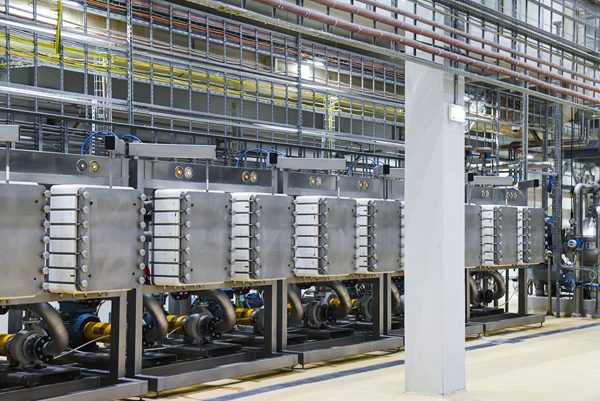
XTD supplies piping and tubing across multiple systems within a desalination plant. Seawater intake and outfall pipelines need large-diameter super duplex pipe with uniform wall thickness and full weld traceability. RO membrane racks use high-pressure piping to connect membrane modules; dimensional accuracy and pressure-rating compliance are required here.
Heat exchangers and condensers are equipped with seamless U-tubes and straight tubes, where the quality of the internal surface finish and strict dimensional tolerances influence overall thermal efficiency. Brine discharge systems carry the most concentrated salt solutions produced by the plant and need the highest level of corrosion resistance.
Chemical dosing and pre-treatment lines handle acids, antiscalants, and biocides, which require corrosion-resistant tubing grades. Distribution and transfer piping for treated water is typically specified in duplex grades. Pressure vessels and evaporator piping take advantage of the high strength of duplex and super duplex grades, enabling thinner walls while still meeting required pressure ratings.
Why Choose XTD for Desalination Piping
Zhejiang Xintongda Special Steel Manufacturing Co., Ltd. has been producing specialised steel pipes and tubes since 1985. That's over 40 years of production experience in duplex, super duplex, and high-alloy grades.
The key advantage for desalination customers is that XTD is a manufacturer of seamless pipes, tubes, U-tubes, heat exchanger tubes, and condenser tubes, all of which are produced in-house. Key grades held in stock include Duplex S31803/S32205, Super Duplex S32750/S32760/S32550, SMO 254, and nickel alloys.
All products are manufactured under ISO 9001, ISO 14001, and ISO 45001 certified conditions, with international certifications including NORSOK M650, PED, AD2000, DNV, BV, LR, ABS, and CCS. Every order goes through pressure testing, NDT inspection, and full material traceability. XTD exports to the Middle East, North Africa, and Asia-Pacific, the regions where desalination project activity is highest.
XTD’s technical team can help with material selection, grade comparisons, and pricing for desalination projects of any scale. To get in touch, contact us via email or phone, or submit your specifications through our online enquiry form. If you need a full product overview, ask about our desalination product catalogue.
Industry Applications
Installed in SWRO membrane systems, seawater intake lines, and brine discharge piping for handling high-chloride seawater and concentrated salt solutions reliably.
All Industry Applications
 All Industry Applications