Incoloy 825 and Inconel 625 are both nickel-based alloys built for extreme corrosion resistance. But they differ in nickel content, molybdenum levels, temperature capability, and cost. An incorrect alloy selection can result in unnecessary cost or premature equipment failure.
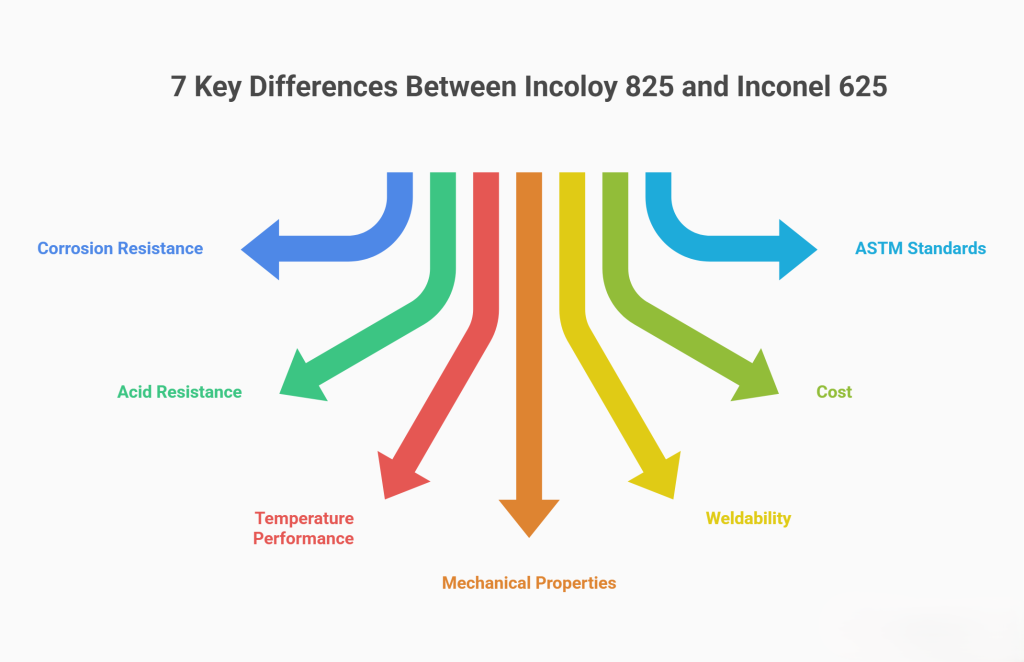
This guide compares Incoloy 825 and Inconel 625 across 7 factors: composition, corrosion resistance, temperature performance, mechanical strength, weldability, cost, and applications. This guide identifies the conditions under which each alloy is most appropriate.
What is Incoloy 825?
Incoloy 825 is a nickel-iron-chromium alloy with additions of molybdenum, copper, and titanium. Its UNS designation is N08825. The alloy contains approximately 38–46% nickel, 19.5–23.5% chromium, 2.5–3.5% molybdenum, and 1.5–3.0% copper.
The copper addition gives Incoloy 825 good resistance to reducing acids like sulfuric acid and phosphoric acid. The titanium stabilises the alloy against sensitisation during welding.
Incoloy 825 falls under the ASTM B423 standard for seamless pipe and tube. We manufacture Incoloy 825 seamless pipes and tubes at our Zhejiang facility.
What is Inconel 625?
Inconel 625 is a nickel-chromium-molybdenum alloy with a high niobium (columbium) content. Its UNS designation is N06625. The alloy contains approximately 58% minimum nickel, 20–23% chromium, 8–10% molybdenum, and 3.15–4.15% niobium.
The high molybdenum content (8–10% versus 2.5–3.5% in Incoloy 825) gives Inconel 625 outstanding resistance to chloride pitting, crevice corrosion, and seawater attack. Niobium provides solid-solution strengthening in the as-welded condition, eliminating the need for post-weld heat treatment.
Inconel 625 falls under the ASTM B444 standard.
Chemical Composition Comparison
This table compares the key alloying elements in Incoloy 825 and Inconel 625.
| Element | Incoloy 825 (N08825) | Inconel 625 (N06625) |
| Nickel (Ni) | 38.0–46.0% | 58.0% min |
| Chromium (Cr) | 19.5–23.5% | 20.0–23.0% |
| Molybdenum (Mo) | 2.5–3.5% | 8.0–10.0% |
| Iron (Fe) | 22.0% min (balance) | 5.0% max |
| Copper (Cu) | 1.5–3.0% | — |
| Niobium (Nb) | — | 3.15–4.15% |
| Titanium (Ti) | 0.6–1.2% | 0.40% max |
The 3 most significant compositional differences are:
- Nickel: 625 has 12–20% more nickel than 825
- Molybdenum: 625 has 3x more Mo (8–10% vs 2.5–3.5%)
- Iron: 825 is iron-based with nickel additions; 625 is nickel-based with minimal iron
7 Key Differences Between Incoloy 825 and Inconel 625
1. Corrosion Resistance in Chloride Environments
Inconel 625 dominates in chloride service. Its PREN exceeds 50, attributed to its elevated molybdenum and chromium content. It resists pitting in seawater at temperatures up to 80°C (176°F).
Incoloy 825 has a PREN of approximately 30–33. It handles mild chloride exposure but starts pitting in warm seawater above 30°C (86°F).
Choose Inconel 625 for seawater, brine, and chloride-heavy chemical service.
2. Resistance to Reducing Acids
Incoloy 825 performs better in this case. Its copper content (1.5-3.0%) provides good resistance to sulphuric acid at concentrations ranging from 20 to 50%, as well as phosphoric acid at various concentrations.
Inconel 625 also handles sulfuric acid, but its real strength is in oxidising and mixed-acid environments. For pure reducing acid service, Incoloy 825 gives you adequate performance at a lower price.
3. Temperature Performance
Inconel 625 operates at much higher temperatures than Incoloy 825.
| Property | Incoloy 825 | Inconel 625 |
| Max Continuous Service Temp | 540°C (1,000°F) | 815°C (1,500°F) |
| Creep Resistance | Moderate | High (Nb strengthening) |
| Oxidation Resistance | Good to 540°C | Good to 980°C (1,800°F) |
The niobium in Inconel 625 provides solid-solution strengthening that holds up at high temperatures. Incoloy 825 loses significant strength above 540°C.
For furnace components, gas turbine exhaust, and high-temp reactor piping, Inconel 625 is the clear winner.
4. Mechanical Properties at Room Temperature
This table compares room-temperature mechanical properties of both alloys in the annealed condition.
| Property | Incoloy 825 | Inconel 625 |
| Tensile Strength | 586 MPa (85 ksi) min | 827 MPa (120 ksi) min |
| Yield Strength | 241 MPa (35 ksi) min | 414 MPa (60 ksi) min |
| Elongation | 30% min | 30% min |
| Hardness | 175 HB typical | 190 HB typical |
Inconel 625 is 72% stronger in yield and 41% stronger in tensile strength than Incoloy 825. This higher strength allows thinner walls and lighter-weight pipe designs.
5. Weldability
Both alloys weld well using matching filler metals. Neither requires pre-heat or post-weld heat treatment for most applications.
- Incoloy 825 uses ERNiFeCr-1 (AWS A5.14) filler metal
- Inconel 625 uses ERNiCrMo-3 (AWS A5.14) filler metal
Inconel 625 filler is also used to weld dissimilar metals, for example, joining carbon steel to stainless steel or cladding carbon steel vessels. Its high alloy content makes the weld zone more corrosion resistant than the base metals it joins.
6. Cost
Inconel 625 costs 40–60% more than Incoloy 825 in pipe form. The reasons are:
- Higher nickel content: 58% vs 38–46% — nickel is the most expensive alloying element
- More molybdenum: 8–10% vs 2.5–3.5%
- Niobium addition: 3.15–4.15% Nb adds cost
In comparative pricing for NPS 3 Schedule 40 seamless pipe, Inconel 625 typically carries a premium over Incoloy 825, subject to prevailing market conditions.
Inconel 625 should only be specified when operating conditions genuinely require its enhanced properties. Incoloy 825 handles many corrosive environments at a fraction of the cost.
7. ASTM Standards
| Standard | Incoloy 825 | Inconel 625 |
| Pipe & Tube | ASTM B423 | ASTM B444 |
| Plate & Sheet | ASTM B424 | ASTM B443 |
| Bar | ASTM B425 | ASTM B446 |
When Should You Choose Incoloy 825?
Incoloy 825 is the right choice for these 5 applications:
- Sulfuric acid service — acid concentrations of 20–50% at moderate temperatures
- Phosphoric acid processing — wet-process and thermal phosphoric acid
- Oil and gas production — sour gas wells with H₂S and CO₂ at moderate temperatures
- Chemical processing — mixed-acid environments without heavy chloride content
- Pollution control—flue gas desulfurisation scrubbers
When Should You Choose Inconel 625?
Inconel 625 is the right choice for these 5 applications:
- Seawater and marine — subsea flowlines, splash zone components, desalination
- Aerospace and gas turbines — exhaust systems, combustion liners
- Nuclear — reactor core components, waste processing
- High-temperature chemical — furnace piping above 540°C
- Weld overlay and cladding — a corrosion-resistant layer on carbon steel vessels
Incoloy 825 vs Inconel 625: Quick Decision Guide
Ask these 3 questions:
- Is the primary corrosive agent chloride or seawater? → Choose Inconel 625
- Is the primary corrosive agent sulfuric or phosphoric acid? → Choose Incoloy 825
- Does the operating temperature exceed 540°C (1,000°F)? → Choose Inconel 625
When the corrosion data is borderline, Inconel 625 is the safer pick. When the budget is tight and conditions are moderate, Incoloy 825 saves money without sacrificing reliability.
Conclusion
Incoloy 825 offers excellent resistance to reducing acids and performs well in moderate sour gas applications at a more affordable cost. Inconel 625 outperforms in chloride-rich environments, saltwater, and high-temperature situations while also having much better strength. Both alloys have good weldability and high resistance to stress corrosion cracking.
Match the alloy to the dominant corrosion mechanism. Using Inconel 625 for pure acid service adds unnecessary cost, while Incoloy 825 does not provide enough protection in aggressive chloride environments. Contact us for help with alloy selection and seamless pipe quotations.