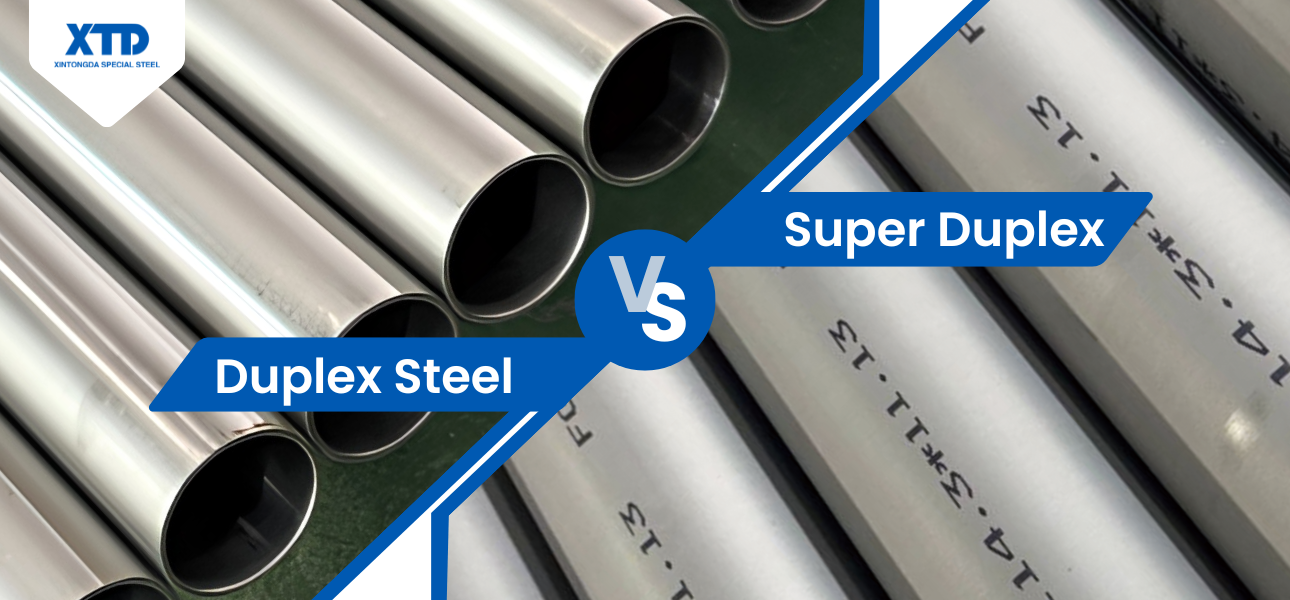
Duplex and super duplex stainless steels share the same dual-phase microstructure. Both contain roughly 50% austenite and 50% ferrite. But super duplex pushes the alloy content higher, giving it a PREN above 40 and a yield strength above 550 MPa. That extra performance comes at a higher price.
This guide breaks down the 6 main differences between duplex and super duplex stainless steel, covering composition, corrosion resistance, strength, temperature limits, cost, and applications. We also explain when the upgrade to super duplex is worth the investment.
What is Duplex Stainless Steel?
Duplex stainless steel has a two-phase microstructure containing roughly equal parts austenite and ferrite. This balanced structure gives duplex steel about twice the yield strength of standard austenitic grades like 304 and 316, while keeping good corrosion resistance.
The most common duplex grades are:
- Duplex 2205 (UNS S32205 / S31803) – covers about 80% of all duplex applications
- Duplex 2304 (UNS S32304) – a lean duplex grade with lower cost
Duplex 2205 contains 22% chromium, 5% nickel, 3% molybdenum, and 0.15% nitrogen. Its PREN sits at approximately 35.
What is Super Duplex Stainless Steel?
Super duplex stainless steel is a higher-alloyed version of duplex. The defining characteristic is a PREN of 40 or above. This means more chromium, more molybdenum, and more nitrogen than standard duplex.
The most common super duplex grades are:
- Super Duplex 2507 (UNS S32750) – the most widely used super duplex grade
- Super Duplex 2760 (UNS S32760) – adds copper and tungsten, along with elevated nitrogen, improving resistance to both oxidising and reducing acids.
- Super Duplex 2550 (UNS S32550) – a copper-bearing super duplex grade
Super Duplex 2507 contains 25% chromium, 7% nickel, 4% molybdenum, and 0.28% nitrogen. Its PREN reaches approximately 43.
Chemical Composition: Duplex vs Super Duplex
This table compares the chemical composition of Duplex 2205 and Super Duplex 2507.
| Element | Duplex 2205 (S32205) | Super Duplex 2507 (S32750) |
| Chromium (Cr) | 22.0–23.0% | 24.0–26.0% |
| Nickel (Ni) | 4.5–6.5% | 6.0–8.0% |
| Molybdenum (Mo) | 3.0–3.5% | 3.0–5.0% |
| Nitrogen (N) | 0.14–0.20% | 0.24–0.32% |
| Carbon © | 0.030% max | 0.030% max |
| Manganese (Mn) | 2.0% max | 1.2% max |
Super duplex has 3% more chromium, 1–2% more nickel, up to 1.5% more molybdenum, and nearly double the nitrogen content. Each addition improves corrosion resistance and strength.
6 Key Differences Between Duplex and Super Duplex
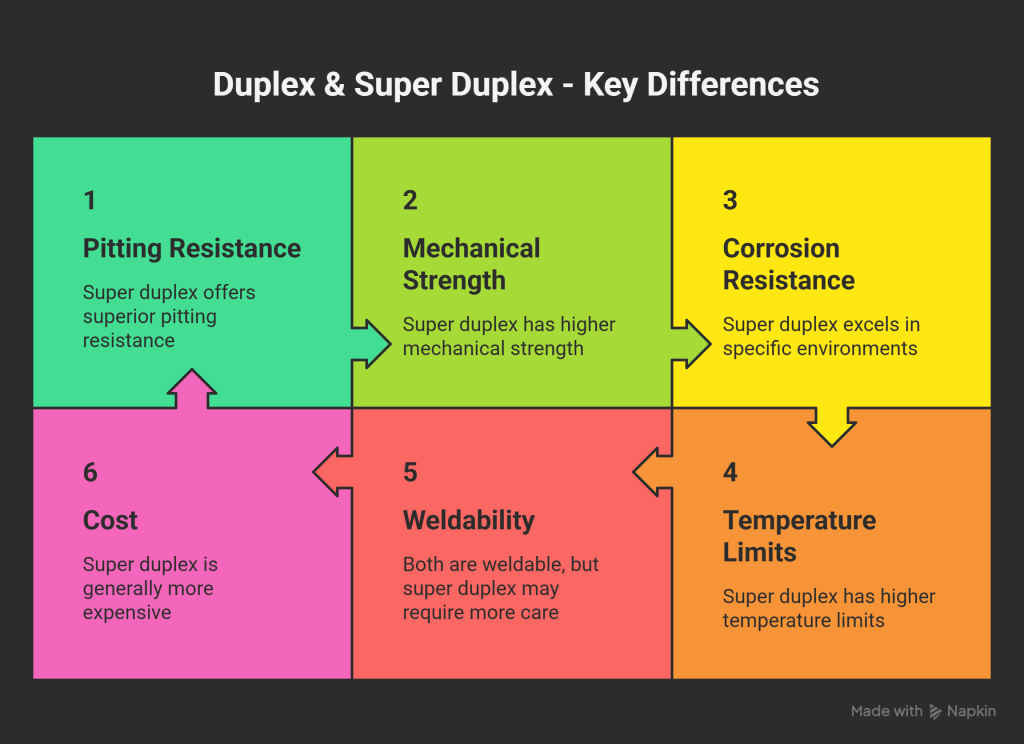
1. Pitting Resistance (PREN)
The PREN tells you how well a steel resists chloride pitting. The formula is %Cr + (3.3 × %Mo) + (16 × %N).
- Duplex 2205 PREN: ~35
- Super Duplex 2507 PREN: ~43
This difference of 8 PREN points is significant in practice. Super duplex resists pitting in seawater at temperatures as high as 50°C (122°F), while duplex 2205 has a critical pitting temperature (CPT) in seawater that normally ranges between 25 and 35°C, depending on flow conditions and chloride concentration.
For hot chloride environments, such as heated seawater cooling systems or chloride-rich chemical streams, super duplex is the better option.
2. Mechanical Strength
Both duplex families outperform austenitic stainless steels in yield strength. But super duplex goes further.
| Property | Duplex 2205 | Super Duplex 2507 |
| Yield Strength (min) | 450 MPa (65 ksi) | 550 MPa (80 ksi) |
| Tensile Strength (min) | 620 MPa (90 ksi) | 795 MPa (116 ksi) |
| Elongation | 25% min | 15% min |
| Hardness | 293 HB max | 310 HB max |
Super duplex 2507 has 22% higher yield strength and 28% higher tensile strength than duplex 2205. This enables for thinner pipe walls with the same pressure rating, which saves weight in offshore and subsea structures.
3. Corrosion Resistance in Specific Environments
Chloride pitting and crevice corrosion: Super duplex wins. Its higher PREN means it handles hotter, more concentrated chloride solutions.
Stress corrosion cracking (SCC): Both duplex and super duplex resist chloride SCC far better than austenitic grades. The ferritic phase blocks crack propagation. Neither grade shows SCC in chloride solutions at temperatures below 150°C (302°F).
Sulfuric acid: Resistance depends heavily on temperature, aeration, and the presence of oxidising agents. Consult corrosion isocorrosion charts before specifying for acid service. Super duplex extends this range to higher concentrations and temperatures.
Sour gas (H₂S): Both grades are suitable for sour service, as per NACE MR0175 / ISO 15156. Super duplex can endure larger H₂S partial pressures and lower pH values.
4. Temperature Limits
Both duplex and super duplex have a maximum service temperature of about 315°C (600°F). Above this temperature, the sigma phase forms. Sigma phase is a brittle intermetallic compound that destroys toughness and corrosion resistance.
Super duplex is more prone to sigma phase formation because of its higher chromium and molybdenum content. Hold it above 300°C for too long, and the material degrades.
For cryogenic service, the toughness of both grades at sub-zero temperatures should be verified in accordance with the applicable design code, as acceptable limits vary depending on the specification and product form.
5. Weldability
Duplex 2205 is easier to weld than Super Duplex 2507. The lower alloy content gives a wider range of acceptable heat input.
Super duplex requires:
- Tighter heat input control: 0.5–2.5 kJ/mm typical
- Lower interpass temperature: 150°C (302°F) max
- Matching filler metal: 25Cr-9Ni-4Mo type
- Post-weld inspection: Ferrite count between 35–65% in the weld zone
Improper welding of super duplex creates excessive ferrite or sigma phase, both of which significantly degrade corrosion resistance. Use qualified welders with duplex experience.
6. Cost
Super duplex costs 25–40% more than duplex 2205, depending on the product form and current alloy surcharges.
The extra cost comes from:
- Higher nickel, molybdenum, and chromium content
- Tighter manufacturing controls
- Lower production volumes
- More complex welding and fabrication
The cost is justified only when duplex 2205 cannot meet the corrosion or strength requirements.
Duplex vs Super Duplex: Comparison Table
This table gives you a side-by-side view of the 2 most common grades in each family.
| Factor | Duplex 2205 | Super Duplex 2507 |
| PREN | ~35 | ~43 |
| Yield Strength | 450 MPa (65 ksi) | 550 MPa (80 ksi) |
| Max Service Temp | 315°C (600°F) | 315°C (600°F) |
| Seawater Pitting Temp | ~20°C (68°F) | ~50°C (122°F) |
| Weldability | Good | Requires more control |
| Cost (relative) | 1.0x | 1.25–1.40x |
| ASTM Standard (Pipe) | ASTM A790 | ASTM A790 |
| ASTM Standard (Tube) | ASTM A789 | ASTM A789 |
When Should You Use Duplex 2205?
Use duplex 2205 for these applications:
- Offshore topside piping – process piping on platforms where seawater contact is limited
- Chemical storage tanks – moderate acid and chloride service
- Desalination plants – feed and brine piping
- Pulp and paper mills – bleach lines with chloride exposure
- Structural components – where high strength reduces weight
We manufacture duplex 2205 seamless pipes and duplex S31803 seamless pipes at our facility.
When Should You Use Super Duplex 2507?
Use super duplex 2507 when:
- Hot seawater service – cooling systems above 25°C
- Subsea pipelines – flowlines exposed to high chloride and H₂S
- Sour gas processing – high-pressure H₂S service per NACE MR0175
- Concentrated chloride environments – flue gas desulfurisation, brine processing
- Weight-critical offshore structures – where higher strength allows thinner walls
We supply super duplex 2507 seamless pipes and super duplex 2760 seamless pipes.
Conclusion
Duplex 2205 covers 80% of duplex applications with its PREN of 35 and 450 MPa yield strength. Super duplex 2507 steps in for the remaining 20%, where hotter chlorides, higher pressures, and sour gas demand a PREN above 40.
Duplex 2205 should be the default selection; super duplex should be specified only when the corrosion data or design code requires it. The extra cost is worth it for subsea and hot seawater service, not for general industrial use. Contact us for grade selection help and pricing.