Both 304 and 316 are austenitic stainless steels that resist corrosion, handle high temperatures, and weld easily. One critical element that separates them is molybdenum. This element improves corrosion resistance and affects both performance and cost.
This comparison covers chemical composition, corrosion resistance, mechanical properties, cost, and the best applications for 304 and 316 stainless steel pipes. By the end, one will know exactly which grade fits your project.
What Is 304 Stainless Steel?
304 stainless steel includes approximately 18% chromium and 8% nickel. It is the most common stainless steel grade in production today, making up roughly 50% of all stainless steel output globally.
304 is known as 18/8 stainless steel in the industry. Its UNS designation is S30400, and its low-carbon variant, 304L (S30403), limits carbon to 0.03% maximum for better weldability.
304 handles atmospheric corrosion, mild chemicals, and food-contact applications very well. It falls short when chlorides enter the picture.
What Is 316 Stainless Steel?
316 stainless steel contains approximately 16% chromium, 10% nickel, and 2–3% molybdenum. This molybdenum addition is the key difference. The UNS designation is S31600, and its low-carbon version is 316L (S31603).
The 2–3% molybdenum gives 316 significantly better resistance to chloride pitting and crevice corrosion. That makes it the go-to grade for marine, chemical, and pharmaceutical applications.
Chemical Composition: 304 vs 316
This table compares the chemical composition of 304 and 316 stainless steel per ASTM A312.
| Element | 304 (S30400) | 316 (S31600) |
| Chromium (Cr) | 18.0–20.0% | 16.0–18.0% |
| Nickel (Ni) | 8.0–10.5% | 10.0–14.0% |
| Molybdenum (Mo) | None | 2.0–3.0% |
| Carbon (C) | 0.08% max | 0.08% max |
| Manganese (Mn) | 2.0% max | 2.0% max |
| Silicon (Si) | 0.75% max | 0.75% max |
| Nitrogen (N) | 0.10% max | 0.10% max |
The key difference: 316 trades some chromium for higher nickel and adds molybdenum. This shifts its corrosion resistance profile toward chloride-heavy environments.
Corrosion Resistance: Where Each Grade Wins
Pitting Resistance (PREN)
The Pitting Resistance Equivalent Number (PREN) measures a grade’s ability to resist chloride pitting. Higher PREN = better pitting resistance.
PREN formula: PREN is calculated as %Cr + 3.3×%Mo + 16×%N (ISO 11463 variant).
- 304 PREN: ~18
- 316 PREN: ~23–25
That 5–7 point difference is significant. It means 316 resists pitting in chloride concentrations up to 1,000 ppm, while 304 resists pitting under typical ambient conditions; actual thresholds vary with temperature, pH, and surface finish.
Atmospheric Corrosion
304 performs well in indoor and outdoor atmospheric conditions. It handles rain, humidity, and mild pollution without issues. For architectural and food-grade applications, 304 is sufficient.
Chemical Corrosion
316 outperforms 304 in:
- Sulfuric acid at low concentrations
- Hydrochloric acid traces
- Acetic acid and formic acid
- Seawater and brackish water
Use 304 for mild conditions. Switch to 316 when chlorides, acids, or marine exposure are part of the equation.
Mechanical Properties: 304 vs 316
This table compares the mechanical properties of 304 and 316 stainless steel at room temperature.
| Property | 304 | 316 |
| Tensile Strength | 515 MPa (75 ksi) min | 515 MPa (75 ksi) min |
| Yield Strength | 205 MPa (30 ksi) min | 205 MPa (30 ksi) min |
| Elongation | 40% min | 40% min |
| Hardness (Brinell) | 201 HB max | 217 HB max |
| Density | 7.93 g/cm³ | 7.98 g/cm³ |
The mechanical properties are nearly identical. You will not gain a strength advantage by choosing one over the other. The choice comes down to corrosion resistance and cost.
Temperature Performance
Both grades handle continuous service up to 870°C (1,598°F) and intermittent service up to 925°C (1,697°F).
For temperatures above 425°C (797°F) in long-term service, consider carbide-stabilised grades such as 321 (titanium-stabilised) or 347 (niobium-stabilised). Both 304 and 316 can suffer from sensitisation (chromium carbide precipitation) in the 425–870°C range during extended exposure.
The low-carbon versions (304L and 316L) reduce sensitisation risk but do not eliminate it at the highest temperatures.
Cost Comparison: 304 vs 316

316 stainless steel costs 15–25% more than 304, depending on current nickel and molybdenum market prices.
The extra cost comes from:
- Higher nickel content: 10–14% in 316 versus 8–10.5% in 304
- Molybdenum addition: 2–3% Mo is an expensive alloying element
- Lower production volume: 304 is produced in much larger quantities, giving it better economies of scale
For a project using NPS 4, Schedule 40 seamless pipe in 50-metre lengths, switching from 304 to 316 might add to the material cost. On large-volume orders, this premium can represent a significant procurement cost.
Specifying 316 where 304 is sufficient adds unnecessary cost; conversely, using 304 in chloride-heavy environments risks premature failure.
Best Applications for 304 Stainless Steel Pipes
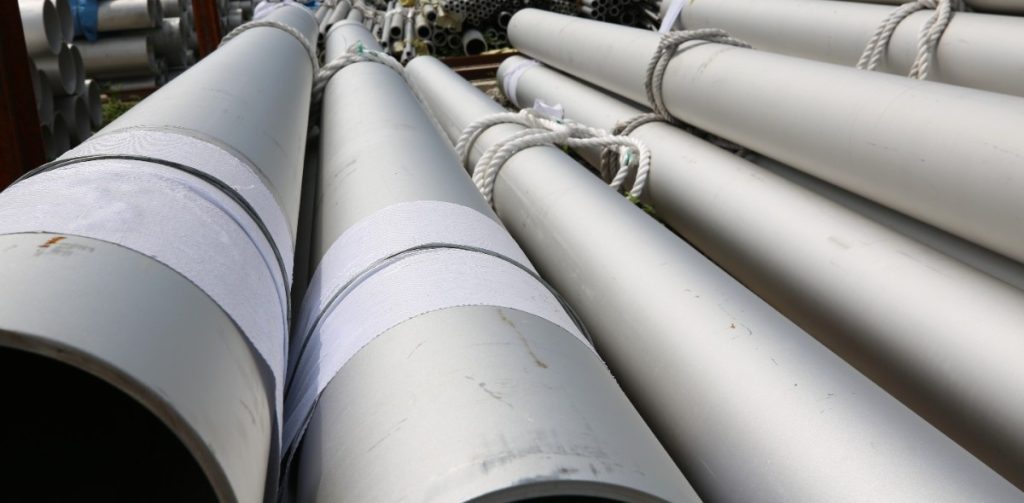
304 is your best choice for these 5 applications:
- Food and beverage processing: dairy, brewing, food-grade piping
- Architectural and decorative: handrails, cladding, building facades
- Water treatment: freshwater systems with low chloride content
- Kitchen and sanitary equipment: sinks, countertops, fittings
- General industrial piping: where chloride exposure is minimal
Best Applications for 316 Stainless Steel Pipes
316 is the right choice for these 5 applications:
- Chemical processing: reactors, storage tanks, transfer piping for acids and chlorides
- Marine environments: coastal structures, boat fittings, desalination plants
- Pharmaceutical and biotech: clean-in-place (CIP) systems, sterile piping
- Oil and gas: production piping, surface and subsurface piping in non-sour, low-chloride upstream applications; consult NACE MR0175 for sour service.
- Pulp and paper: chloride-containing bleaching chemicals
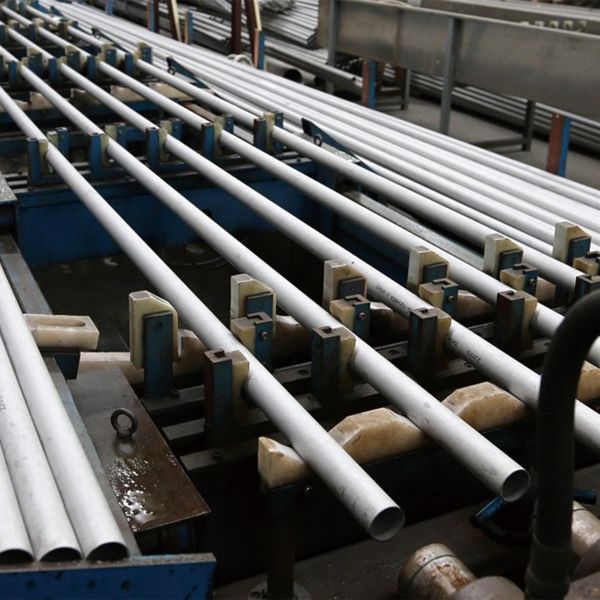
We manufacture 316 seamless pipes and 316L seamless pipes under ASTM A312.
304 vs 316: Quick Decision Guide
Ask yourself these 3 questions:
- Will the pipe contact chlorides or seawater? → Choose 316
- Is the environment indoor, dry, or freshwater only? → Choose 304
- Is the budget tight and corrosion risk low? → Choose 304
When in doubt, 316L is the safer bet. The extra cost is insurance against pitting and crevice attack.
Conclusion
304 and 316 stainless steel share the same basic structure and mechanical strength. The difference is molybdenum. That 2–3% Mo in 316 raises its PREN from ~18 to ~23, giving it real chloride resistance.Use 304 for general-purpose, non-chloride applications. Use 316 wherever chlorides, marine air, or acidic chemicals are present. We produce both grades as seamless pipes and tubes. Contact us for availability and pricing.