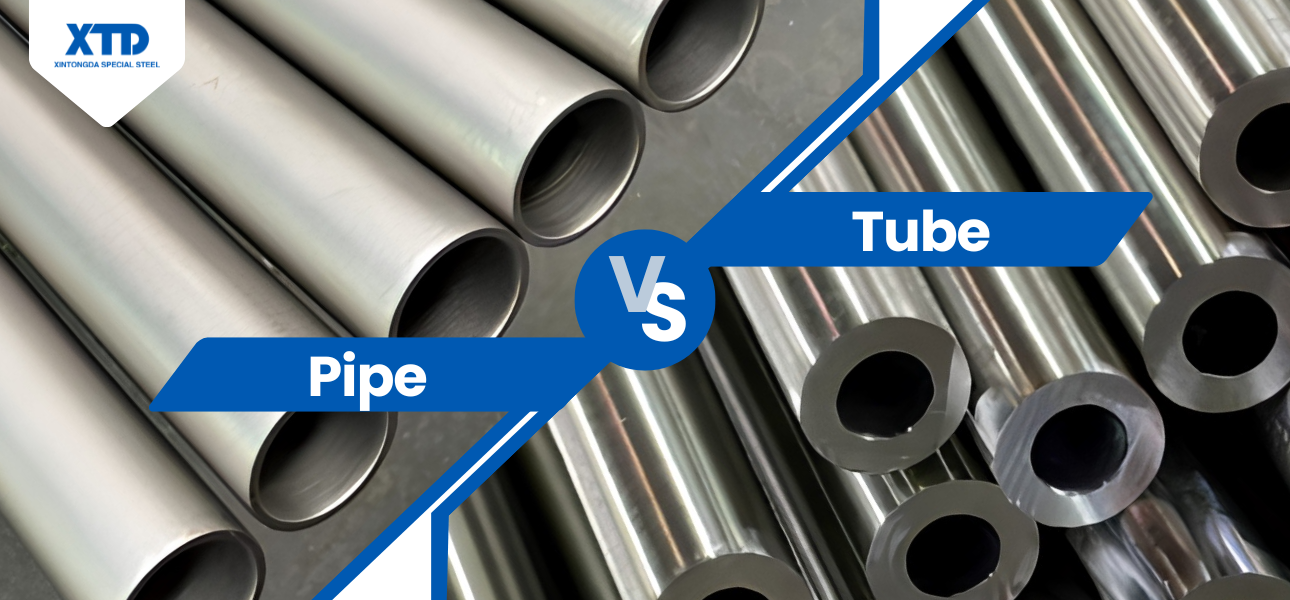
Pipe and tube are visually similar and often stocked alongside one another. They are both hollow, cylindrical, and made from the same metals. But they follow different ordering standards, different dimensional tolerances, and serve very different purposes.
This article explains the 7 key differences between pipe and tube, covering how they are sized, ordered, measured, and used. We also explain when to pick a pipe over a tube (and vice versa) for your next project.
Pipe vs Tube: A Quick Definition
A pipe is a hollow cylindrical product sized by its Nominal Pipe Size (NPS) and schedule number. The outside diameter (OD) of a pipe is standardised; it does not match the NPS number. For example, NPS 2 pipe has an actual OD of 60.3 mm (2.375 inches), not 2 inches.
A tube is a hollow cylindrical product ordered by its actual outside diameter (OD) and wall thickness. When you order a 2-inch tube, the actual OD is 50.8 mm (2.000 inches), exactly what you asked for.
This single difference in their sizing creates a chain of differences in wall thickness, tolerances, applications, and cost.
7 Key Differences Between Pipe and Tube
Here are the 7 differences between pipes and tubes, covering sizing, measurement, tolerances, shape, applications, standards, and end connections.
1. Sizing and Ordering Method
You order a pipe by NPS and schedule. The NPS tells you the approximate bore size. The schedule tells you the wall thickness. Check our pipe size chart for a full list of NPS-to-OD conversions.
You order a tube by exact OD and wall thickness in millimetres or inches. There is no “schedule” system for tubing. You specify exactly what you need.
Example: NPS 4, Schedule 40 pipe has an OD of 114.3 mm and a wall of 6.02 mm. A 4-inch tube has an OD of 101.6 mm and whatever wall thickness you specify.
2. Dimensional Tolerances
Tubes hold tighter tolerances than pipes on both OD and wall thickness.
- Pipe OD tolerance: ±1% (per ASTM A312)
- Tube OD tolerance: ±0.1 mm or ±0.5% (per ASTM A213)
Tighter tolerances matter when the tube must fit precisely into a tube sheet, like in heat exchangers, condensers, or boilers.
3. How They Are Measured
Pipe size is described by NPS (Nominal Pipe Size) or DN (Diamètre Nominal) in metric countries. Neither value equals the true OD or ID of the pipe.
Tube size is described by the actual OD; no translation is needed. A 25.4 mm OD tube measures exactly 25.4 mm on the outside.
This is why tube sizing is more intuitive for mechanical and instrumentation applications.
4. Shape Options
Pipes are always round. They carry fluids and gases under pressure, and a round cross-section handles internal pressure better than any other shape.
Tubes come in round, square, rectangular, and oval shapes. Structural tubes use square and rectangular profiles. Round tubes are standard for heat transfer and instrumentation.
5. Common Applications
Pipes carry fluids from one location to another. Their main job is flow and pressure containment:
Process piping in refineries and chemical plants
- Water supply and distribution
- Oil and gas transmission
- Steam and condensate lines
Tubes serve 2 primary functions: heat transfer and structural support.
- Heat exchanger tubes transfer heat between fluids
- Boiler tubes contain water/steam in boilers
- Instrumentation tubes carry signals and samples
- Structural tubes, frames, handrails, and supports
6. Applicable Standards
Pipes and tubes follow different ASTM standards, even when made from the same stainless steel grade.
This table shows the common ASTM standards for stainless steel pipes and tubes.
| Product | ASTM Standard | Scope |
| Seamless & Welded Pipe | ASTM A312 | Austenitic SS pipe for high-temp and corrosive service |
| Seamless Tube | ASTM A213 | Boiler, superheater, and heat exchanger tubes |
| Seamless & Welded Tube | ASTM A269 | General service tubing |
| Duplex Pipe | ASTM A790 | Duplex and super duplex pipe |
| Duplex Tube | ASTM A789 | Duplex and super duplex tube |
7. End Connections
Pipes connect through threaded ends, flanged ends, or butt-weld ends. Pipe fittings (elbows, tees, reducers) follow the same NPS system.
Tubes connect through compression fittings, flared fittings, or rolled-into tube sheets. Tube fittings are sized by OD, not NPS.
Pipe vs Tube: Comparison Table
This table summarises the 7 differences between pipe and tube at a glance.
| Factor | Pipe | Tube |
| Sizing | NPS + Schedule | Actual OD + Wall Thickness |
| OD Tolerance | ±1% | ±0.1 mm or ±0.5% |
| Measurement | NPS / DN (not actual size) | Exact OD in mm or inches |
| Shape | Round only | Round, square, rectangular, oval |
| Primary Use | Fluid/gas transport | Heat transfer, structural |
| Standards | ASTM A312, A790 | ASTM A213, A269, A789 |
| End Connection | Threaded, flanged, butt-weld | Compression, flare, tube sheet |
When Should You Choose a Pipe?
Choose a pipe when your project involves:
- Transporting fluids or gases under pressure from one point to another
- Large-diameter runs above NPS 4 where standard pipe fittings are available
- Code-governed piping systems designed per ASME B31.3 or B31.1
- Fire protection and water systems sized by flow rate and NPS
When Should You Choose a Tube?
Choose a tube when your project involves:
- Heat transfer equipment: shell-and-tube exchangers, condensers, boilers
- Instrumentation and control: sample lines, signal tubing, hydraulic tubing
- Tight-tolerance mechanical parts: where exact OD is critical for fit
- U-bend applications: U-tubes for heat exchangers
Can a Pipe Be Used as a Tube (or Vice Versa)?
While technically possible, this practice is not recommended. The tolerances, standards, and testing requirements differ. A pipe installed in a tube sheet may not seal properly because its OD tolerance is looser. A tube used in a piping system may not match standard pipe fittings.
Use each product for its intended purpose. The cost savings of swapping are small, but the risk of leaks and premature failures is significant.
Conclusion
Pipes are sized by NPS and schedule for fluid transport. Tubes are sized by exact OD and wall thickness for heat transfer and tight-tolerance applications. They appear the same; however, their dimensional standards, tolerances, and end connections vary.
Match the product to the application. Contact our technical team for help selecting the right product.