Ordering stainless steel pipe without understanding NPS, schedule, and OD leads to wrong sizes, wasted material, and project delays. These 3 dimensions define every pipe you buy, but they confuse even experienced engineers.
This guide explains how NPS, schedule, and OD work together. We cover the sizing system, common size-to-OD conversions, schedule-to-wall-thickness data, and a practical method for selecting the right pipe size for your project.
What Is NPS (Nominal Pipe Size)?
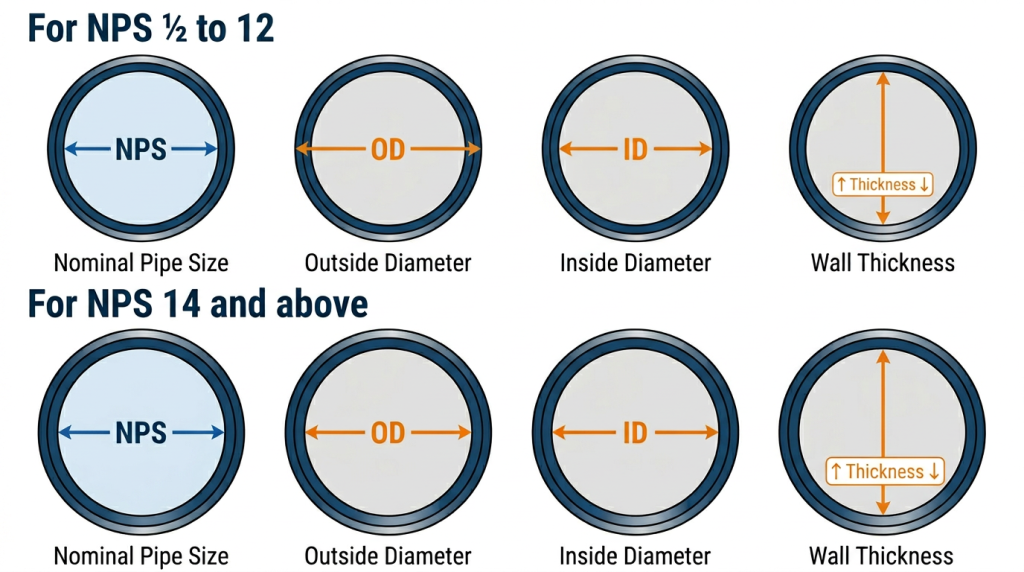
NPS stands for Nominal Pipe Size. It is a North American designation that identifies a pipe by a number, like NPS 2, NPS 4, or NPS 10. However, the NPS number does not correspond to the actual pipe OD: the NPS number does not equal the actual OD or ID of the pipe.
For pipe sizes NPS 1/8 through NPS 12, the NPS number is a label, not a measurement. For example:
- NPS 2 pipe has an actual OD of 60.3 mm (2.375 inches) — not 2 inches
- NPS 4 pipe has an actual OD of 114.3 mm (4.500 inches) — not 4 inches
- NPS 6 pipe has an actual OD of 168.3 mm (6.625 inches) — not 6 inches
For pipe sizes NPS 14 and above, the NPS number equals the OD in inches. NPS 14 pipe has an OD of exactly 355.6 mm (14.000 inches).
The international equivalent of NPS is DN (Diamètre Nominal). DN is expressed in millimetres; DN 50 corresponds to NPS 2, DN 100 to NPS 4, and so on.
What Is a Pipe Schedule?
Pipe schedule is a wall thickness designation. It indicates how thick the pipe wall is for a specific NPS size. Higher schedule numbers indicate thicker walls.
Common schedule numbers for stainless steel pipe include:
- 5S and 10S — thin wall (the “S” stands for stainless steel series)
- 40S — standard wall
- 80S — extra strong
- 120, 160 — heavy wall
- XXS — double extra strong (the thickest standard wall)
The schedule number originally came from a formula: Schedule = (1,000 × P) / S, where P is the internal pressure in psi, and S is the allowable stress in psi. Today, schedule numbers are standardised values in ASME B36.19M (for stainless steel) and ASME B36.10M (for carbon steel).
One critical point: the same schedule number gives different wall thicknesses at different NPS sizes. Schedule 40S for NPS 2 is 3.91 mm, but Schedule 40S for NPS 8 is 8.18 mm.
What Is OD (Outside Diameter)?
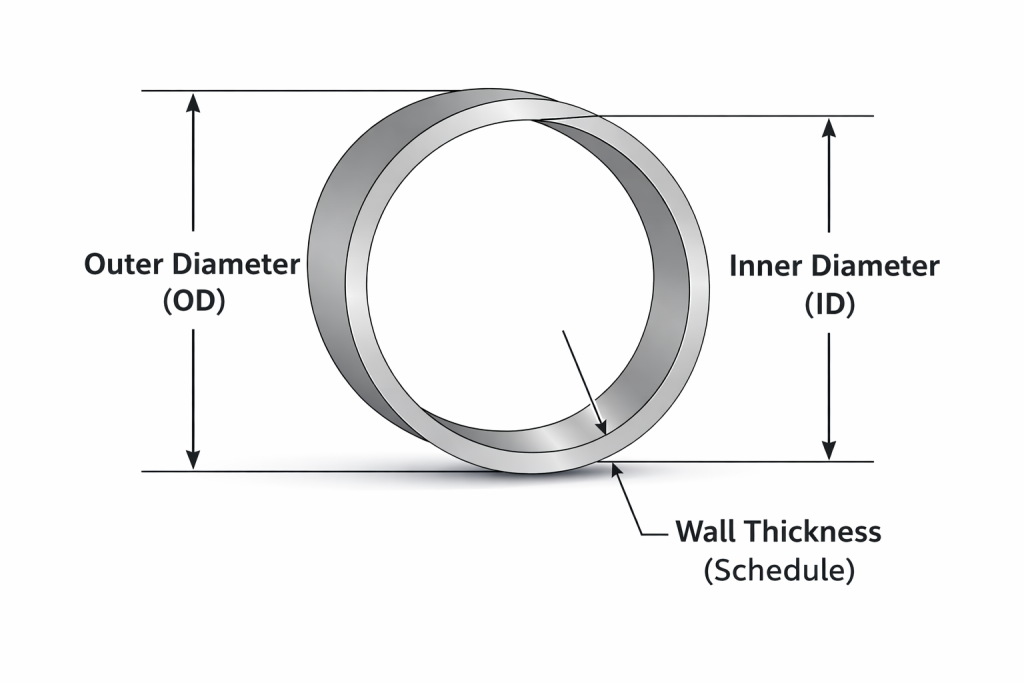
OD is the actual outside diameter of the pipe measured in millimetres or inches. In contrast to NPS, the OD is a real physical measurement that can be validated using a calliper.
Every NPS size has a fixed OD that does not change regardless of the schedule. When you increase the schedule, only the wall thickness increases inward; the OD stays the same.
This means:
- NPS 4 Schedule 5S has an OD of 114.3 mm
- NPS 4 Schedule 80S also has an OD of 114.3 mm
- The difference is wall thickness: 1.65 mm (5S) versus 8.56 mm (80S)
- The ID (inside diameter) changes with schedule: ID = OD – (2 × wall thickness).
NPS to OD Conversion Table
This table converts the 20 most common NPS sizes to their actual OD in both millimetres and inches. Use this for ordering and design.
| NPS | DN | OD (mm) | OD (inches) |
| 1/8 | 6 | 10.3 | 0.405 |
| 1/4 | 8 | 13.7 | 0.540 |
| 3/8 | 10 | 17.1 | 0.675 |
| 1/2 | 15 | 21.3 | 0.840 |
| 3/4 | 20 | 26.7 | 1.050 |
| 1 | 25 | 33.4 | 1.315 |
| 1-1/4 | 32 | 42.2 | 1.660 |
| 1-1/2 | 40 | 48.3 | 1.900 |
| 2 | 50 | 60.3 | 2.375 |
| 2-1/2 | 65 | 73.0 | 2.875 |
| 3 | 80 | 88.9 | 3.500 |
| 4 | 100 | 114.3 | 4.500 |
| 5 | 125 | 141.3 | 5.563 |
| 6 | 150 | 168.3 | 6.625 |
| 8 | 200 | 219.1 | 8.625 |
| 10 | 250 | 273.1 | 10.750 |
| 12 | 300 | 323.9 | 12.750 |
| 14 | 350 | 355.6 | 14.000 |
| 16 | 400 | 406.4 | 16.000 |
| 20 | 500 | 508.0 | 20.000 |
For a complete reference including all sizes and schedules, see our pipe size chart.
Schedule to Wall Thickness Table
This table shows wall thickness in mm for 6 common NPS sizes across 5 schedule designations. All values follow ASME B36.19M for stainless steel pipe.
| NPS | Sch 5S (mm) | Sch 10S (mm) | Sch 40S (mm) | Sch 80S (mm) | Sch 160 (mm) |
| 1 | 1.24 | 1.73 | 3.38 | 4.55 | — |
| 2 | 1.65 | 2.77 | 3.91 | 5.54 | 8.74 |
| 3 | 1.65 | 3.05 | 5.49 | 7.62 | 11.13 |
| 4 | 1.65 | 3.05 | 6.02 | 8.56 | 13.49 |
| 6 | 1.65 | 3.40 | 7.11 | 10.97 | 18.26 |
| 8 | 1.65 | 3.76 | 8.18 | 12.70 | 20.62 |
Notice how Schedule 5S stays at 1.65 mm for NPS 2 through NPS 8. That same thin wall carries very different pressure ratings depending on the OD. An NPS 2 Sch 5S pipe withstands higher pressure than an NPS 8 Sch 5S pipe due to its smaller outer diameter-to-wall thickness ratio.
How NPS, Schedule, and OD Work Together
Here is the relationship in simple terms:
- NPS determines the OD (as per ASME B36.19M).
- The schedule determines the wall thickness (which varies by NPS).
- ID = OD minus (2 × wall thickness)
When you order a pipe, you specify 3 things:
- NPS (or OD in mm)
- Schedule (or wall thickness in mm)
- Material grade (e.g., TP316L per ASTM A312)
That gives the manufacturer everything needed to produce your pipe.
How to Select the Right Pipe Size: 4 Steps
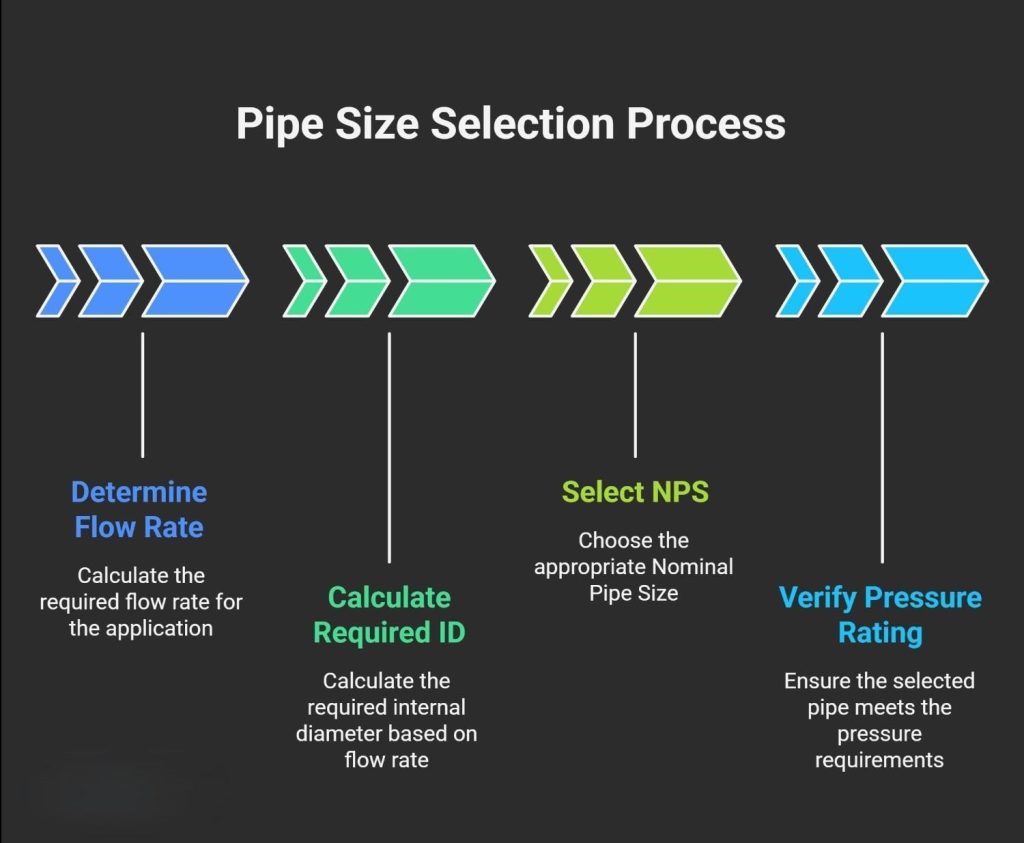
Step 1: Determine the Flow Rate
Determine how much fluid your system needs to transport per hour (m³/h or GPM). This determines the minimum interior area of the pipe.
Step 2: Calculate the Required ID
Use the flow rate and the recommended flow velocity for your fluid. For example:
- Liquid service: 1.5–3.0 m/s (5–10 ft/s) typical
- Gas service: 15–30 m/s (50–100 ft/s) typical
- Steam service: 25–50 m/s (80–160 ft/s) typical
The formula is: ID = √(4 × Q / (π × V)), where Q = flow rate in m³/s and V = velocity in m/s.
Step 3: Select the NPS
Find the NPS size whose ID at your chosen schedule matches or surpasses the calculated ID. You may need to check several schedules.
Step 4: Verify the Pressure Rating
Calculate the specified working pressure per ASME B31.3 to confirm that the chosen NPS and schedule can withstand your design pressure at the operating temperature.
If the pressure check fails, increase the schedule number and recheck.
Common Mistakes in Pipe Sizing
Avoid these 4 common errors:
- Assuming NPS equals OD, NPS 2 is not a 2-inch OD. Check the conversion table above.
- Using carbon steel schedule tables for stainless steel, Stainless steel uses ASME B36.19M schedules (5S, 10S, 40S, 80S). Carbon steel uses B36.10M (STD, XS, XXS). The wall thicknesses can differ.
- Ignoring corrosion allowance, add 1.0–3.0 mm to the calculated minimum wall for expected corrosion over the design life.
- Specifying Schedule 40 by default, not every application needs Schedule 40. For low-pressure utility service, Schedule 10S saves weight and cost. For high-pressure service, you may need Schedule 80 or above.
DN vs NPS: What Is the Difference?
The terms DN (Diamètre Nominal) and NPS (Nominal Pipe Size) denote the same pipe sizes but are numbered differently:
- NPS uses inches (NPS 2, NPS 4, NPS 6)
- DN uses millimetres (DN 50, DN 100, DN 150)
They map to the same physical OD. DN 50 = NPS 2 = 60.3 mm OD. DN 100 = NPS 4 = 114.3 mm OD.
European and Asian projects typically use DN. North American projects use NPS. Both systems are defined in ASME B36.19M and follow the same dimensional tables.
Stainless Steel Pipe Sizing for Our Products
We manufacture stainless steel seamless pipes from NPS 1/8 (6 mm OD) to NPS 24 (610 mm OD) in schedules from 5S to XXS. Our wall thickness range goes up to 60 mm for heavy wall applications.
Available grades include 304, 304L, 316, 316L, 321, 347, duplex 2205, super duplex 2507, and nickel alloys. All pipes follow ASTM A312, A790, or the applicable ASTM B-series standard.
Visit our pipe size chart for the full dimensional reference.
Conclusion
NPS identifies the pipe size, schedule sets the wall thickness, and OD is the actual measured outside diameter. These 3 values define every stainless steel pipe order. Use the NPS-to-OD table and the schedule-to-wall table in this guide to get your dimensions right.
Start with flow rate, calculate the ID, pick the NPS, and verify the pressure rating. When in doubt, contact us at Xintongda Special Steel. We help customers select the right pipe size, grade, and schedule every day.