
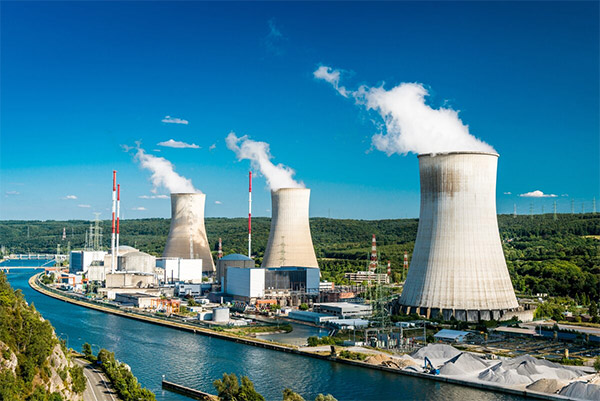
Stainless Steel & Nickel Alloy Pipes for Nuclear Power & Defence
The Global Nuclear Renaissance
Nuclear power is back, and this time the growth is substantial. The global nuclear plant market stands at USD 33–38 billion in 2025, with over 70 gigawatts of new capacity currently under construction worldwide. That’s the highest figure in 30 years. More than 40 countries are planning nuclear expansion, and the IAEA has raised its capacity projections for the fifth consecutive year. The small modular reactor (SMR) market adds further momentum, growing at nearly 9% annually. Defence programmes, nuclear submarines and surface vessels, require the same high-integrity piping as civilian plants. One thing is consistent across all of it: nuclear demands the highest material quality and traceability of any industry on earth.
Why Nuclear Service Demands the Highest Material Standards
Nuclear piping operates under conditions that would stress test almost any engineering material. Reactor coolant systems run at extreme pressures and temperatures well above what most industrial systems see for decades without replacement.
Prolonged neutron irradiation is the challenge that sets nuclear apart from every other industry. It degrades material properties over time and creates the risk of irradiation-assisted stress corrosion cracking (IASCC), a slow, insidious failure mode unique to reactor environments.Low-carbon grades are essential to prevent sensitisation in welded piping, which can trigger intergranular corrosion at grain boundaries.
Low cobalt content is also specified across nuclear alloys to minimise radioactive activation and reduce radiation dose to plant workers. Coastal installations add seawater corrosion into the mix. Full material traceability from melt to delivery is mandatory, not optional. ASME Section III and RCC-M codes set the qualification bar, and it’s the highest in any industry.
Nuclear-Grade Alloys for Reactor and Defence Applications
We manufacture seamless pipe and tube across the full range of alloy families used in nuclear power and defence, austenitic stainless steel, nickel alloys, and duplex grades. Each material family covers a distinct set of conditions within the plant.
Austenitic Stainless Steel (304L, 316L, 316LN, 321, 347)
Nickel Alloys for Core Nuclear Components
Duplex & Super Duplex for Nuclear Cooling Systems
Where Our Pipes & Tubes Serve the Nuclear Sector
Reactor systems use our 316L, 316LN, and nickel alloy seamless pipe in primary coolant loops, secondary circuits, auxiliary systems, and reactor vessel internals. Steam generation and heat exchange applications draw on our Inconel and 316L tubes, including seamless U-tubes and straight heat exchanger tubes.
Cooling and water systems, particularly at coastal sites, are served by our duplex and super duplex pipe in essential service water and seawater cooling circuits. Storage, containment, and defence applications include spent fuel handling, radioactive waste containment, CVCS piping, and nuclear submarine propulsion systems, where material integrity and full traceability are non-negotiable.
Why Choose XTD for Nuclear & Defence Piping
We’ve been manufacturing seamless pipe since 1985. Seamless construction is mandatory for nuclear primary circuit piping; there’s no weld seam to act as a failure initiation point under irradiation and thermal cycling. Our nuclear-grade range covers 304L, 316L, 316LN, 321, 347, Inconel 625, Incoloy 825, 800H, 800HT, Duplex 2205, Super Duplex S32750, and SMO 254.
Every pipe is supplied with EN 10204 3.1 or 3.2 material certification and full heat-level traceability from melt to delivery. QA includes hydrostatic testing, NDT, positive material identification, and IGC testing to ASTM A262. Certifications include PED, NORSOK M650, DNV, BV, LR, ISO 9001, 14001, and 45001.
Contact our team to discuss nuclear-grade material selection, traceability requirements, and specifications for your nuclear power or defence project. Reach us via our enquiry form or contact page. Our materials team is ready to assist.
Industry Applications
Serving reactor coolant circuits, steam generators, and naval propulsion systems where structural integrity must hold under sustained radiation, pressure, and thermal cycling.
All Industry Applications
 All Industry Applications