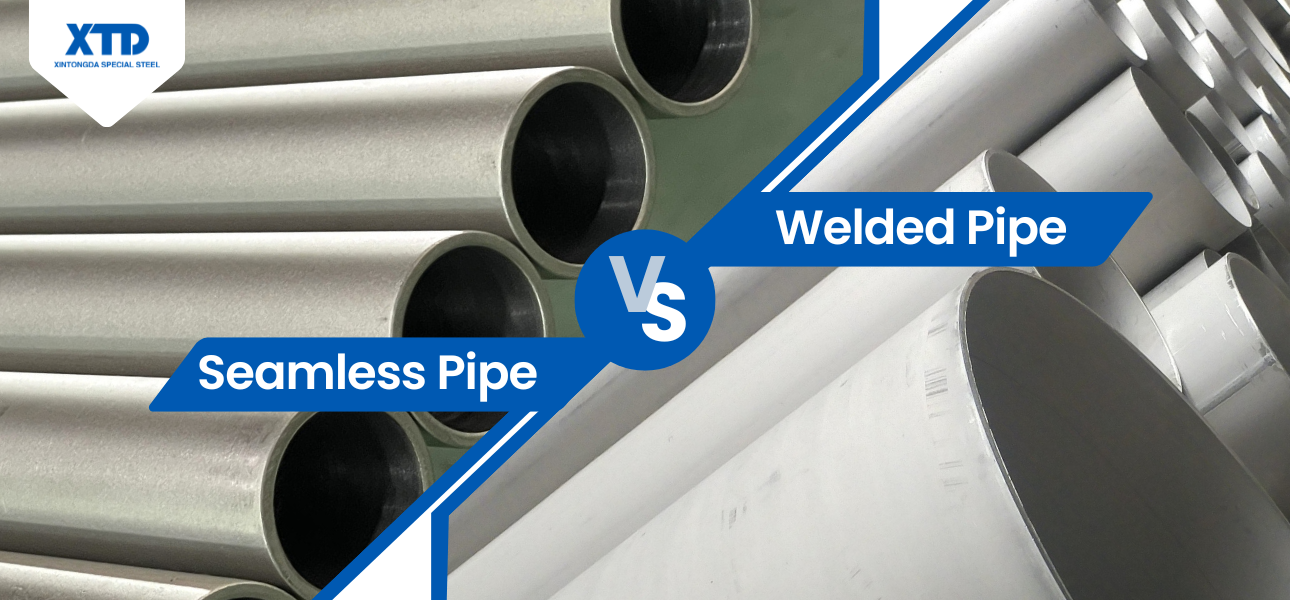
The choice between seamless and welded pipes impacts the project’s safety, cost, and durability. Both pipes are designed for specific pressure ratings, temperature ranges, and corrosion conditions. The best option relies on your operational environment and budget.
This guide explains how each pipe is manufactured, where each type works best, and the 6 major differences between seamless and welded pipes. We also break down strength, cost, size availability, and surface finish to help you make an informed decision.
What is a Seamless Pipe?
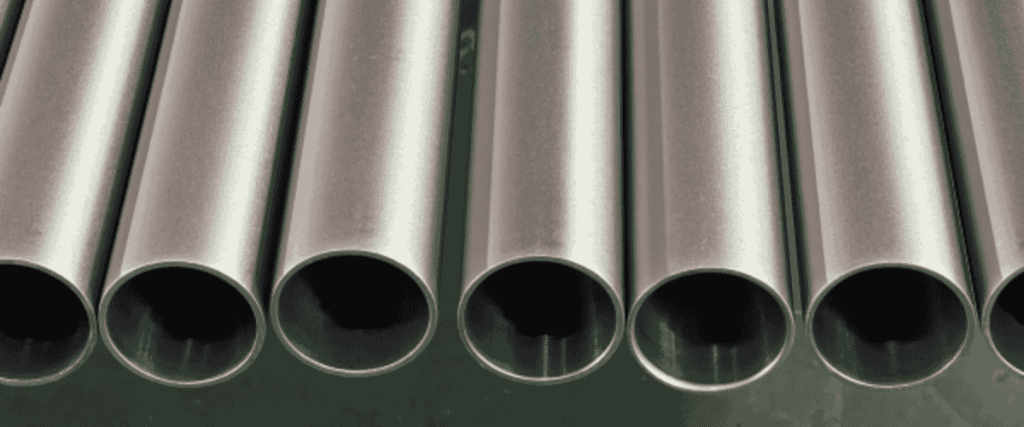
A seamless pipe is a hollow tube made from a solid steel billet without any weld joint. The billet is heated and pierced through the centre using a mandrel. This process creates a pipe with a uniform grain structure across the full cross-section.
Because there is no weld seam, seamless pipes handle higher pressures and temperatures than welded pipes of the same grade and wall thickness. Manufacturers produce them under standards like ASTM A312 for stainless steel and ASTM A106 for carbon steel.
We manufacture stainless steel seamless pipes at our facility in Zhejiang, China, with over 30 years of production experience since 1985.
What is a Welded Pipe?
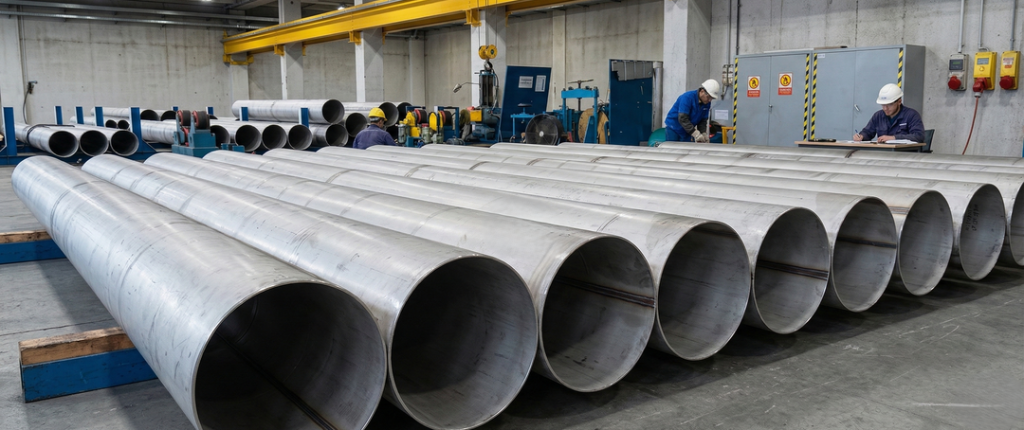
A welded pipe starts as a flat steel strip or plate. The strip is rolled into a cylindrical shape, and the edges are bonded with welding, such as electric resistance welding (ERW), submerged arc welding (SAW), or laser welding.
A visible line is generated along the pipe’s length by the weld seam. The weld seam can act as a potential stress concentration point, which is why additional testing and inspection are required. Welded pipes are an effective option for low-to-medium pressure applications, such as water distribution, structural support, and fencing.
Welded pipes are available in larger diameters than seamless pipes. Welding is often used for sizes larger than NPS 24 (610 mm OD) because the piercing process cannot produce such large diameters.
6 Key Differences Between Seamless and Welded Pipes
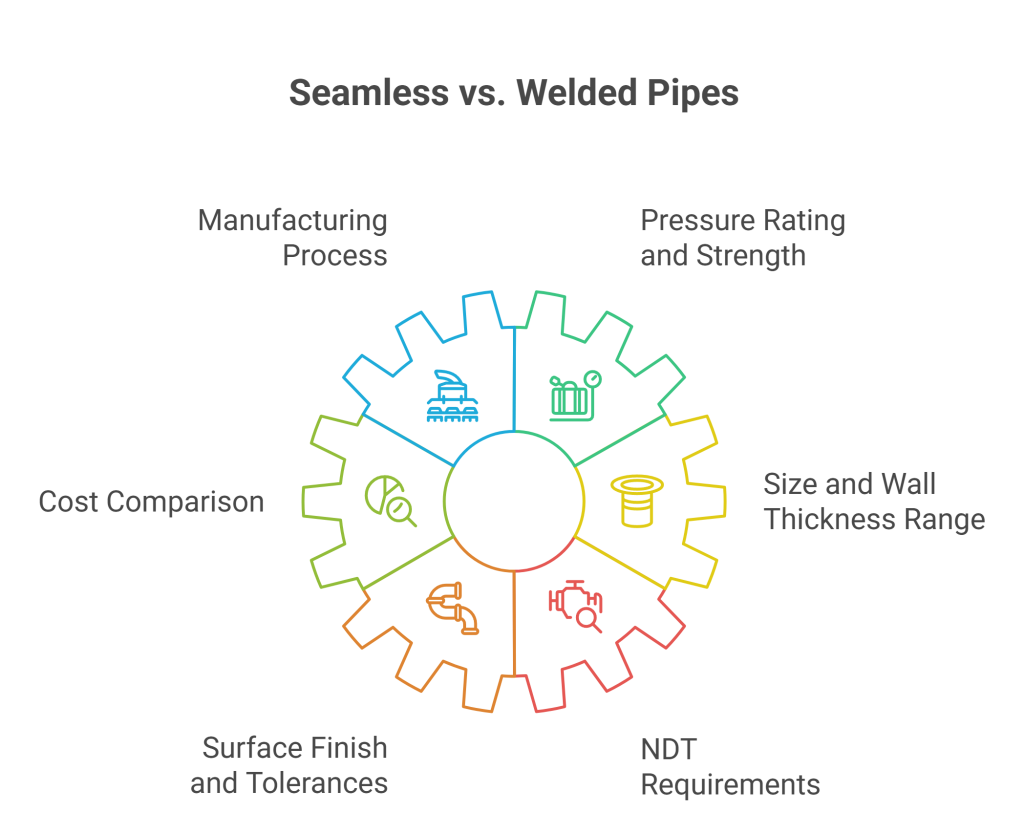
Here are the 6 primary differences between seamless and welded pipes, which include manufacturing, strength, cost, size range, surface quality, and testing requirements.
1. Manufacturing Process
Seamless pipes go through hot extrusion or rotary piercing of a solid billet. No welding takes place at any stage.
Welded pipes are formed from a flat strip that is rolled and welded along the longitudinal seam. The weld joint may be treated with post-weld heat treatment (PWHT) to restore corrosion resistance.
2. Pressure Rating and Strength
Seamless pipes carry higher pressure ratings because the grain structure flows continuously around the full circumference. There is no heat-affected zone (HAZ).
Welded pipes have a HAZ near the seam. This zone has a different microstructure than the base metal, as explained in the heat-affected zone concept. Under high pressure or cyclic loading, the weld seam is the first failure point.
For example, an ASTM A312 TP316L seamless pipe with Schedule 80 wall thickness handles working pressures above 3,000 psi (20.7 MPa) at room temperature. The same grade in welded form requires a weld efficiency factor of 0.85, reducing its rated pressure by 15%.
3. Cost Comparison
Welded pipes cost 20% to 40% less than seamless pipes of the same size and grade. The flat strip raw material is cheaper, and the forming process uses less energy.
Seamless pipes demand more raw material and more processing steps. The piercing, elongation, and sizing stages all add cost. Choose seamless when your application requires it, not as a default.
4. Size and Wall Thickness Range
Welded pipes cover a wider diameter range, from NPS 1/8 (6 mm OD) to NPS 80+ (2,032 mm OD).
Seamless pipes typically range from NPS 1/8 (6 mm OD) to NPS 24 (610 mm OD). Wall thickness ranges from Schedule 5S up to Schedule XXS (extra-extra strong). We supply heavy-wall seamless stainless steel pipes up to 60 mm wall thickness.
5. Surface Finish and Tolerances
Seamless pipes consist of tighter OD and wall thickness tolerances than welded pipes. The rotary piercing process produces a smooth inner bore without a weld bead.
Welded pipes may have an internal weld bead that requires grinding or removal. The OD tolerance is generally ±1% versus ±0.75% for seamless.
For instrumentation, heat exchangers, and hygienic applications, seamless pipes give you a cleaner internal surface.
6. Non-Destructive Testing (NDT) Requirements
Seamless pipes require ultrasonic testing (UT) or eddy current testing (ECT) to check for internal defects, such as inclusions or voids.
To ensure joint integrity, welded pipes must undergo radiographic testing (RT) or ultrasonic testing (UT) on the welding seam. For vital service, the weld zone must pass a 100% inspection test.
Welded vs Seamless Pipe: Quick Comparison Table
This table summarises the core differences between seamless and welded stainless steel pipes across 6 factors.
| Factor | Seamless Pipe | Welded Pipe |
| Weld Seam | None | Longitudinal seam present |
| Pressure Rating | Higher (no weld factor) | Lower (0.85 weld efficiency) |
| Cost | 20–40% more expensive | More affordable |
| Max OD | Up to NPS 24 (610 mm) | NPS 80+ (2,032 mm) |
| Wall Tolerance | ±0.75% typical | ±1% typical |
| Best For | High pressure, high temp, corrosive service | Structural, low-medium pressure |
When Should You Use a Seamless Pipe?
Use a seamless pipe in these 5 situations:
- High-pressure service — boilers, pressure vessels, hydraulic lines above 2,000 psi
- High-temperature service — superheater tubes, furnace components above 500°C (932°F)
- Corrosive environments — offshore platforms, chemical processing, sour gas (H₂S) service
- Critical safety applications — nuclear piping, subsea pipelines, LNG transfer lines
- Small-bore instrumentation — tubing under NPS 2 where weld beads restrict flow
When Should You Use a Welded Pipe?
Use a welded pipe in these 4 situations:
- Structural and architectural use — handrails, frames, columns
- Water and drainage systems — municipal supply, wastewater
- Large-diameter pipelines — transmission lines above NPS 24
- Budget-sensitive projects — general service with moderate pressure and temperature
Which Industries Prefer Seamless Pipes?
Seamless stainless steel pipes dominate in industries where failure is not an option. These include:
- Oil and gas — downhole tubing, flowlines, subsea umbilicals
- Petrochemical — reactor piping, heat exchanger bundles
- Power generation — boiler tubes, superheater sections
- LNG — cryogenic transfer lines rated to -196°C (-321°F)
- Offshore — platform risers, fire water systems
We supply seamless pipes to all these sectors from our production facility in Zhejiang, with full material test reports and third-party inspection.
Conclusion
Seamless pipes win on pressure rating, strength, and corrosion resistance. Welded pipes win on cost and large-diameter availability. Your application dictates the right choice.
Choose seamless pipes for high-pressure, high-temperature, and corrosive applications. Welded pipes are ideal for structural, low-pressure, and cost-effective projects. When you need quality seamless stainless steel pipes, contact us for a quote. We have been manufacturing them since 1985.